
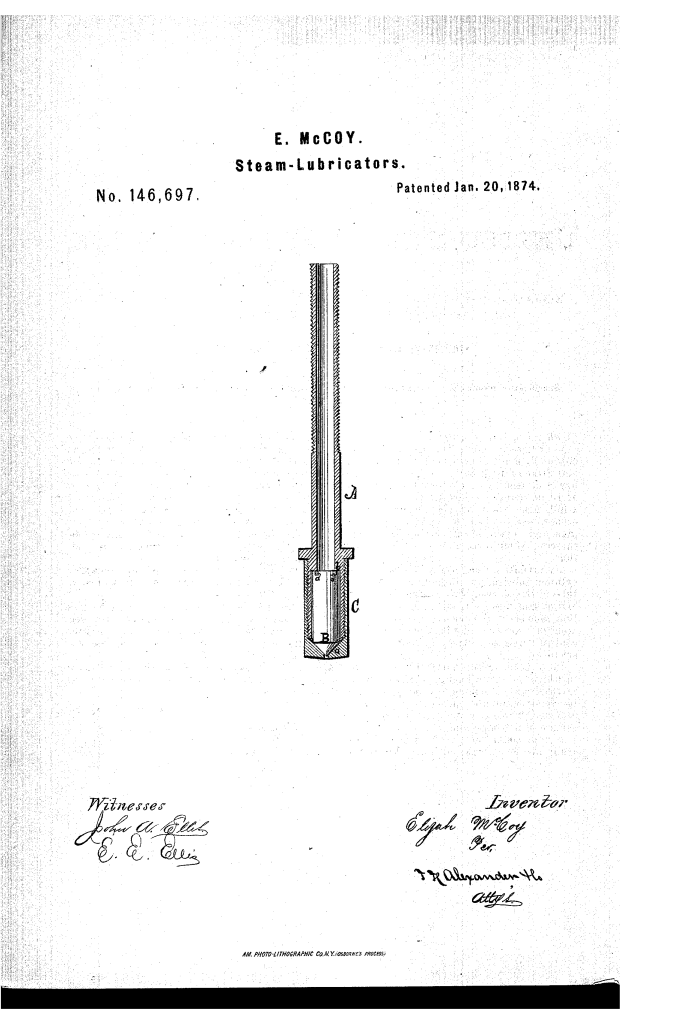
Elijah McCoy’s patent for an “Improvement in Steam-Lubricators”, No. 146,697, describes a refinement of the valve mechanism within his automatic lubricator. Patented on January 20, 1874, the invention focused on a “thimble-valve” designed to control the flow of oil more effectively. The valve was a hollow tube with slots or perforations at its lower end. It sat on a shoulder inside the lubricator’s main central tube. When steam pressure was applied, the valve would lift from its shoulder, allowing oil to pass over its top and through its slots into the main tube for delivery. This design was intended to provide a more precise and controlled drip of oil to the engine.
Societal Impact and Legacy
This patent is another example of McCoy’s continuous refinement of his core invention. By improving the valve, he enhanced the lubricator’s performance and reliability, further cementing his reputation for quality.
- Increased Efficiency: A more precise valve meant a more consistent and controlled flow of oil. This not only improved the performance of steam engines but also made the use of expensive lubricant more economical, reducing waste.
- Industrial Reliability: The reliability of industrial machinery was directly tied to the quality of its lubrication. McCoy’s constant improvements, like this thimble-valve, made his lubricators a preferred choice for engineers and machinists.
- The “Real McCoy”: The superior quality of his inventions, which were far more reliable than the numerous imitations, is widely believed to have given rise to the phrase “The Real McCoy”.
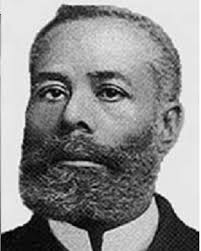
- The Inventor’s Legacy: Elijah McCoy was a brilliant African American inventor who, despite immense racial discrimination, became a foundational figure in American industrial technology. His numerous patents were critical to the development of the railroad system and factory machinery of the late 19th century.
