
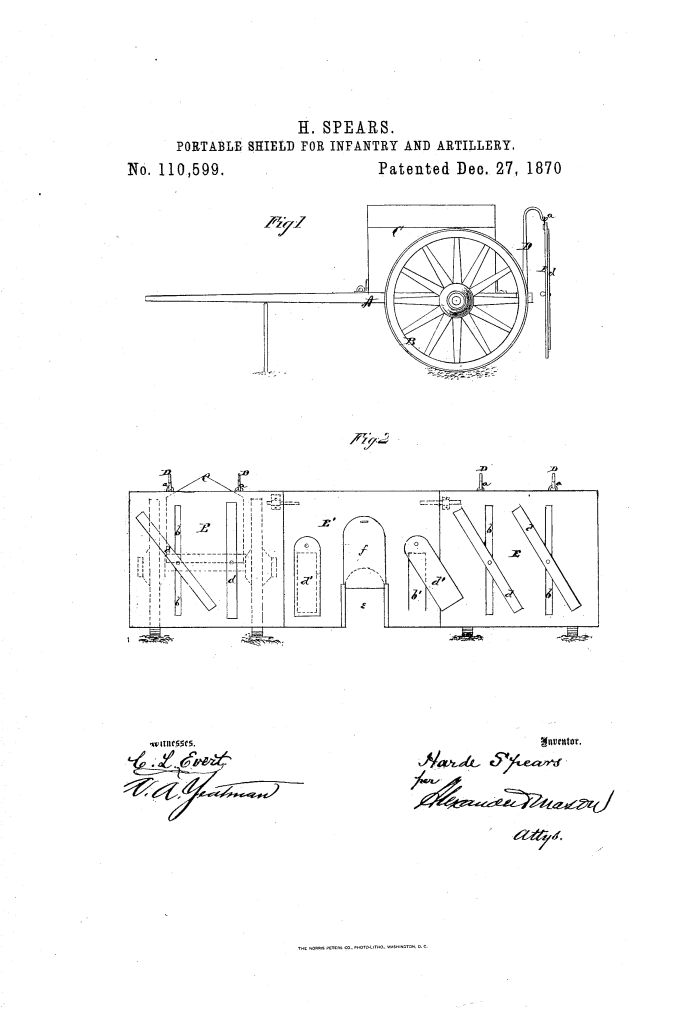
Portable Shield for Infantry and Artillery (1870)
U.S. Patent No. 110,599, granted on December 27, 1870, to Harde Spears, describes a novel, mobile defensive armor system designed to protect ground troops and artillery units during battlefield engagements. Harde Spears, an inventor based in Snow Hill, North Carolina, developed this adjustable fortification to provide immediate, heavy-gauge cover without sacrificing the mobility of field batteries.
This specific invention solved a critical tactical problem in late 19th-century warfare: how to protect exposed infantrymen and artillery crews from small-arms fire and incoming artillery shells without forcing them to rely on slow, labor-intensive earthworks or rigid, heavy fortifications that immobilized the army.
The Innovation: The “Kinetic Energy-Absorbing Suspended Shield”
Traditional military breastworks of the era were fixed in place or mounted rigidly to vehicles, meaning direct hits absorbed the full impact energy, often cracking the armor or overturning the carriages. Spears’s breakthrough was a dynamic, loose-hanging design that weaponized gravity and physics.
By hanging heavy iron plates loosely from flexible steel hooks, the armor was allowed to swing freely upon impact. When a projectile struck the surface, the plate yielded to the blow, absorbing and diverting the kinetic energy rather than resisting it rigidly, causing balls and shell fragments to ricatochet harmlessly away.
Why This Design Works
- Kinetic Deflection: The loose-hanging assembly allows the heavy metal plates to swing back under impact, spending the velocity of incoming bullets and cannonballs.
- Dual-Level Infantry Staging: The vehicle frame is engineered so ammunition boxes can slide or turn out of the way, creating a dual-level firing platform for troops on the ground and on the carriage itself.
- Modular Interlocking Defenses: Multiple units can be parked side-by-side and linked with bridging plates, transforming isolated supply wagons into a continuous, armored fort line.
- Flexible Support Structural Standards: The supporting vertical standards are constructed of spring-tempered steel designed to flex and give during sudden concussions rather than snapping.
Key Structural Components
The portable breastwork transforms standard battlefield logistics transport into an adaptable defensive front:
| Component | Function |
| Pivoted Standards (D) | Resilient steel uprights mounted to the rear of the carriage frame that flex under stress to prevent structural breakage. |
| Suspended Metal Plate (E) | A heavy shield made of boiler iron (5/16 to 1/2 inch thick) coated in weather-resistant black paint that extends wide enough to protect the wheels. |
| Suspension Hooks (a) | Curved upper extensions of the standards that hold the heavy plates loosely, allowing them to swing freely. |
| Infantry Ports & Shutters (b, d) | Vertical firing slots equipped with exterior pivoted steel flaps, allowing soldiers to fire from cover and immediately seal the opening. |
| Artillery Port-Hole (e) | A centralized, gate-protected aperture built into the interlocking middle plates to allow field cannons to fire through the shield wall. |
How the Apparatus Functions
The defense system deploys rapidly from a transit state into a fortified battle configuration:
| Step | Action | Tactical Purpose |
| 1. Configuration | The ammunition box (C) is slid or rotated down the shafts of the carriage frame (A). | Clears the rear deck space to accommodate a squad of infantry riflemen. |
| 2. Suspension | Heavy boiler-iron plates (E) are unlimbered and hung loosely upon the curved hooks ($a$) of the standards (D). | Establishes the primary ballistic curtain protecting the wheels, chassis, and crew. |
| 3. Interlocking | Multiple carriages are aligned, and intermediate plates (E) are dropped into place via integrated pins and sockets. | Seals the hazardous gaps between vehicles, establishing a continuous armored perimeter. |
| 4. Combat Engagement | Infantrymen fire through shutters (d), while artillery crews operate field pieces through the main port-hole ($e$). | Secures safe, reciprocal fire capabilities while incoming rounds hit the swinging plates and drop spent into the dirt. |
Historical and Scientific Impact
Harde Spears’s design emerged during the post-Civil War era, reflecting a period of intense military analysis regarding small-arms lethality and troop protection:
“The plates constituting such breast-work are not rigid but hang loosely on the hooks… hence, when musket-balls, or even cannon-balls and shells strike the same, it yields to the force of the balls, diverting the direction of the same…”
- Mobility-First Fortification: When the unit needs to move or retreat, the plates can be quickly unhooked and stowed flat on the limbers, ensuring an army remains fast and unencumbered.
- Energy Management: The invention accurately anticipated modern principles of non-rigid, modular vehicle armor, proving that a flexible, energy-dissipating shield is vastly more resilient than a rigid one of equal weight.
- Force Multiplication: By utilizing standard caissons and limbers as structural foundations, the system gave supply and support trains their own intrinsic defensive fire value, protecting vital rear-guard assets.
About the Inventor: Harde Spears
Harde Spears was an innovative Reconstruction-era African American inventor from Snow Hill, Greene County, North Carolina, whose work adapted practical mechanical insights to heavy industrial and military challenges.
- Patents: Beyond his mobile ordnance shields, Spears focused on mechanical utilities and agricultural tools suited to rebuilding and streamlining Southern infrastructure in the late 19th century.
- Historical Context: Developing complex military hardware during the early Reconstruction period in North Carolina, Spears demonstrated exceptional resourcefulness in patenting advanced metalwork concepts during a time of extreme economic and social transition.
- Legacy: His engineering approach relied on a deep understanding of ballistics and structural stress, introducing an early precursor to modern reactive and flexible armor solutions used in modern defensive design.
Summary of Claims
The patent explicitly claims:
- A defensive breastwork formed of durable metal plates suspended loosely upon hooks to permit kinetic deflection.
- The mechanical combination of flexible vertical standards mounted to limber or caisson frames with interlocking, bridgeable intermediate plates.
- The specific layout of protective sheets featuring shuttered infantry firing slots operating alongside a centralized artillery port-hole system.
- The portable, toolless assembly of adjustable defensive plates equipped with modular ports and gates for adaptive field deployment.
