
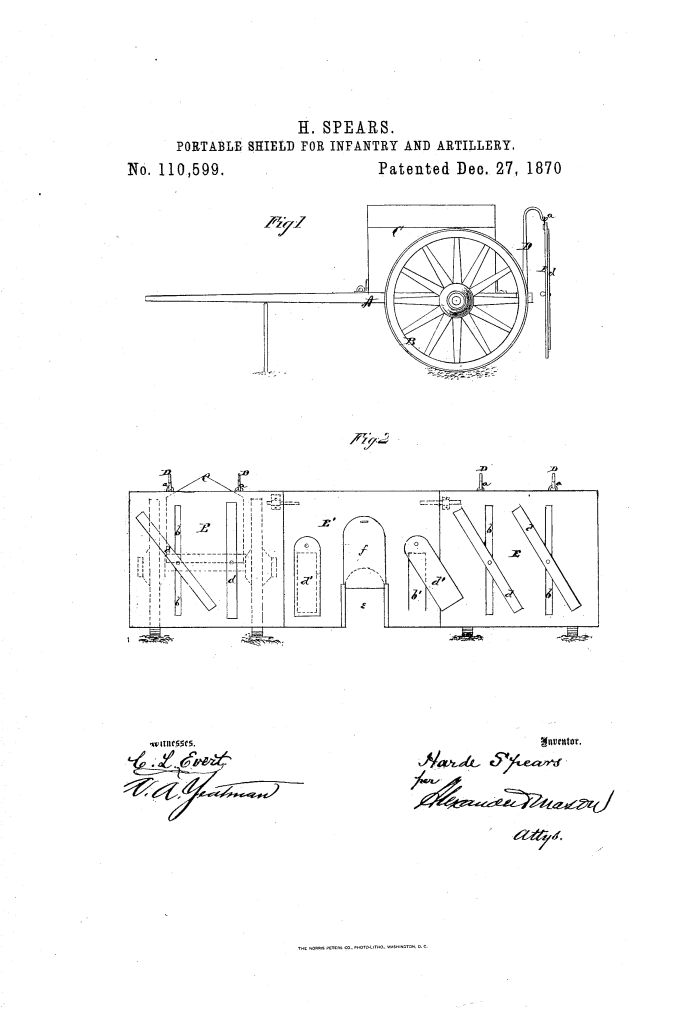
Harde Spears, of Snow Hill, North Carolina, was an African-American inventor who received a U.S. patent for an “Improvement in Portable Shields for Infantry and Artillery.” His patent, U.S. Patent No. 110,599, was granted on December 27, 1870.
This invention is particularly interesting as it comes shortly after the American Civil War, a period that saw significant advancements in military technology and tactics. Spears’s design aimed to provide a portable and effective defensive measure for soldiers on the battlefield.
Here are the key aspects of Harde Spears’s “Improvement in Portable Shields for Infantry and Artillery”:
- Mounted on Limbers or Caissons: The shields were designed to be applied to the limbers (the front part of a gun carriage, used for towing) or caissons (ammunition wagons) of an artillery battery. This made them mobile and easily transportable with the existing military equipment.
- Pivoted Standards and Suspended Plates: The core of the invention involved two pivoted standards (upright supports) made of steel or other suitable material, which were attached to the rear part of the carriage frame. These standards were bent outward at their upper ends, forming hooks.
- Metallic Plates as Shields: Upon these hooks, metallic plates were suspended. These plates were of sufficient dimensions to extend beyond and protect the wheels of the carriage. They could be made of boiler-iron or other heavy material, five-sixteenths to half an inch thick, and painted to reduce visibility.
- Loose Suspension for Ballistic Deflection: A crucial feature was that the metal plates were “not rigid but hang loosely on the hooks.” This loose suspension was intentional. Spears noted that “when musket-balls, or even cannon-balls and shells strike the same, it yields to the force of the balls, diverting the direction of the same.” This design aimed to absorb and deflect the impact of projectiles, rather than rigidly resisting them, which could lead to shattering or breaking.
- Firing Ports and Shutters: The shields were equipped with vertical slots or “ports” and covered by pivoted shutters. These ports allowed infantrymen to fire through the shield, while the shutters could be closed for added protection. There was also a central “port-hole” for a cannon and additional openings for infantry, all with shutters.
- Protection for Gunners and Infantry: The overall design aimed to protect both the artillery gunners and the infantry supporting them, offering a “portable breast-work” that could be deployed quickly in the field.
- Connecting Multiple Units: The patent also described how multiple limbers or caissons with these shields could be placed side-by-side, and an additional plate could be suspended between them to cover the space, forming a more continuous defensive line.
Harde Spears’s invention demonstrated a practical understanding of battlefield needs and material science (the concept of a yielding rather than rigid shield). It represents an attempt to integrate protective measures directly into military transport, providing mobile cover for troops and artillery in an evolving era of warfare.
Personal and Historical Significance:
- Post-Civil War Military Innovation: Harde Spears’ invention came just five years after the devastating American Civil War, a conflict that highlighted the brutal realities of modern warfare and the need for improved protection for soldiers. His focus on military technology demonstrates an engagement with national defense needs in the immediate aftermath of a major conflict.
- African American Contribution to Warfare Technology: This patent is a remarkable example of an African American inventor contributing to the field of military technology. While many Black inventors focused on domestic or industrial improvements, Spears tackled a complex problem related to battlefield survival.
- Challenges in Commercialization: While innovative, the widespread adoption of such a system would have faced significant hurdles, including military procurement processes, cost, and the general evolution of firearms technology that quickly rendered many static defenses obsolete. It’s unclear if Spears’ invention saw widespread use, but its existence is a testament to his vision.
- Assertion of Citizenship and Intellect: Like other patents granted to African Americans in the early Reconstruction era, Spears’ patent was a powerful statement. For a Black man from the South (Snow Hill, North Carolina), recently freed from slavery, to be granted a patent for military innovation speaks volumes about his intellect, his ability to navigate the patent system, and the symbolic recognition of his citizenship and inventive rights in a still deeply prejudiced society.
- Underrepresented Area of Invention: Inventions related to military defense are less commonly highlighted when discussing African American inventors, making Spears’ contribution particularly noteworthy and demonstrating the broad scope of their ingenuity.
Harde Spears’ “Improvement in Portable Shields for Infantry and Artillery” is a testament to his forward-thinking approach to military protection and stands as a significant, though perhaps lesser-known, example of African American innovation in the immediate post-Civil War period.
