
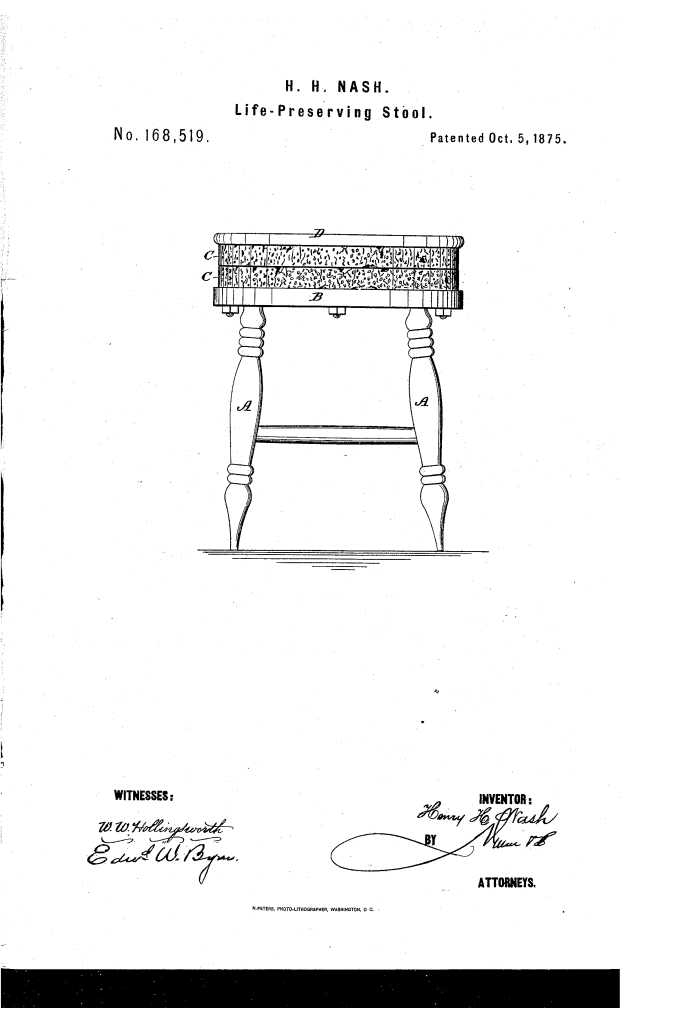
The Invention: Life-Preserving Stool
Henry H. Nash’s invention is a simple, effective, and reliable piece of safety equipment intended for use on steamers and other sea-going vessels, serving the dual purpose of a functional piece of furniture and an emergency flotation device.
Key Components and Design:
- Structure: The device is a standard stool or chair supported by legs () attached to a rounded base ().
- Life-Preserving Seat: The key feature is the composition of the seat, which is made of:
- One or more disks of cork (), a naturally buoyant material.
- The cork disks are sandwiched and secured between the rounded base board () and a second board () placed on top, forming the seat.
- Securing: The entire assembly is fastened together by bolts or other suitable means.
- Finish: The inventor notes that the edges of the cork may be left exposed or covered with a suitable band or upholstering border for a better finish.
Advantages Over Prior Art:
Nash emphasized the superiority of his cork design over existing life-preserving furniture:
- Reliability: Previous designs used an air-chamber to achieve buoyancy. Nash states that air-chambers are “likely to become leaky from use and exposure,” rendering the device useless.
- Durability: The use of solid cork disks eliminates the possibility of leaks. Nash argues that “no accident or contingency could occur which would destroy its value,” making it more reliable than air-filled devices.
- Accessibility: Nash suggests that buoyant stools are more reliable than life preservers “ordinarily employed, which latter are generally stored away in out-of-the-way places.” The stool is always readily available for use.
- Simplicity and Cost: The construction is described as “simple,” enabling “any one to manufacture the same,” and is “cheap, practical, and neat.”
Claim:
Nash claimed the invention of a:
“A life-preserving stool or chair having a seat made of disks of cork confined between suitable boards, substantially as described, and for the purpose set forth.”
Historical Significance and Relation to Modern Products
Historical Significance
This patent is significant within the history of maritime safety and furniture design, reflecting the intense focus on saving lives at sea during the 19th century, particularly after a spate of steamship disasters.
- Necessity of Accessible Safety: The invention highlights the recognized problem that emergency safety gear was often inaccessible or improperly maintained. By integrating the life preserver into a piece of everyday furniture, Nash was pioneering the concept of readily available, multi-purpose safety equipment—a crucial step in passive passenger safety.
- The Cork Solution: Cork was the most reliable, readily available, and natural material for buoyancy before the widespread use of closed-cell foam and other synthetic materials. Nash’s reliance on solid cork disks was a return to proven, durable technology at a time when competing (but flawed) air-chamber designs were popular.
Relation to Modern Products
While modern maritime safety relies on highly regulated, specialized life vests and rafts, the core concept of dual-purpose furniture remains relevant:
| Nash’s Feature (1875) | Modern Equivalent (Today) | Enduring Principle |
| Life-Preserving Stool/Chair (Cork filled) | Life Raft/Life Jacket Seats | The idea of integrating floatation into seating is maintained in maritime seating on small craft and in some airline seating designs, though not typically as the primary flotation device. The concept, however, directly inspired buoyant cushions and throw-able flotation devices required on many vessels. |
| Buoyancy from Solid Material | Closed-Cell Foam Core | Modern life jackets, cushions, and life rings use durable, synthetic, closed-cell foam (e.g., polyethylene or PVC foam) instead of cork. This foam is waterproof and cannot leak or absorb water, directly fulfilling Nash’s goal of a non-leaky, reliable, and durable buoyant core, but using modern materials. |
| Accessibility as Furniture | Marine Throw Cushions | The requirement for buoyant cushions that can serve as emergency flotation devices, which are often stored on or near seats, is a direct legacy of the push to make flotation equipment highly accessible and functional in daily use, as championed by Nash’s invention. |
