
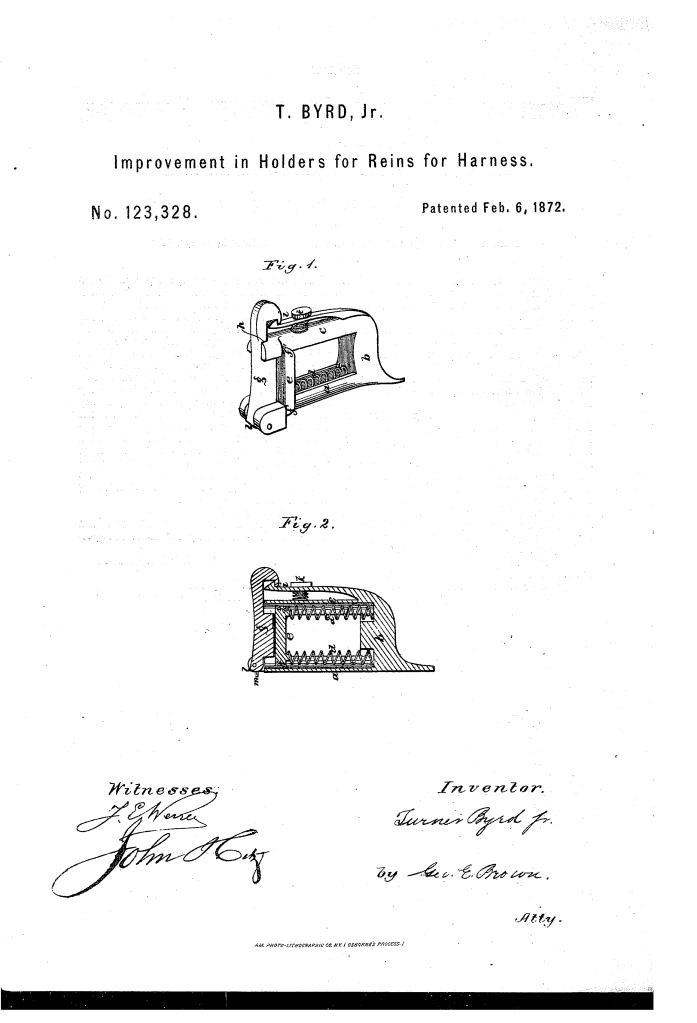
Inventor: Turner Byrd Jr. (and Isaiah Byrd)
Patent Number: 123,328 (and 124,790 for a related invention)
Date of Patent: February 6, 1872 (for the rein holder)
Invention: Improvement in Holders for Reins for Horses (or Harness)
Description of the Invention: Turner Byrd Jr.’s “Improvement in Holders for Reins for Harness” (Patent No. 123,328) aimed to provide a convenient and secure mechanism for holding reins, halters, and similar items when not in use. The patent describes a device designed to be attached to the saddle of a harness or the backband. It consisted of a frame with an offset and a standard. A hinged latch was positioned at the top of the frame, designed to receive and hold the reins. A spring-catch helped to secure the reins in place, and a tooth at the base of the latch prevented accidental release. The mechanism allowed for the reins to be firmly held but could be released by pressing on a plate that would disengage the latch.
It’s important to note that Turner Byrd Jr., often collaborating with Isaiah Byrd, held multiple patents in 1872 related to horse-drawn vehicles. These include:
- Patent No. 124,790, dated March 19, 1872: “Improvement in Apparatus for Detaching Horses from Carriages.” This invention allowed an occupant of a carriage to quickly and safely detach a horse in case it became unmanageable, or for other reasons, by simply pulling a string. This was a significant safety improvement.
- Patent No. 126,181, dated April 30, 1872: “Improvement in Neck-Yokes for Wagons.” This invention focused on mechanisms that allowed draft animals to be easily detached or to detach themselves from neck-yokes without unbuckling straps, further improving safety and efficiency.
Personal Significance (Turner Byrd Jr.): Turner Byrd Jr. was an African American inventor from Williamsville, Michigan. His multiple patents in 1872, particularly those related to horse-drawn transportation, demonstrate his inventive prowess and commitment to solving practical problems. In a period when African Americans faced significant systemic barriers to education, professional advancement, and recognition for their intellectual contributions, Byrd’s achievements are particularly noteworthy. His patents, along with those of other Black inventors of the era, highlight the ingenuity and resilience of a community often denied credit for its innovations. While detailed biographical information about Turner Byrd Jr. beyond his patent records is scarce, his inventions speak to a keen understanding of mechanical principles and a desire to improve daily life and safety.
Historical Significance: The late 19th century was a time when horses were central to transportation, agriculture, and many industries. As such, inventions that improved the safety, efficiency, and management of horse-drawn vehicles had widespread impact.
African American Innovation: The fact that Turner Byrd Jr., an African American, was granted these patents underscores the often-overlooked contributions of Black inventors to American technological advancement. Their ingenuity played a vital role in shaping the nation’s progress, despite facing immense discrimination.
