
Inventor: Thomas J. Martin
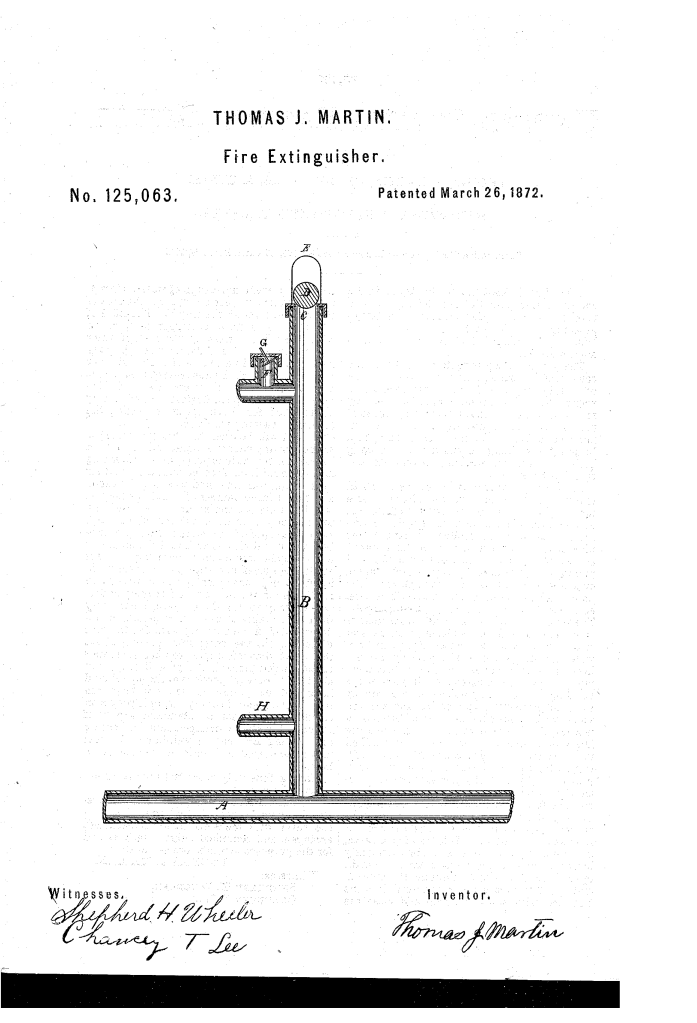
Patent Number: 125,063
Date of Patent: March 26, 1872
Invention: Improvement in Fire-Extinguishers
Description of the Invention: Thomas J. Martin’s patent for an “Improvement in Fire-Extinguishers” in 1872 did not describe a portable, hand-held device akin to modern fire extinguishers. Instead, his invention focused on a system of pipes and valves designed to distribute water from a reservoir throughout a building to extinguish or prevent fires.
The system involved:
- Pipes (A and B): A main pipe (A) connected to a force pump and water supply, leading to branch pipes (B) that extended to all parts of a building where fire protection was desired.
- Nozzles (C): The branch pipes were fitted with discharge nozzles.
- Valves (D) and Cages (E): Each nozzle had a globe-valve (D) seated in a cage (E). These valves were designed to rise when a jet of water was forced through the nozzle, causing the water to spread in an “annular sheet or spray” to wet a large surface.
- Air-Trap (F) with Valve (a) and Stem (G): An air-trap was included with a valve (a) that closed upward. This valve was heavy enough to allow air to pass through for ventilation but would float up and close the trap when water was forced into it, preventing water escape. A stem (G) projecting from this valve was designed to trigger an alarm when the valve rose due to the rush of water, providing a timely fire alarm throughout the building.
Martin envisioned this system not only for extinguishing fires but also for warming, ventilating, and washing buildings, and even for washing pavements and sprinkling streets from a central engine. He claimed a single engine could supply a large number of buildings.
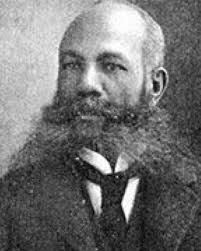
Personal Significance (Thomas J. Martin): Thomas J. Martin was an African American inventor, born in Harpersville, Alabama, in 1842 (some sources say 1844). His patent for an improved fire extinguisher is a significant achievement, especially given the systemic obstacles faced by Black inventors in the post-Civil War era. Martin was a merchant and farmer, and served in the Union Army during the Civil War, being wounded at the Battle of Shiloh. His ability to secure a patent highlights his ingenuity and determination. While details about his life beyond his inventions are somewhat scarce, his contributions are part of the broader, often unsung, narrative of African American innovation that helped shape American industry and safety.
Historical Significance: Thomas J. Martin’s fire extinguishing system reflects a crucial period in fire safety and building technology. In the 1870s, urban areas and industrial facilities were highly vulnerable to devastating fires, often leading to massive property loss and loss of life. While portable fire extinguishers existed (such as those using carbon tetrachloride or soda-acid, and even “fire grenades” – glass orbs to be thrown at flames), Martin’s invention presented a more comprehensive, integrated approach to fire suppression for larger structures or even entire city blocks.
Impact on Urban Development: As cities grew, the need for effective fire protection became paramount. Inventions like Martin’s contributed to the development of safer buildings and urban environments, ultimately leading to more robust fire codes and protective measures that are standard today. becoming major conflagrations.
Move Towards Integrated Fire Suppression: Martin’s system foreshadowed modern sprinkler systems and centralized fire protection infrastructure. Instead of relying solely on manual intervention or small, localized extinguishers, his design aimed for a more automatic and widespread response, which was a significant advancement in fire safety philosophy.
Prevention and Multi-purpose Use: The fact that he conceived of his system for ventilation, warming, and even street washing, alongside fire extinguishing, demonstrates an innovative vision for multi-functional building systems. This holistic approach to building management was forward-thinking for its time.
African American Contribution to Safety: Martin’s patent is an important historical document recognizing the intellectual contributions of African Americans to public safety and technological progress. His work, along with that of other Black inventors, challenged racial prejudices and laid groundwork for future innovations in various fields.
