
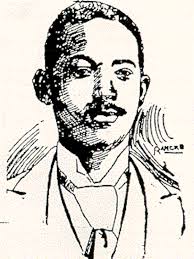

Ice-Cream Mold and Disher (1897)
U.S. Patent No. 576,395, granted on February 2, 1897, to Alfred L. Cralle, addresses a common problem in late 19th-century food service: the awkward, messy, and two-handed process of scooping and dispensing ice cream.
Before Cralle’s invention, serving ice cream typically required two hands—one to scoop the frozen dessert and a second tool, such as a spoon or scraper, to scrape it out of the mold. The portioning process was slow, sticky, and frequently led to damaged or misshapen servings. Cralle, an inventor working out of Pittsburgh, Pennsylvania, created a mechanism that allowed a server to scoop, shape, and release a portion of ice cream cleanly using only one hand.
The Core Design: The One-Handed Scraper and Mold System
The core of Cralle’s design is the combination of a rotatable mold and an internal scraping mechanism driven by a spring-loaded hand lever.
- The Mold and Rotating Rack (a, k)The body of the device features a hollow mold (a)—famously shown in a cone shape, though adaptable to other geometries. Around the outer rim of the mold sits a toothed rack (k).
- The Stationary Scraper Blades and Band (f, g, e)Inside the mold are thin, form-fitting cutter blades (f). These blades are attached to a central pivot pin (e) at the apex of the mold and wrap over the rim to join an external band (g) encircling the mold body.
- The Pivoted Handle and Segmental Gear (b, b’, h, l)The device is held by a two-part handle (b and b’). The main arm (b) is fixed to the scraper assembly, while the secondary handle (b’) pivots on a joint (c). The inner end of this pivoting section ends in a curved, meshed gear known as a segmental rack (h). A spring (l) keeps the handles spread apart when not in use.
How the Apparatus Functions
The mechanical sequence turns a simple squeeze of the hand into a clean release:
| Step | Action | Mechanical Purpose |
| 1. Scooping | The operator presses the mold (a) into the ice cream to pack the bowl. | Fills the mold to a uniform shape and portion. |
| 2. Compression | The operator squeezes the two handle sections (b and b’) together. | Forces the segmental rack (h) to mesh with the mold’s gear rack (k). |
| 3. Rotation & Release | Squeezing causes the mold (a) to spin around the stationary internal blades (f). | The blades scrape the inside surface, breaking the suction and allowing the ice cream to drop out freely. |
| 4. Reset | The operator releases hand pressure, and the spring (l) resets the mechanism. | Returns the handles and gear assembly to the starting position for the next scoop. |
Technical Components
Mold (a): The portion-shaping container (often conical or hemispherical).
Fixed Handle Arm (b): Includes an extension arm (d) secured to the apex pivot (e) and outer band (g), holding the internal blades steady.
Operating Lever (b’): The spring-backed movable handle section controlled by the user’s fingers.
Segmental Rack (h): The curved gear segment that drives the mold’s rotation when squeezed.
Toothed Ring/Rack (k): The circular gear mounted directly onto the body of the mold.
Cutters/Blades (f): Precision-fitted metal strips that stay flush against the inner wall of the mold to slice the ice cream free.
Historical and Scientific Impact
Alfred L. Cralle’s ice-cream disher was a major breakthrough in food service equipment, offering durable construction with no delicate components to break or misalign.
Efficiency & Hygiene: The one-handed operation meant servers could hold a cone, dish, or cup in one hand while continuously scooping with the other, speeding up operations at soda fountains and ice cream parlors.
Enduring Ergonomics: The fundamental mechanism—using a hand-actuated gear, spring return, and internal sweeping scraper—became the mechanical baseline for modern ice cream scoops and portion dishers used globally today.
Commercial Durability: Made without delicate or overly complex linkages, Cralle’s design withstood the high pressure and cold temperatures required for serving hard-frozen desserts.
About the Inventor: Alfred L. Cralle
Alfred L. Cralle was an African American entrepreneur and inventor born in Virginia in 1866. After attending Wayland Seminary in Washington, D.C., he moved to Pittsburgh, Pennsylvania, where he worked at a local hotel and drugstore. It was during his work at the hotel that he noticed the difficulty servers had in portioning ice cream efficiently, leading directly to his landmark 1897 patent. His design proved so effective that the basic mechanical layout remains largely unchanged in commercial kitchens over a century later.
Summary of Claims
The patent explicitly claims:
- An ice-cream mold and disher combining a mold with an attached gear rack, a two-part pivoted handle, and internal cutters held steady while a segmental gear on the handle rotates the mold.
- The addition of a spring mechanism positioned between the handle sections to automatically return the lever and reset the scraper assembly upon release.
- An arrangement where the internal blades are secured at the apex pivot and wrap around the rim to an outer support band, holding the scraper rigid while the outer mold rotates around it.
