
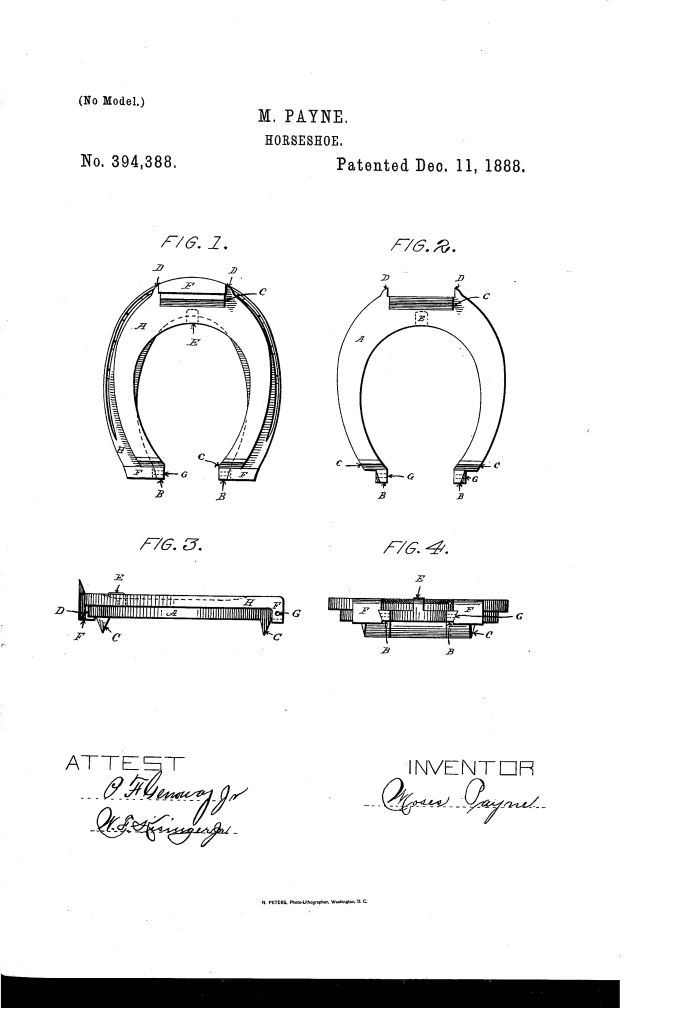
Supplemental Spring-Shoe, Moses Payne, Patent No. 394,388
The patent by Moses Payne of Bellevue, Kentucky describes a Supplemental Spring-Shoe (Patent No. 394,388). This invention is a secondary, removable metal traction device designed to be “sprung” or snapped onto an existing horseshoe already nailed to the animal’s hoof. It allowed for rapid adaptation to icy or slippery conditions without the need for a farrier to remove the primary shoe.
The “Why”
In the late 19th century, urban infrastructure was transitioning to concrete and asphalted pavements. While these were smoother for carriages, they became incredibly hazardous for horses during “severe or slippery weather.” The standard solution was “roughing”—pulling the shoes and sharpening the calks—which was time-consuming, expensive, and stressful for the animal’s hooves. Payne sought a modular solution that a carriage driver could apply or remove at will, providing immediate grip on frozen or slick city streets.
Inventor Section
Moses Payne was a Black inventor operating in the post-Reconstruction era, a time when African American ingenuity was often stifled by the systemic barriers of Jim Crow. His engineering philosophy centered on mechanical efficiency and user accessibility. Rather than requiring specialized tools, Payne’s design utilized the inherent elasticity of steel to create a tension-based fastening system. His work reflects a deep understanding of metallurgy and the practical needs of the industrial labor force in Kentucky and the surrounding urban centers.
Key Systems Section
1. Elastic Tension Interface (The “Spring” Mechanism)
The core of the device is the use of a spring-tempered metal bar. By utilizing the material’s yield strength, the shoe acts as a large tension clip.
- Function: The shoe is slightly oversized or undersized relative to the fixed shoe, requiring mechanical force to “snap” it into place.
- Modern Term: Interference fit or snap-fit assembly.
(Note: While not a linkage, this represents the mechanical force application used to snap the device into a locked state.)
2. Dovetail Bevel Clamping
At the heel ends, Payne integrated specific projections (B B) with a dovetail bevel on the outer edge.
- Function: These bevels wedge themselves against the interior faces of the existing heel calks (F F). The geometry ensures that the more downward pressure is applied (by the horse’s weight), the tighter the lateral grip becomes.
- Modern Term: Self-locking tapered wedge.
3. Tri-Point Toe Stabilization
To prevent the supplemental shoe from sliding laterally or rotating, Payne designed a three-point stabilization system at the toe.
- Projections D D & E: These act as a “cradle.” D D wraps around the existing toe calk, while E hooks over the inner front edge of the primary shoe.
- Modern Term: Multi-axis constraint system.
4. Auxiliary Fastening (Fail-Safe)
For high-intensity use, Payne included pin-holes (G G) for optional riveting.
- Function: If the spring tension was insufficient for particularly rugged terrain, a simple rivet could permanently lock the two units together.
Comparison Table
| Feature | Standard Methods (1880s) | Payne’s Innovation |
| Installation | Requires a farrier to pull and reset nails. | User-installed by hand or simple lever. |
| Adjustability | Permanent until the next shoeing. | Removable “at will” based on weather. |
| Traction Type | Fixed calks (wears down quickly). | Renewable calks on a modular frame. |
| Hoof Health | Repeated nailing weakens the hoof wall. | Zero impact; uses existing hardware for grip. |
Significance Section
- Modular Traction: A direct ancestor to modern removable tire chains for vehicles and “crampons” for hiking boots.
- Safety Engineering: Recognized the specific dangers of urban slick-surface pavements, anticipating the need for specialized treads on asphalt.
- Snap-Fit Design: Early industrial application of using material memory (spring steel) to replace threaded fasteners or permanent welds.
