
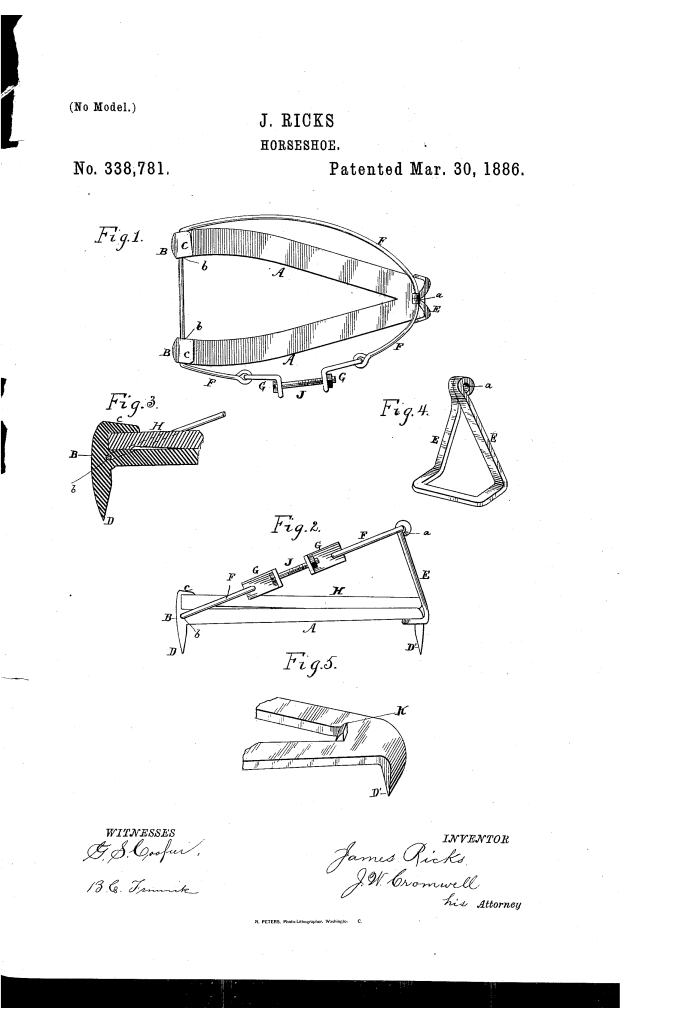
James Ricks, a resident of Albany, New York, received U.S. patent #338,781 on March 30, 1886, for an “Improvement in Horseshoes.” His invention was designed to make horseshoes more durable and easier to attach to a horse’s hoof.
Details of the Patent
Ricks’ patent was a clever improvement to a common object. It focused on a design that was both practical and innovative, addressing the frequent need for horseshoe replacement. 🐴
- The Invention: Ricks’ horseshoe was a unique design that included a series of removable calks. Calks are small metal studs on the bottom of a horseshoe that provide traction.
- Key Features: The primary innovation was the use of sockets on the underside of the horseshoe. The removable calks could be inserted into these sockets and held in place by friction. This design allowed a blacksmith or farrier to easily replace a worn-out calk without having to remove and replace the entire shoe.
- Problem Solved: Traditional horseshoes had fixed calks that would wear down unevenly, making the shoe less effective and requiring frequent replacement. Ricks’ invention saved time and money by allowing for the replacement of only the worn calk, extending the life of the horseshoe.
Significance of the Invention and Inventor
James Ricks’ patent for an improved horseshoe is notable for its practicality and its place in the history of African-American inventors.
- Ingenious Design: The invention showcases Ricks’ ingenuity in applying a simple solution to a persistent problem. His design was a precursor to modern modular systems, showing a forward-thinking approach to product design and maintenance.
- Legacy as an Inventor: James Ricks was an African-American man living in the late 19th century. His successful patent demonstrates his ability to innovate and navigate the patent system despite the significant racial barriers of the era. His work is part of a larger, often overlooked history of African-American contributions to technology and daily life in the United States.
