
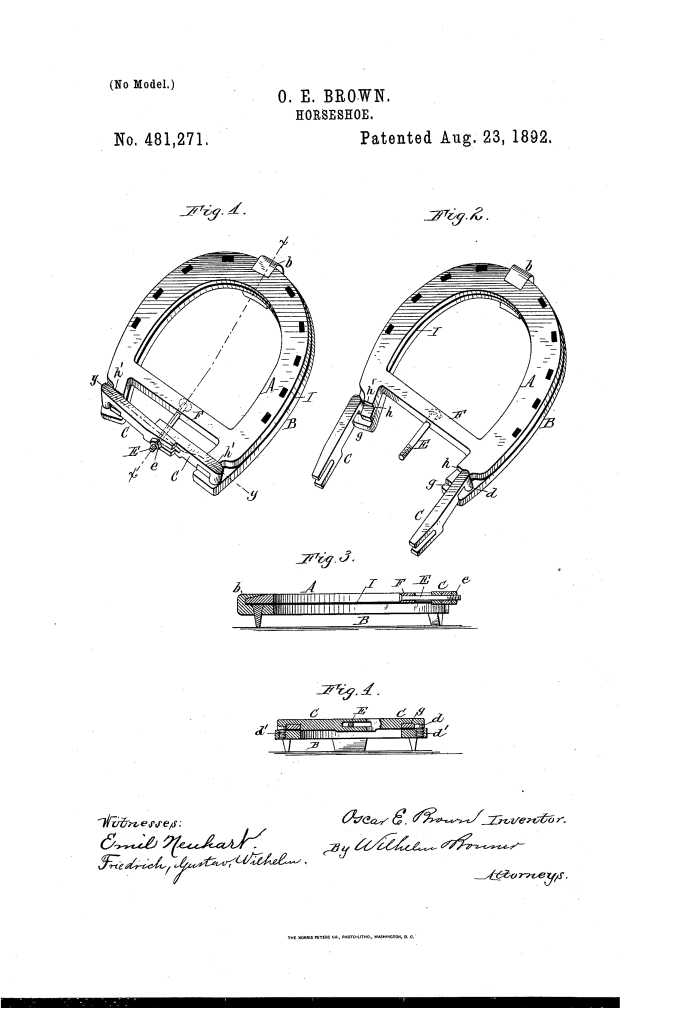
Double or Compound Horseshoe (1892)
U.S. Patent No. 481,271, granted on August 23, 1892, to Oscar E. Brown, describes a multi-layered, modular horseshoe designed to allow easy removal and replacement of the outer shoe without pulling nails from the animal’s hoof. Oscar E. Brown, an inventor based in Buffalo, New York, created this system to streamline equine maintenance and improve animal welfare.
This specific invention solved two persistent problems for working horses in urban environments: the labor-intensive process of removing an entire nailed shoe just to sharpen worn calks (the traction cleats), and the severe, unyielding impact of standard iron shoes against hard stone pavements.
The Innovation: The “Lever-Locking” Double Shoe
Instead of relying on nails to secure the entire assembly, Brown split the horseshoe into a permanent upper base and a modular lower section. The lower auxiliary shoe could be swapped out seamlessly using an ingenious, mechanical clamping system that relied on leverage rather than heavy tools.
Why This Design?
- Hoof Preservation: The upper shoe stays nailed to the hoof long-term, preventing the splitting and damage caused by constant re-nailing.
- Shock Absorption: It introduces a shock-absorbing buffer between the plates to reduce joint strain on hard city streets.
- Quick Adaptation: It allows a teamster to quickly transition a horse from a smooth shoe configuration to a high-traction calked shoe when weather or terrain demands it.
The Core Design: The Modular Clamping System
The mechanics of Brown’s horseshoe rely on a precise balance between a front anchor point and a dual-lever rear lock:
- The Toe Hook (b): The front of the lower detachable shoe features an upwardly-projecting hook. This hook slides into a designated recess at the toe of the permanently nailed upper shoe, anchoring the front half of the assembly against lateral movement.
- The Threaded Pivots (d): At the heels of the lower shoe, vertical pivots are secured into threaded openings. By using integrated screw-threads rather than traditional rivet heads, Brown ensured the pivots could rotate freely without wearing down or slipping out over time.
- The Locking Levers (C): Attached to these pivots are two horizontal latches that swing inward to overlap the heels of the upper shoe. When swung into place, they align perfectly to bridge the rear gap of the horseshoe.
How the Apparatus Functions
The removal and attachment process follows a strict sequence to secure a tight, rigid fit that can withstand the force of a horse’s stride:
1.Engage the Toe Anchor:Step 1.
Position the lower shoe beneath the hoof and slide its upward toe hook (b) forward into the corresponding recess of the nailed upper shoe (A).
2.Swing the Levers Inward:Step 2.
Rotate the horizontal locking levers (C) inward from their open position until their outer bifurcated (forked) ends overlap each other at the rear of the shoe.
3.Straddle the Retention Bolt:Step 3.
Align the overlapping forked ends of the levers so they straddle the central, longitudinal screw-bolt (E) extending from the upper shoe’s cross-bar (F).
4.Tighten and Clamp:Step 4.
Thread the nut (e) onto the bolt and tighten it down against the outer lever face. As the nut draws the levers inward, the lever arms press against heel shoulders (h), acting as fulcrums that forcefully pull the lower shoe backward, locking the toe hook tightly into its front seat.
Key Technical Components
The assembly is a combination of rigid components and resilient materials working in unison:
| Component | Function |
| Upper Shoe (A) | The permanent base plate nailed directly to the hoof. It features recessed heels and a rear cross-bar to support the locking hardware. |
| Lower Detachable Shoe (B) | The wearable ground-contact plate that houses the traction calks and the primary latch mechanisms. |
| Rubber Cushion (I) | A resilient strip of rubber clamped tightly between the upper and lower plates to absorb road vibration and soften impact. |
| Tapered Calks | Removable traction cleats seated into upwardly-flaring openings in the lower shoe. They are held firmly in place from above by the bottom face of the upper shoe. |
Historical and Scientific Impact
Oscar E. Brown’s invention entered the market during the peak of urban draft animal reliance, where concrete and cobblestone infrastructure demanded advanced hoof protection.
- Economic Efficiency: Replacing just the lower plate reduced the downtime for working draft horses, lowering maintenance costs for urban transport and shipping networks.
- Veterinary Care: The inclusion of the rubber cushion (I) was an early advancement in equine ergonomics, actively mitigating chronic joint degradation and lameness caused by continuous travel on unyielding pavement.
- Toolless Maintenance: By reducing shoe changes down to a single nut adjustment, teamsters could service or sharpen traction calks directly in the field during freezing winter conditions without needing a full blacksmith setup.
About the Inventor: Oscar E. Brown
Oscar E. Brown was an active late-19th-century inventor based out of Buffalo, New York, a major industrial and transportation hub during the Gilded Age. Operating in Erie County, his practical approach to mechanical design focused heavily on improving everyday utilitarian items. His compound horseshoe design reflects the era’s growing focus on mechanical efficiency and animal welfare within rapidly expanding, paved industrial cities.
Summary of Claims
The patent explicitly claims:
- A compound shoe utilizing a front interlocking hook and a rear-mounted lever secured by an adjustable retaining device.
- The implementation of dual locking-levers that swing inward to overlap the upper shoe heels and lock via a single retention mechanism.
- The use of integrated heel shoulders on the upper shoe to serve as fulcrums for the locking levers, ensuring longitudinal clamping tension across the entire length of the shoe.
- A fastening assembly utilizing a cross-bar on the upper shoe equipped with a threaded bolt and nut to compress the overlapping forked ends of the latches.
