
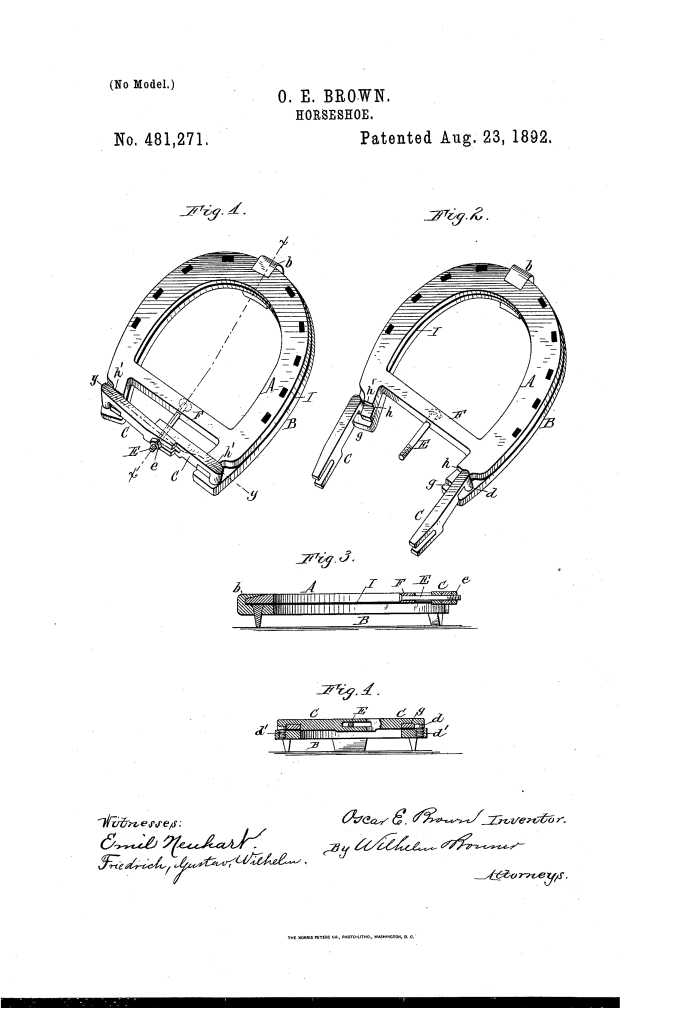
Based on the patent application for the “HORSESHOE” by Oscar E. Brown, Patent No. 481,271, issued on August 23, 1892, here’s a detailed explanation of the invention.
The patent describes a compound or double horseshoe designed to be more versatile and comfortable for the animal than traditional single-piece horseshoes. It consists of two main parts:
- An upper shoe (A), which is nailed to the horse’s hoof in the conventional manner.
- A lower auxiliary shoe (B), which is designed to be easily and removably attached to the upper shoe.
Key Features and Functionality
- Secure Locking Mechanism: The primary innovation is the locking system that fastens the lower shoe to the upper one.
- Front Connection: The lower shoe has an upwardly-projecting hook (b) at its toe. This hook fits into a corresponding recess on the underside of the upper shoe, holding the front of the lower shoe in place.
- Rear Locking Levers: At the heels of the lower shoe are two horizontal locking levers or latches (C). These levers are attached to the lower shoe by pivots (d).
- Clamping System: When in the locked position, the levers swing inward to overlap the heels of the upper shoe. A longitudinal bolt (E), attached to a cross-bar (F) on the upper shoe, passes through the bifurcated ends of the levers. A nut (e) is then tightened on the bolt, forcing the levers inward. This action pulls the entire lower shoe rearward, firmly clamping the front hook (b) against the upper shoe’s toe.
- Cushioning: The invention also includes a cushion (I), preferably made of rubber, that is placed between the upper and lower shoes. This feature is intended to:
- Reduce the force of the shoe’s impact against hard surfaces like pavement.
- Provide a “cushioned” feel, making the shoe less rigid and unyielding for the horse.
- Purpose and Benefits: The design allows for the lower shoe to be quickly and easily replaced or re-sharpened without the need to remove the upper shoe from the horse’s hoof. This saves time and effort for the farrier. The lower shoe can also be equipped with removable calks, which are tapering spikes that provide traction on slick surfaces. The patent suggests that the upper shoe could be used alone as a smooth shoe when conditions permit, and the lower, calked shoe could be attached when extra traction is needed.
