
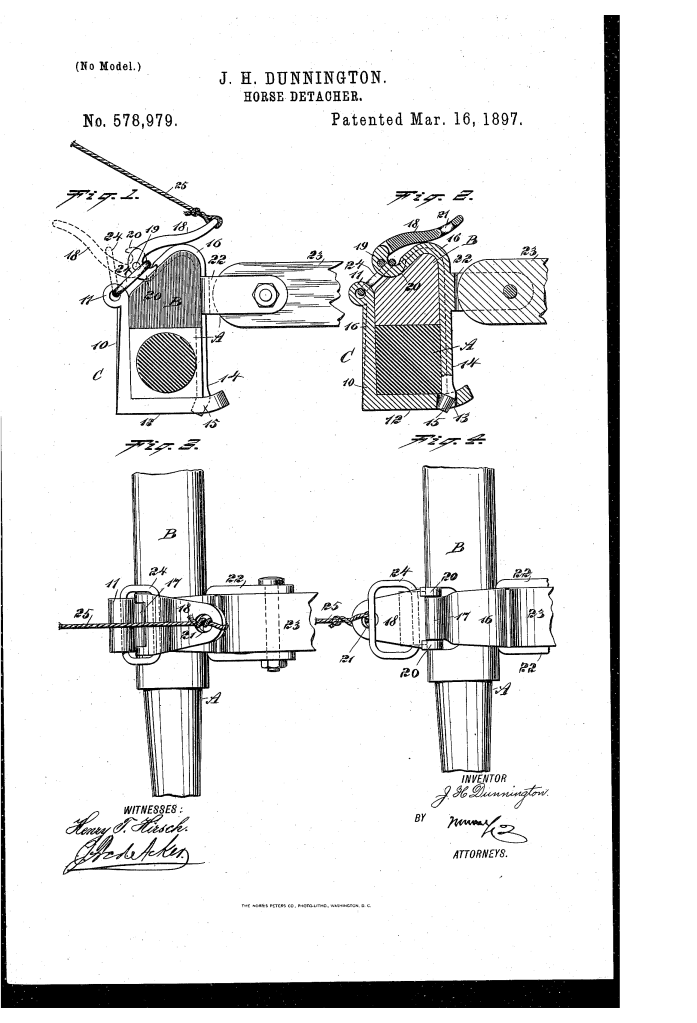
Horse-Detacher (James H. Dunnington, No. 578,979)
The patent by James H. Dunnington of Washington, Pennsylvania, describes a Horse-Detacher (Patent No. 578,979, 1897). The primary object is to provide a mechanism that allows the occupants of a vehicle to quickly and completely disengage an unruly or runaway horse from the vehicle while remaining safely seated.
Inventor Background: James H. Dunnington
James H. Dunnington was an inventor who contributed a critical safety mechanism to horse-drawn transportation. In the late 19th century, runaway horses were a major public hazard, often leading to severe accidents. Dunnington’s invention was a direct, mechanical safety solution to this pervasive danger.
Invention and Mechanism
The device is a quick-release clip made in two sections, allowing the entire thill assembly to drop away from the axle when released by a remote cord.
1. Two-Section Clip (The Thill Clip)
- Body/Rear Section (10): The fixed section, angular in shape, fits behind and beneath the axle (A) and axle-bed (B). The lower member (12) extends forward beneath the axle and has an opening (13).
- Thill-Carrying/Front Section (14): This section is pivoted to the thill (23′) and fits in front of the axle. Its lower end terminates in a head (15), which is tapered and inclined to fit loosely into the opening (13) of the body section (10).
- Function: When engaged, the two sections tightly embrace the axle and axle-bed, functioning like a conventional, rigid axle clip.
2. Locking Mechanism
- Lock-Lever (18): A lever fulcrumed (pivoted) upon the upper end of the thill-carrying section (14).
- Hooks (20): The lower, bifurcated end of the lever (18) is curved forward to form hooks (20).
- Link (24): A link loosely mounted in an eye (11) at the upper portion of the rear body-section (10).
- Operation (Locking): The lock-lever (18) is passed through the link (24) and carried downward and forward. The hooks (20) engage the link (24) and throw it forward, past the pivot point of the lever. This over-center action holds the link taut, firmly securing the two sections of the clip and the thill to the axle.
3. Remote Release (Key Innovation)
- Cord or Chain (25): A cord or chain is attached to the free end of the lock-lever (18) and extends back to the body of the vehicle within reach of the occupants.
- Operation (Detaching):
- The occupant pulls the cord (25), drawing the lock-lever (18) rearward (reversing the over-center lock).
- The lock is instantly disengaged.
- The team, now free to move, draws the front or thill-carrying section (14) completely away from the axle.
- The thills and the horse are released from the vehicle, while the rear body-section (10) simply drops to the ground.
Concepts Influenced by This Invention
Dunnington’s device influenced subsequent mechanical safety designs by pioneering the remote-actuated, over-center lock for emergency release in vehicle systems.
- Remote Emergency Release: The most direct influence is the concept of a driver- or passenger-actuated cord/cable (25) that triggers an emergency safety release. This principle is used in modern:
- Emergency Brake Releases and Ejection Systems.
- Towing/Hitching Safety Systems on trailers, which use breakaway mechanisms.
- Over-Center Locking (Toggle/Clutch): The mechanism where the lever’s pivot point is leveraged to create a high-force, stable lock (the hooks 20 engaging the link 24 past the pivot) is a classic example of an over-center toggle lock . This mechanism is used in heavy-duty latches, cargo binders, and quick-release mechanisms because it holds securely until the lever is reversed.
- Quick-Drop/Total Separation: The design goal of achieving instantaneous and complete separation of the motive power (horse) from the vehicle is a functional precursor to modern trailer and vehicle safety hitches that are designed to detach cleanly in an emergency to prevent the towing vehicle from being pulled into a crash.
