
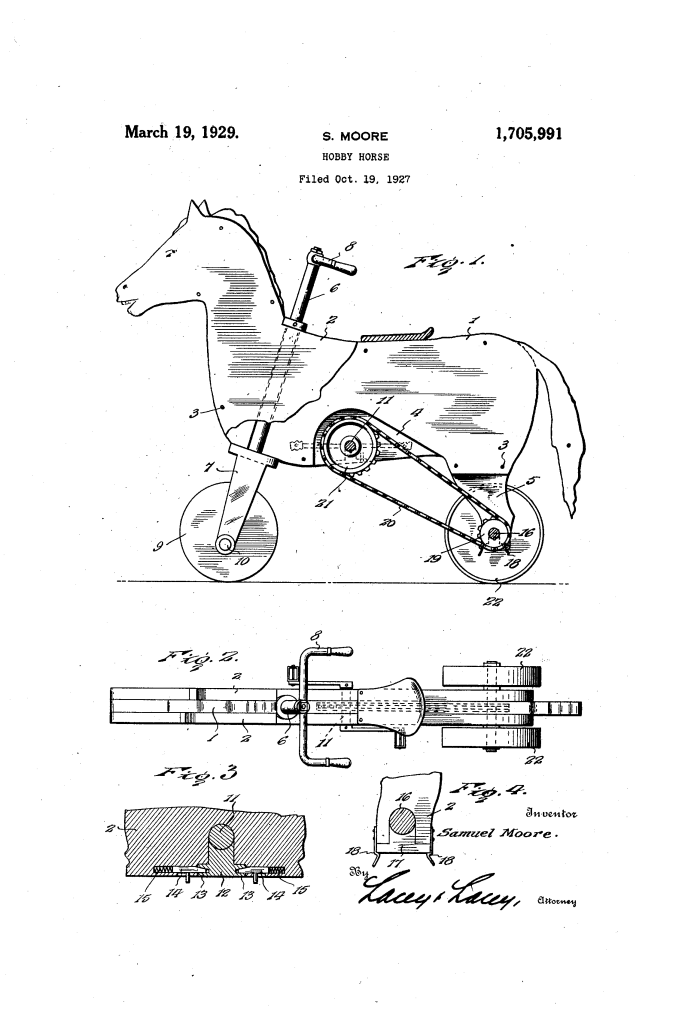
Hobby Horse (Samuel Moore, No. 1,705,991)
The patent by Samuel Moore of Cleveland, Ohio, describes a specialized Hobby Horse (Patent No. 1,705,991, 1929). This invention is a pedaled, wheeled toy designed to provide a realistic “galloping” sensation for the rider. Moore’s primary objective was to create a toy that could be cheaply mass-produced from wood while incorporating a sophisticated internal drive mechanism that remained hidden for safety. His innovation features a symmetrical laminated body and an eccentric front axle that imparts a rhythmic up-and-down movement as the horse moves forward.
Inventor Background: Samuel Moore
Samuel Moore was a prolific African American inventor and engineer active in the 1920s. While he is best known for his safety-focused automotive and locomotive headlight mechanisms, this 1929 patent showcases his versatility in mechanical toy design. Moore’s work often focused on “kinetic translation”—taking one type of movement (like steering or pedaling) and converting it into a secondary, more complex action. In this case, he applied his engineering expertise to the burgeoning consumer toy market, emphasizing manufacturing efficiency and user safety during the “Golden Age of Play.”
Key Mechanical & Structural Systems
The toy is built like a “sandwich,” with the drive components protected inside the wooden core.
1. Laminated Body Construction (1, 2, 3)
- The “Sandwich” Design: The horse’s body is formed of three layers: an intermediate section (1) and two side sections (2), held together by screws (3).
- Internal Housing: The middle section is strategically cut away to create spaces (4 and 5).
- Function: These internal pockets house the chain and gears. By enclosing the mechanics between the side layers, Moore ensured that a child’s fingers or clothing would not get caught in the moving parts.
2. The Galloping Motion Axle (9, 10) (Key Innovation)
- The Front Fork (7): The front steering post carries a wheel (9).
- Eccentric Axis (10): The axis of the front wheel is eccentric (off-center).
- Action: Because the axle is not in the center of the wheel, the front portion of the horse rises and falls with every rotation. This creates a lifelike “pitching” movement that mimics the motion of a real horse, providing a more immersive experience for the rider.
3. The Chain Drive and Sprocket System (11, 16, 19, 21)
- Pedal Power: A crank-shaft (11) with pedals is mounted through the body.
- Transfer: A sprocket wheel (21) on the pedal shaft is connected via a chain (20) to a second sprocket (19) on the rear axle (16).
- Function: This standard bicycle-style drive allows the rider to propel the horse with their legs. The gear ratio could be adjusted during manufacturing to make the horse easier to pedal or faster on flat ground.
4. Quick-Release Filler Pieces (12, 14, 17)
- Maintenance Access: The shaft and axle are held in place by filler pieces (12, 17).
- Spring Latches (14, 18): These pieces are secured by wedge-shaped latches and springs.
- Function: This “snap-in” design allowed for easy assembly and repairs. A parent or shopkeeper could quickly pop out the filler pieces to replace a chain or oil the axles without dismantling the entire horse.
Improvements Over Standard 1920s Hobby Horses
| Feature | Standard “Rocking” Horses | Moore’s Wheeled Hobby Horse |
| Mobility | Stationary; only rocked back and forth. | Fully mobile; can be steered and pedaled. |
| Realism | Static height during motion. | Eccentric axle (10) provides “galloping” movement. |
| Safety | Exposed rockers or wheels could pinch. | Laminated body (2) guards all drive gearing. |
| Manufacture | Required complex carving or metal casting. | Cheaply constructed from standard flat boards. |
Significance to Engineering and Consumer Design
Samuel Moore’s hobby horse influenced the development of kinetic toys and safety-first product architecture.
- Kinetic Sensory Integration: By linking forward travel to a vertical oscillation (galloping), Moore practiced early human-factor engineering, aligning the toy’s mechanical behavior with the user’s imaginative play.
- Modular Fastening: The use of spring-loaded wedge latches (14) for mechanical assembly anticipated the “snap-fit” plastic components used in modern manufacturing today.
- Industrial Safety Standards: Enclosing the drive gearing within the chassis remains a fundamental rule in toy safety engineering, protecting users from moving mechanical hazards.
- Material Efficiency: Moore’s method of “cutting and stacking” boards to create complex internal cavities is a precursor to modern CNC and laser-cutting assembly techniques used in high-end wooden kits.
