
High-Pressure Optical Cell (1963)
The High-Pressure Optical Cell (U.S. Patent 3,079,505), granted on February 26, 1963, to C. E. Weir, E. R. Lippincott, and A. Van Valkenburg, is a landmark invention in high-pressure physics and spectroscopy. It introduced what is now famously known in the scientific community as the Diamond Anvil Cell (DAC). This device allows researchers to subject microscopic samples to extreme pressures—equivalent to those found deep inside the Earth—while simultaneously shining light through them to study their molecular structure.
The Problem: Pressure vs. Transparency
Before this invention, studying materials under high pressure was difficult because the “windows” of the pressure vessels were usually made of materials that were either too weak to withstand high force or opaque to important wavelengths of light.
- Mechanical Weakness: Materials like alkali halides are transparent but break easily under pressure.
- Spectral Limits: Most sturdy window materials cut off important infrared (IR) frequencies, preventing scientists from seeing how atomic bonds vibrate under stress.
The Innovation: Type II Diamond Anvils
The inventors realized that diamonds, the hardest known natural substance, were the perfect material for both pressure and transparency. However, not just any diamond would work.
- Type I Diamonds: Contain nitrogen impurities that create strong absorption bands, “blinding” the instrument in the infrared range.
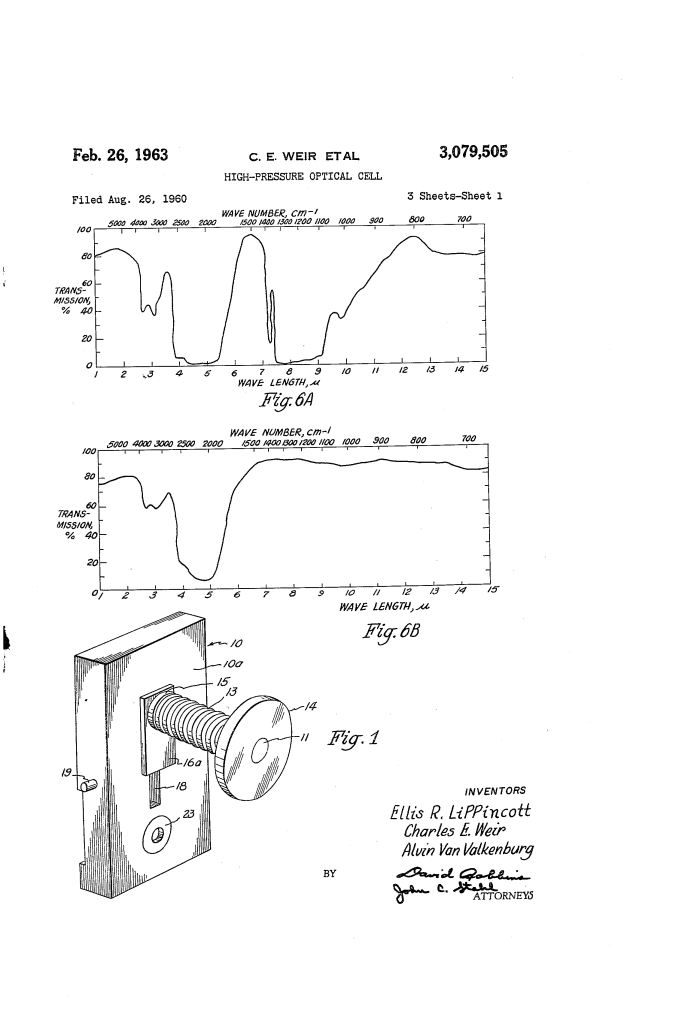
- Type II Diamonds: These rare diamonds are relatively pure and transparent from 1 to 4 microns and from 5.2 to beyond 30 microns. This transparency allows scientists to perform infrared spectroscopy on a sample while it is being crushed.
How the Device Works
The cell functions like a ultra-precision vise. A microscopic amount of sample (powder or solid) is placed between the “flats” of two gem-cut diamonds.
1. The “Squeezer” Mechanism
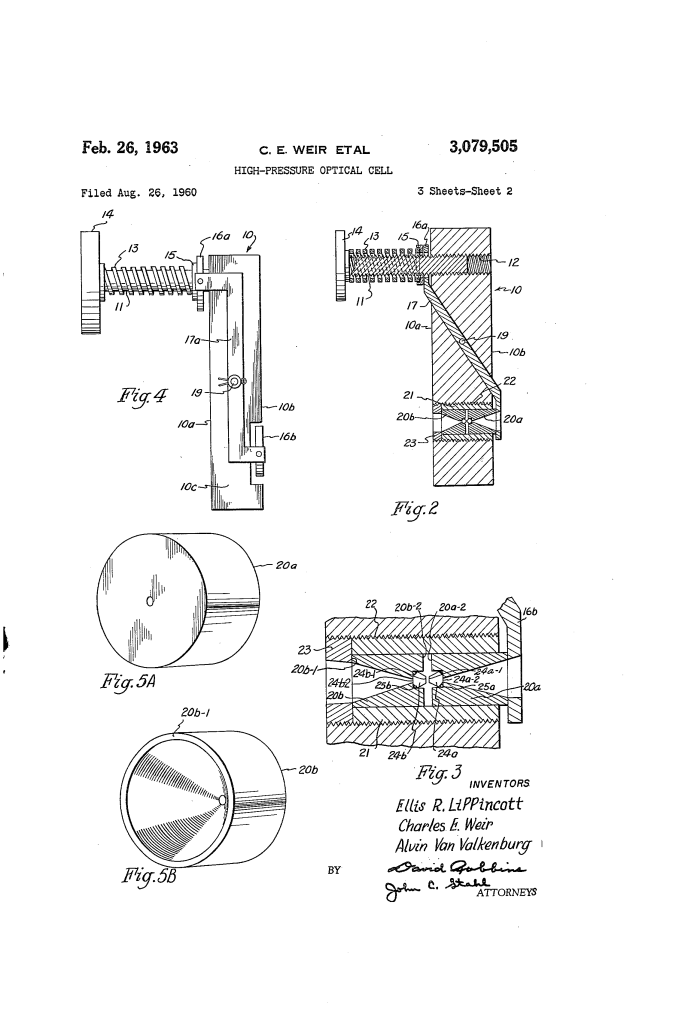
- The Anvils (24a, 24b): Two type II diamonds are ground down so their tips (culets) are flat. These flats are tiny—approximately 0.002 square inches.
- Pressure Multiplication: Because the surface area of the diamond tips is so small, a moderate force applied to the device results in massive pressure on the sample. The patent describes pressures up to 160,000 atmospheres (approx. 2.3 million psi).
2. The Force Train
- Calibrated Spring (13): A spindle (11) is turned to compress a spring.
- Lever Arms (17): The spring force is transferred through a lever system to a presser plate (16b).
- Uniaxial Thrust: The mechanism is designed to ensure the diamonds remain perfectly parallel. If they tilt even slightly, the diamonds will shatter.
Spectral Analysis in Action
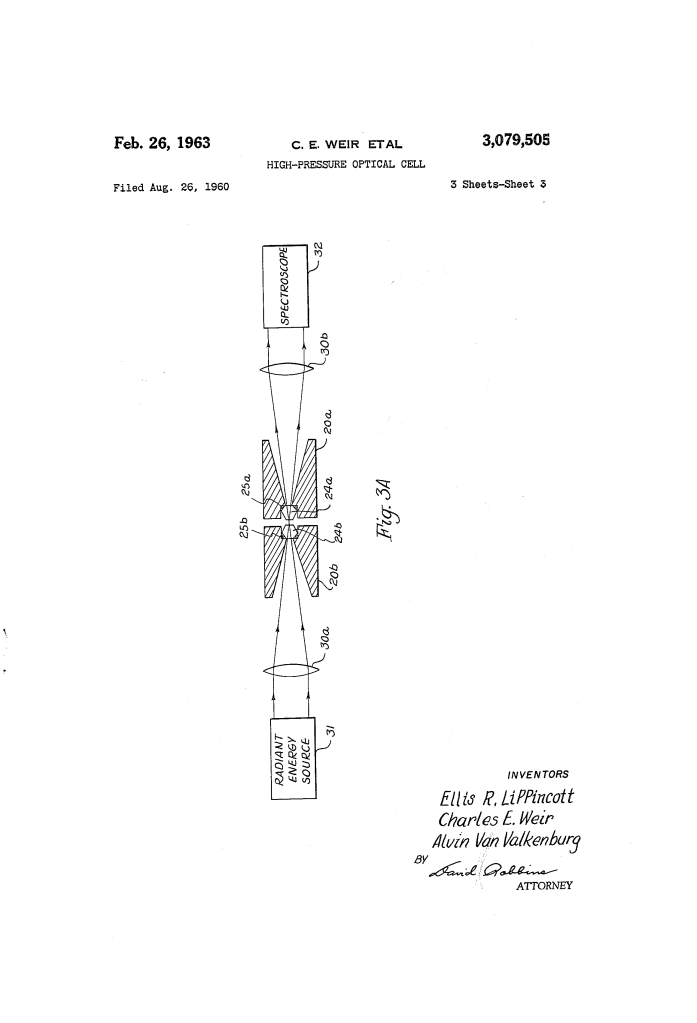
Once the sample is compressed, it is placed in a beam-condensing unit.
- Infrared Source (31): Shines a beam of light through the first diamond.
- The Sample: The light passes through the compressed material. The high pressure causes the absorption bands of the material to shift, split, or change intensity as the atoms are forced closer together.
- Spectroscope (32): Measures the light exiting through the second diamond to determine how the material’s properties have changed.
Key Technical Specifications
| Component | Material/Detail | Purpose |
| Diamond Holders (20a, 20b) | Recessed seats with rubber rings (25a, 25b) | Seats the diamonds and allows for tiny self-alignments under load. |
| Dural Bearing (21) | High-strength aluminum alloy | Houses the diamond holders and ensures they slide smoothly along the thrust axis. |
| Casing (10) | Cold-rolled steel | The “chassis” that holds the entire high-pressure assembly together. |
Legacy of the Invention
The Weir-Lippincott-Van Valkenburg cell revolutionized materials science. It allowed scientists to simulate the pressures of the Earth’s mantle in a laboratory setting. Today, modern versions of this diamond anvil cell are used to discover new forms of matter, such as high-temperature superconductors and “metallic hydrogen.”
