
Heating Apparatus (1898)
U.S. Patent No. 599,985, granted on March 1, 1898, to Benjamin F.Heating Apparatus (1898)
U.S. Patent No. 599,985, granted on March 1, 1898, to Benjamin F. Jackson, details an efficient gas-fueled boiler system designed primarily for circulating hot water through home radiators, as well as generating steam. Jackson, an inventor based in Cambridge, Massachusetts, tackled a key engineering challenge of the era: how to maximize heat transfer from gas fuel while minimizing energy waste and draft disruptions.
Jackson’s design introduced a closed heating chamber paired with high-conductivity internal piping and early automated climate control, creating a clean, highly economical heating plant for residential and commercial spaces.
The Core Design: The Dome and Elbow-Conduit System
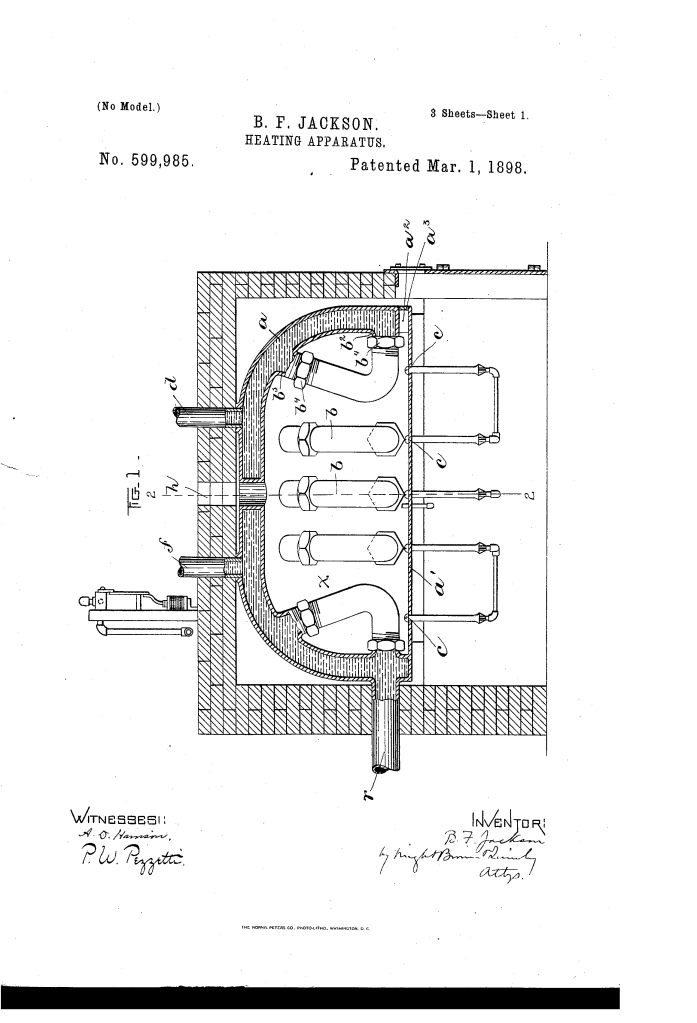
The core architecture centers on an enclosed double-walled dome boiler (a) that houses an internal heating chamber (x). Jackson eliminated heat loss through two primary design strategies:
- Thin-Walled Copper Conduits (b)Instead of forcing burners to heat a single, bulky reservoir of water, Jackson routed water through internal elbow-shaped conduits (b) arranged inside the chamber.Each conduit features a horizontal arm joined to the lower portion of the dome and a vertical arm joined to the top.Made of thin-walled copper, these tubes heat water rapidly. As water warms in the horizontal arm, it quickly rises through the vertical arm, creating a continuous, rapid thermal circulation loop through the building’s radiators via flow pipes (f) and return pipes (r).
- Direct-Target CombustionBurner tubes (c) are placed directly beneath the horizontal arms of the conduits rather than in the empty spaces between them. This focuses the highest flame temperature directly onto the copper conduits, preventing wasted heat.A top flue (h) vents exhaust while drawing the hot air upward across the entire surface of the inner boiler dome.
Air Isolation and Draft Control
Traditional gas heaters suffered from stray drafts that blew flames off target and cooled the heating chamber. Jackson engineered an airtight bottom plate (a1) that seals the base of the chamber.
The burner tubes (c) fit tightly through precision orifices in the floor, blocking cold drafts.
Air for combustion is drawn exclusively from outside the heating chamber using the Bunsen burner principle, mixing fuel and oxygen before reaching the combustion zone to produce a steady, high-temperature flame.
Key Technical Components
The boiler relies on a coordinated set of mechanical and fluid assemblies:
| Component | Function |
| Double-Walled Dome Boiler (a) | Acts as the main water jacket and forms the insulated roof and walls of the heating chamber (x). |
| Elbow Conduits (b) | Rapid-heating copper transfer pipes that circulate water between the lower and upper sections of the boiler. |
| Bunsen Burner Tubes (c) | Fuel tubes fitted with external air inlets to direct pre-mixed, high-efficiency flames against the copper conduits. |
| Pilot Burners (d) | Independent igniting burners supplied by dedicated line (d1) that remain lit continuously to ignite the main burners on demand. |
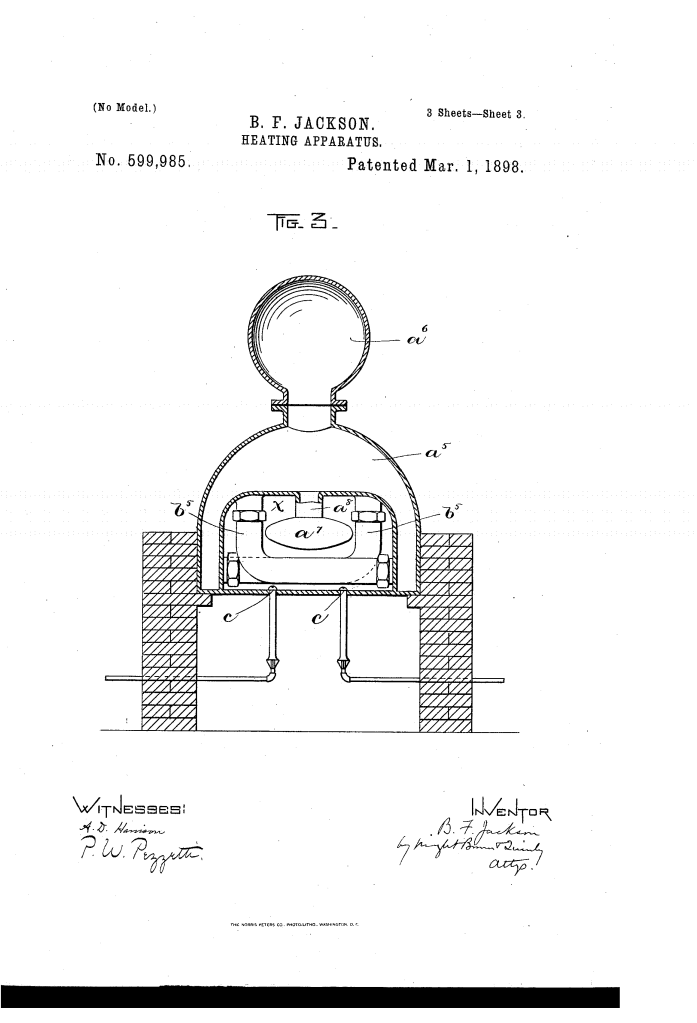
| Supplemental Reservoir (d’) | An interior auxiliary drum used in steam configurations (Fig. 3) to capture residual chamber heat before steam enters the main drum (a5). |
Automated Thermostatic Regulation
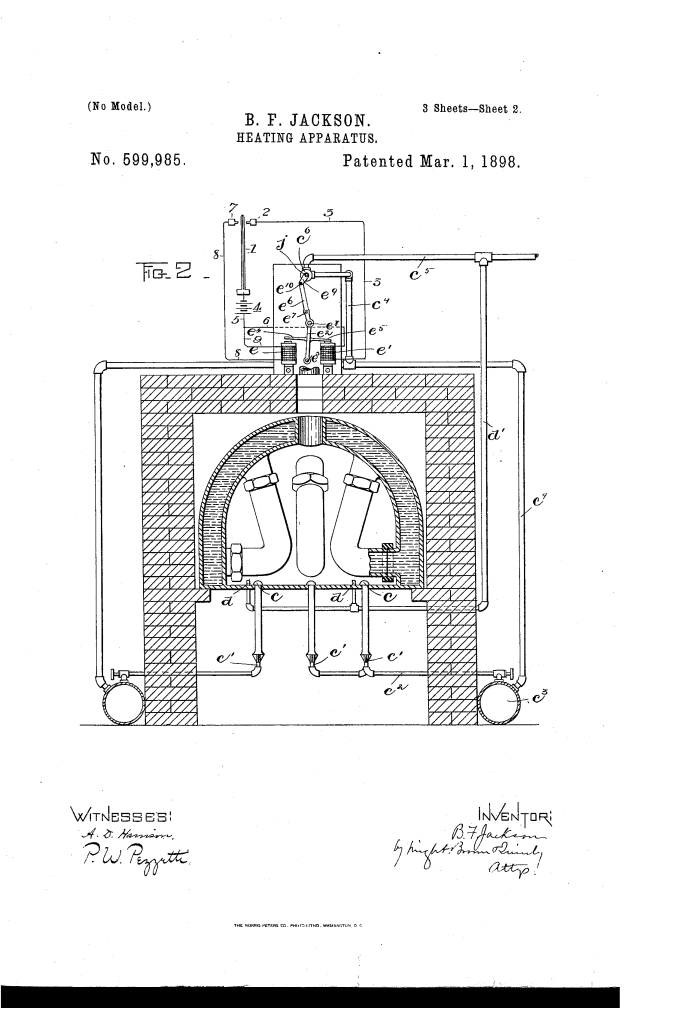
A notable feature of Jackson’s apparatus is an integrated electromechanical thermostat that controls ambient room temperatures automatically:
Dual Electromagnets (e, e1): Wired to a compound bar thermostat (1) placed inside the living quarters.
Armature Linkage: When room temperature drops, circuit contact (7) energizes magnet (e1), pulling a mechanical lever assembly (e2, e4, e6) to open gas cock (c4).
Automatic Shut-off: Once the room reaches the desired temperature, contact (2) closes, energizing magnet (e) to shut the gas valve, leaving only the independent pilot flame (d) lit until heat is required again.
About the Inventor: Benjamin F. Jackson
Benjamin F. Jackson was an inventor working in Cambridge, Massachusetts, at the close of the nineteenth century. His work focused on thermal dynamics, fuel efficiency, and the development of specialized boiler systems during the transition from coal-burning stoves to municipal gas utility infrastructure.
Summary of Claims
Jackson’s patent claims:
A dome-shaped water reservoir enclosing an internal heating chamber, fitted with an upper exhaust flue and sealed from uncontrolled external air infiltration.
The combination of internal, elbow-shaped copper circulation conduits with burner tubes positioned directly beneath their horizontal arms.
Airtight floor fittings for the burner tubes that mix gas and air below the chamber floor before combustion.
The integration of a secondary, independently fueled ignition burner system to allow automatic shut-off and reignition.
