
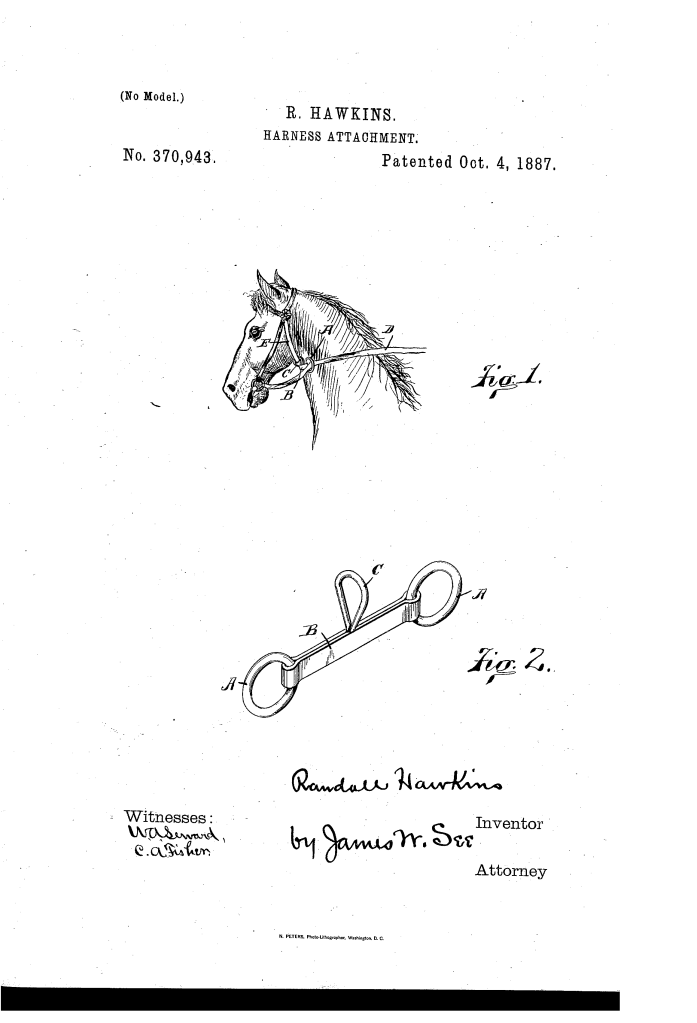
Harness Attachment (Randall Hawkins, No. 370,943)
The patent by Randall Hawkins of Hamilton, Ohio, describes an improved Harness Attachment (Patent No. 370,943, 1887). The invention is a specialized hardware accessory designed to be suspended from the throat-latch of a horse’s bridle to act as a guide for the driving-reins. It aims to keep the reins organized and prevent them from tangling or dropping too low during operation.
Inventor Background: Randall Hawkins
Randall Hawkins was an African-American inventor and harness maker based in Ohio during the late 19th century. His invention reflects the high demand for efficient equine transportation tools in the era before the automobile. Hawkins’s design is noted for its simplicity and its specific geometric orientation, which addressed a common annoyance for drivers—reins becoming slack or caught under the horse’s neck. By securing a patent and assigning half-interest to a local business partner, Hawkins demonstrated the entrepreneurial spirit typical of the “Golden Age” of Black inventors.
Invention and Mechanism (Simplified)
The attachment is a single metal unit composed of three primary parts that manage the “line of sight” for the driving reins.
1. The Guide Rings (A)
- Design: A pair of rings (A) are positioned at either end of the attachment. These are roughly the same size as standard martingale rings.
- Function: The driving-reins (D) pass through these rings. They serve as “fairleads” that keep the reins spaced correctly relative to the horse’s head and the driver’s hands.
2. The Connecting Brace (B)
- Design: A rigid metal brace (B) connects the two rings. Hawkins specified the distance from center to center as approximately six inches.
- Function: This brace maintains a fixed width between the reins, preventing them from crossing over each other or irritating the horse’s neck.
3. The Suspending Loop (C) (Key Innovation)
- Orientation: Projecting upward from the center of the brace is a loop (C).
- Perpendicular Plane: Crucially, the plane of this loop is at a right angle (perpendicular) to the plane of the two rings.
- Function: The throat-latch (E) of the bridle passes through this loop. Because the loop is turned at a 90-degree angle, the attachment hangs naturally and flat against the horse’s throat, allowing the rings to face forward and backward to accommodate the reins smoothly.
Concepts Influenced by This Invention
Hawkins’s harness attachment influenced the ergonomics of animal-drawn transport and the standardization of horse hardware.
- Ergonomic Reinstearing: The use of fixed-width guide rings suspended from a central point influenced later designs in coaching and carriage driving, where maintaining a clean “line” for the reins is essential for safety and fine control.
- Spatial Orientation in Hardware: Hawkins’s focus on the perpendicular loop is a classic engineering solution for “correct orientation” in hanging objects. This ensures that the primary function (the rings) is not compromised by the mounting point (the loop).
- Simplified Article of Manufacture: By designing the unit as a single, durable article, Hawkins paved the way for mass-produced, low-maintenance horse gear that replaced complex, multi-strap leather alternatives.
- Integration with Standard Equipment: The attachment was designed to work with “the usual” bridle and reins, illustrating an early awareness of backward compatibility—making a new invention useful without requiring the user to buy a whole new harness system.
