
Harness Attachment, Joseph Sidney Coolidge, Patent No. 392,908
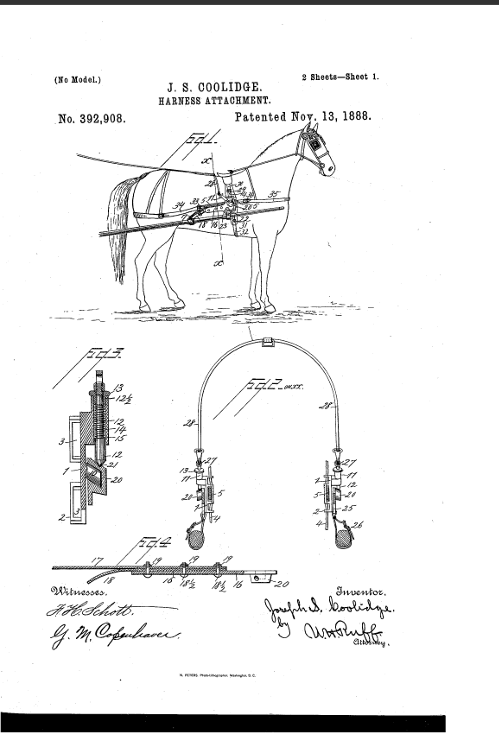
The patent by Joseph Sidney Coolidge of Washington, District of Columbia, describes a Harness Attachment (Patent No. 392,908). This invention is a sophisticated quick-release coupling system designed to secure a horse to a vehicle (such as a carriage or thill) while providing a mechanical failsafe to instantly detach the animal in the event of an emergency, such as a runaway.
The “Why”
In the late 19th century, carriage accidents were a leading cause of urban injury. If a horse became spooked and bolted, the driver was often trapped in a direct mechanical link with a panicked animal. Existing “safety” harnesses usually required permanent modification (cutting or disfiguring) of expensive leather tack. Coolidge sought to solve two primary pain points: occupant safety through an instantaneous release mechanism and economic versatility by creating a device that could be retrofitted to any standard harness without damaging the material.
Inventor Section: Joseph Sidney Coolidge
Joseph Sidney Coolidge was a Black inventor operating in Washington, D.C., during the post-Reconstruction era. His engineering philosophy centered on modular safety and non-destructive integration. During a period when African Americans faced systemic barriers to industrial capital and patent protection, Coolidge’s work on “Harness Attachments” (a field with several notable Black inventors like Andrew Beard) demonstrates a keen focus on the transportation infrastructure of the time. He viewed the harness not as a static set of straps, but as a dynamic mechanical interface that required a “safety valve” for the protection of human life.
Key Systems Section
1. The Spring-Loaded Locking Bolt (Primary Actuator)
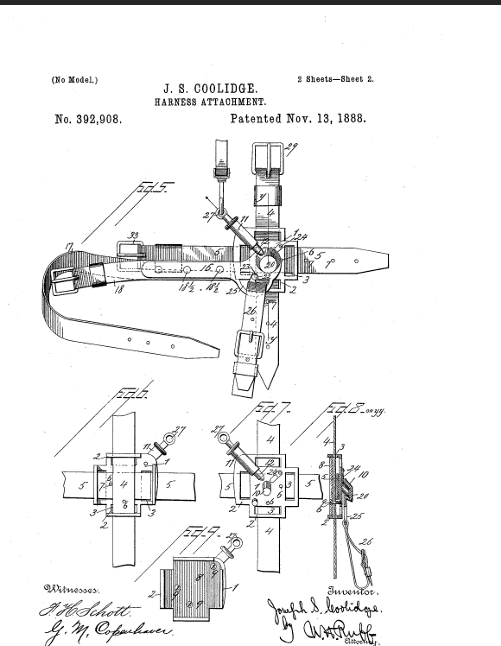
The heart of the device is a reciprocating locking pin housed within a cylinder (11).
- Modern Translation: This is a spring-return linear actuator.
- The bolt (12) features a beveled (sloped) head to allow for “snap-in” engagement, similar to a modern door latch.
- The tension is provided by a spiral compression spring (14), which can be adjusted or replaced by a thumb-nut (13) without dismantling the entire unit.
2. The Universal Case & Lip Interface
Coolidge engineered a “case” (1) with downward-projecting “lips” (2) and oblong eyes.
- Modern Translation: A modular mounting bracket or chassis.
- By using internal pins (6) to engage the holes in the leather straps, the device creates a high-friction grip that doesn’t require stitching or buckles, allowing it to “float” on the existing harness.
3. The Emergency Release Linkage
The system utilizes a manual override connected to the driver via “lines” (28).
- Modern Translation: A cable-actuated emergency disconnect.
- When the driver pulls the safety line, the bolt (12) retracts. A dedicated ejection spring (24) then physically shoves the attachment plate away from the horse, ensuring the vehicle detaches instantly even under the tension of a galloping animal.
Shutterstock Explore
Comparison Table
| Feature | Standard Methods (1888) | Coolidge’s Innovation |
| Attachment | Fixed buckles and stitched leather. | Modular “snap-on” case with pin-locks. |
| Emergency | Required cutting straps or manual unbuckling. | Instantaneous pull-string release. |
| Versatility | Custom-made for specific harnesses. | Universal fit; no “disfiguring” of leather. |
| Maintenance | Entire harness required repair if worn. | User-replaceable internal springs and bolts. |
Significance Section
- Safety Engineering: One of the earliest reliable “quick-disconnect” couplings for high-tension transport.
- Precursor to Seatbelts: The philosophy of a “single-pull” release for passenger safety is a direct ancestor to modern automotive safety restraints.
- Modular Design: Foreshadowed modern “aftermarket” industries where accessories are designed to enhance a base product without altering its structural integrity.
- Kinetic Energy Management: Utilized stored potential energy in the ejection spring to overcome the kinetic friction of the moving carriage.
