
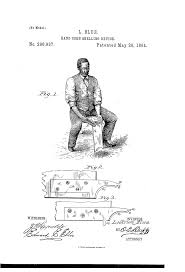
Inventor: Lockrum Blue
Patent Number: 298,937 (US-0298937-A)
Date of Patent: May 20, 1884
Invention: Hand Corn-Sheller
Description of the Invention (from the Patent Document): Lockrum Blue’s 1884 patent for a “Hand Corn-Sheller” aimed to provide a simple, efficient, and cost-effective device for removing kernels from ears of corn by hand. Prior to such devices, corn shelling was a tedious and laborious manual task. Blue’s invention sought to mechanize this process, making it faster and less physically demanding for individuals.
Key features and components of his design:
- Fixed Jaw (A) and Movable Jaw (B): The device consists of two main jaws. The fixed jaw (A) has a central depression or recess to accommodate the ear of corn. The movable jaw (B) pivots on a screw (C) and also has a similar depression.
- Corrugated or Roughened Surfaces (a, b): Both jaws are provided with corrugated or roughened surfaces or ribs (a and b) that serve to grip the ear of corn and facilitate the removal of kernels. These corrugations are typically arranged at an angle to the axis of the ear.
- Spring (D): A spring (D) is attached to the movable jaw (B) and to a lug on the fixed jaw (A). This spring normally holds the jaws open or apart, allowing an ear of corn to be easily inserted.
- Operating Lever or Handle (B’): The movable jaw (B) extends into a handle or lever (B’) that the operator can grasp and press.
- Ejector (E) and Spring (e): An ejector (E) is pivoted to the lower part of the fixed jaw (A) and is normally pressed outwards by a spring (e). This ejector helps to push the shelled ear out of the device once the kernels are removed.
- Thumb-Piece (E’): The ejector (E) has a thumb-piece (E’) that the operator can press to push the shelled ear out.
Principle of Operation: To operate the device, the user inserts an ear of corn into the depressions of the jaws (A and B). The operator then presses the handle (B’) of the movable jaw, causing it to pivot and clamp down on the ear of corn. As the jaws close, their corrugated surfaces strip the kernels from the cob. The shelled corn falls away, and once the pressure is released and the thumb-piece (E’) is pressed, the ejector pushes the bare cob out.
Personal Significance (Lockrum Blue): Lockrum Blue was an African American inventor from Alexandria, Rapides Parish, Louisiana. His patent for a “Hand Corn-Sheller” is a significant example of Black ingenuity applied to practical agricultural problems. In the late 19th century, corn was a fundamental crop, and manual shelling was a pervasive chore for families, especially in agricultural regions. Blue’s invention offered a simple, mechanical solution to alleviate this labor.
Like many African American inventors of his time, Blue faced immense systemic racial discrimination and limited access to resources and recognition. Despite these challenges, his ability to conceive and patent a device that addressed a common agricultural need underscores his intelligence, mechanical skill, and determination. His contribution adds to the important, yet often overlooked, history of African American innovation in various sectors, including agriculture.
Historical Significance: Lockrum Blue’s “Hand Corn-Sheller” holds historical importance within the context of agricultural tools, labor-saving devices, and African American contributions to technology:
- Addressing Agricultural Labor: Corn shelling by hand was a tedious and time-consuming process for farmers and families who relied on corn as a staple. Simple, portable hand-shellers like Blue’s significantly reduced the manual effort required, improving efficiency in small-scale farming and household use.
- Evolution of Farm Implements: While larger, horse-powered, or eventually engine-powered corn shellers existed for commercial operations, hand-shellers filled a crucial gap for individual farmers or families who needed a more efficient method than using bare hands or simple pegs. Blue’s invention contributed to the broader mechanization of farm tasks, even at the household level.
- Impact on Rural Life: By making the process of preparing corn for consumption or animal feed easier, such devices directly improved the quality of life and productivity in rural communities.
- African American Contribution to Agriculture: Blue’s patent is another valuable example of an African American inventor contributing directly to agricultural technology. It highlights how Black innovators provided practical solutions that benefited the foundational sector of American agriculture, even in the face of societal barriers.
His patent demonstrates how even seemingly simple mechanical improvements could have a significant impact on daily labor and efficiency. Sources

Generate Audio Overview
Deep Research
Canvas
