
Hame-Fastener (1882)
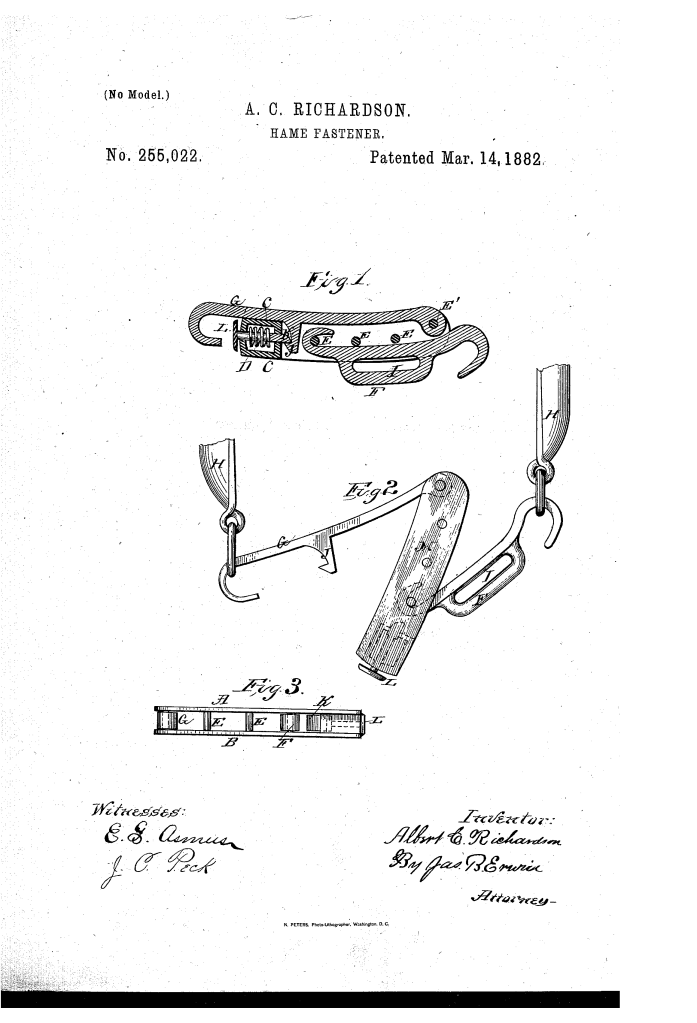
U.S. Patent No. 255,022, granted on March 14, 1882, to Albert C. Richardson, represents a significant mechanical refinement in the field of equestrian hardware and animal husbandry. Richardson, based in South Frankfort, Michigan, designed this improved “hame-fastener” to secure the wooden or metal harness bars (hames) around a horse’s collar more safely and efficiently than previous models.
This invention was an evolution of Richardson’s own earlier work. It addressed a specific safety flaw in his 1880 design: the tendency for hames to slip out of their hooks during the “draft” or pulling motion of the horse. By re-engineering the geometry of the hooks and the locking mechanism, Richardson eliminated the need for complex springs to keep the harness from falling apart.
The Innovation: Gravity and Geometric Safety
The “brilliance” of the 1882 fastener lay in its simplicity and its use of physics to ensure security. In the previous iteration, the hooks opened upward, meaning the natural upward pull of the horse could accidentally unseat the harness. Richardson flipped the design—literally.
1. Downward-Facing Hooks
The openings of the hooks (F and G) were designed to face downward. Because the tension of the harness pull is always upward or outward, the hames are naturally forced deeper into the hooks rather than away from them. This made the “snap-springs” used in earlier versions entirely unnecessary.
2. The S-Shaped Adjustable Hook (F)
Richardson recognized that not all horses or collars are the same size. He created an S-shaped hook that could be moved between different internal rods (E) within the frame. This allowed the farmer to “size” the fastener to the specific animal, ensuring a snug fit every time.
3. The Integrated Pole/Bell Loop (I)
In a clever bit of multi-functional design, Hook F included a secondary loop. This provided a convenient attachment point for pole straps or decorative bells, reducing the amount of extra hardware dangling from the horse.
Key Mechanical Components
The device used a streamlined metal frame to house a secure locking system:
| Component | Function |
| Frame (M) | Constructed of two plates (A and B) that house the internal locking hardware. |
| S-Shaped Hook (F) | The adjustable hook that attaches to the first hame; its shape allows for multiple sizing positions. |
| Pivoted Hook (G) | Permanently attached to the frame; it features a Keeper (J) that locks the system closed. |
| Sliding Latch (K) | A spring-loaded bolt that catches the keeper to prevent the fastener from opening during use. |
| Spiral Spring (D) | Provides the tension needed to keep the latch engaged until manually released. |
| Knob (L) | The external control used by the operator to retract the latch and unfasten the harness. |
How the Apparatus Functions
The fastening process followed a simple, three-step mechanical sequence:
- Attachment: The hooks are inserted into the hame-buckles while the frame is in the “open” position.
- Closure: The operator draws the frame upward against Hook G. This movement leverages the hames together, tightening the collar around the horse.
- Locking: As the frame closes, the Catch (J) snaps into the Sliding Latch (K). The internal spiral spring ensures the latch stays “clicked” into place, even if the horse moves violently.
- Release: To unhitch the horse, the operator pulls the Knob (L) to withdraw the latch, allowing the hooks to drop free instantly.
About the Inventor: Albert C. Richardson
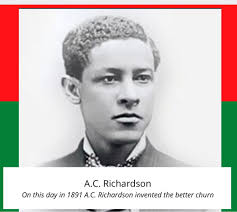
Albert C. Richardson was a prolific inventor whose contributions were essential to the late-19th-century economy, particularly in rural Michigan.
- Evolution of Design: This patent is a prime example of Richardson’s iterative approach to engineering—taking a functional 1880 patent and radically simplifying it to remove points of failure.
- Agricultural Impact: Before these types of fasteners, harnesses often relied on leather straps and buckles that could stretch, rot, or break. Richardson’s metal fasteners provided a level of durability and speed essential for commercial transport and farming.
- Broad Expertise: While he is often celebrated for his 1891 butter churn and his 1894 casket lowering device, his early work in harness hardware shows his deep understanding of the mechanical stresses involved in animal labor.
Summary of Claims
The patent explicitly protects:
- A frame (A, B) with internal walls and a spring-loaded bolt for a secure, enclosed locking mechanism.
- The specific use of downward-inclined hooks that use the horse’s own draft tension to stay secured.
- The combination of a pivoted catch (J) and a sliding latch (K) that allows for a “one-click” secure connection.
