
Hame-Fastener (Albert C. Richardson, No. 255,022)
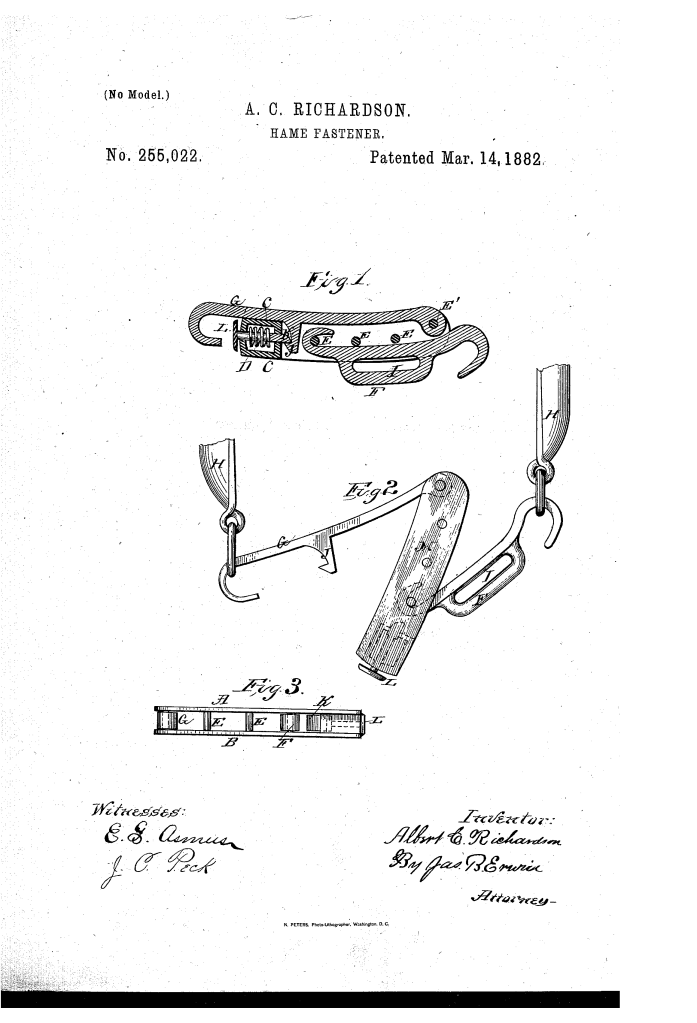
The patent by Albert C. Richardson of South Frankfort, Michigan, describes an Improvement in Hame-Fasteners (Patent No. 255,022, 1882). This invention is an improvement on his earlier patented device and is designed to more securely and easily fasten the lower ends of the hames (the two curved pieces of a harness collar) around a horse’s neck. The key improvement is designing the hooks so that the draft (pulling force) holds the hames on instead of pulling them off, eliminating the need for safety snaps.
Inventor Background: Albert C. Richardson
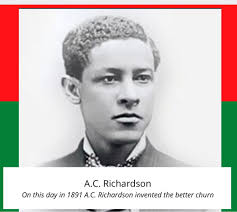
Albert C. Richardson was an African-American inventor known for practical innovations ranging from funeral equipment to household goods.1 This patent shows his focus on improving utilitarian hardware, specifically addressing a common safety and reliability issue in horse harness and agricultural equipment.
Invention and Mechanism (Simplified)
The device is a compact, two-piece frame with downward-facing hooks and a sliding latch for quick, secure connection of the hames.
- Frame and Body: The fastener consists of a frame (M) made of two main metal plates (A and B). Plate B has side walls (C) that act as bearings for the sliding latch and house a spiral spring (D).
- Downward-Facing Hooks (Key Innovation): The two main hooks, F (S-shaped) and G, are attached to the frame.
- Direction: The openings in the hooks are inclined downward, away from the hames (H).
- Function: Because the draft (pull of the harness) naturally pulls the hames upward (or in the opposite direction of the hook opening), the hames are not liable to become detached . This eliminates the need for extra safety snaps or plate-springs that were required in his previous upward-opening design.
- Adjustable Hook: Hook F is S-shaped and is loosely attached to rods (E), allowing it to be moved nearer or farther from the frame end.2
- Function: This permits easy adjustment of the fastener to fit different sized collars.
- Locking Mechanism:
- The lower end of the frame is drawn up, and a keeper (J) on the hook (G) engages with a sliding latch (K).3
- Function: This securely locks the hames together around the collar. A knob (L) is used to withdraw the latch (K) for quick unfastening.
Concepts Influenced by This Invention
Richardson’s hame fastener influenced subsequent hardware design by pioneering load-dependent securement—using the working load itself to enhance the lock.
- Load-Dependent Locking: The core concept of designing a latch or hook so that the working stress (draft) acts to tighten or retain the connection rather than tending to open it influenced the design of various modern industrial hooks, quick-connect couplings, and safety latches.
- Adjustable Sizing for Retrofitting: The inclusion of an S-shaped hook (F) that is adjustable along a rod (E) influenced the design of universal and retrofittable industrial hardware that must be quickly sized to fit objects of varying dimensions (e.g., adjustable pipe clamps, universal mounting brackets).
- Self-Contained Security: The achievement of safety and anti-detachment without auxiliary springs or snaps influenced the design philosophy of creating simple, reliable, and durable safety hardware.
- Quick-Release Clamping: The use of the sliding latch (K) for rapid unfastening influenced the design of quick-release mechanisms for industrial and utilitarian clamping systems.
