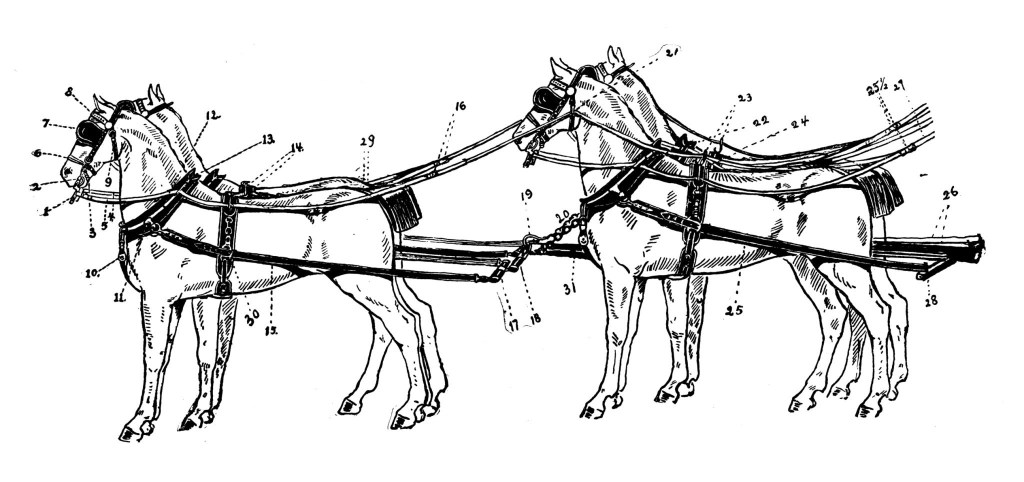
Hame Attachment – Patent No. 450,550
Inventor: William B. Abrams, of Wells, New York.
Patent Number: 450,550
Date of Patent: April 14, 1891
Description: William B. Abrams’s patent for a “Hame Attachment” describes a device designed to improve the harness used for draft animals. The invention consisted of a single metal plate that attached directly to a horse’s hame (the part of the harness that fits over the horse’s collar). The plate featured three key points of attachment:
- Back-Strap Ring: A ring at the top for the back strap, which goes over the horse’s back.
- Breast-Ring Flange: A flange on the front edge with a ring for the breast strap, which goes across the horse’s chest.
- Adjustable Trace Attachment: A series of “steps” with perforations through which a headed bolt could be passed. A “cockeye” or other attachment for the traces (the straps that connect the horse to the wagon or plow) could be secured at any of these steps. This allowed the user to adjust the height of the draft for different tasks or for horses of different sizes.
Societal Impact
Abrams’s invention was a practical, incremental improvement in a world still heavily reliant on horsepower for transportation and agriculture.
- Increased Efficiency and Versatility: The primary benefit of this invention was its adjustability. Farmers and teamsters could quickly and easily change the draft height to suit different tasks, such as plowing, pulling a heavy cart, or working on uneven terrain. This adaptability made a single set of harnesses more versatile and efficient.
- Economic Benefits for Farmers: In an era when horses were essential capital on a farm, any invention that improved their efficiency and made equipment more durable was valuable. By providing a sturdy, adjustable, and easy-to-use attachment, Abrams’s invention helped to improve productivity and longevity of the harness system, which was a significant investment.
- A Glimpse of the Past: This patent is a good example of the kind of pragmatic ingenuity that drove technological progress in the late 19th century. It solved a problem of everyday life in an economy powered by animals, showing how inventors focused on refining existing technologies to make work safer, easier, and more productive.