
Quick-Firing Anti-Aircraft Gun (William D. Polite, No. 1,218,458)
The patent by William D. Polite of Wilmington, North Carolina, describes a Gun (Patent No. 1,218,458, 1917). This invention is a highly advanced quick-firing artillery piece, specifically designed for anti-aircraft defense. Its most innovative feature is a shell magazine and breech block that operate as a single unit, adjustable longitudinally along the barrel. This design allowed for rapid, automatic loading, firing, and ejection of shells, all controlled by an operator using foot-pedals, leaving the hands free for steering and aiming.
Inventor Background: William D. Polite
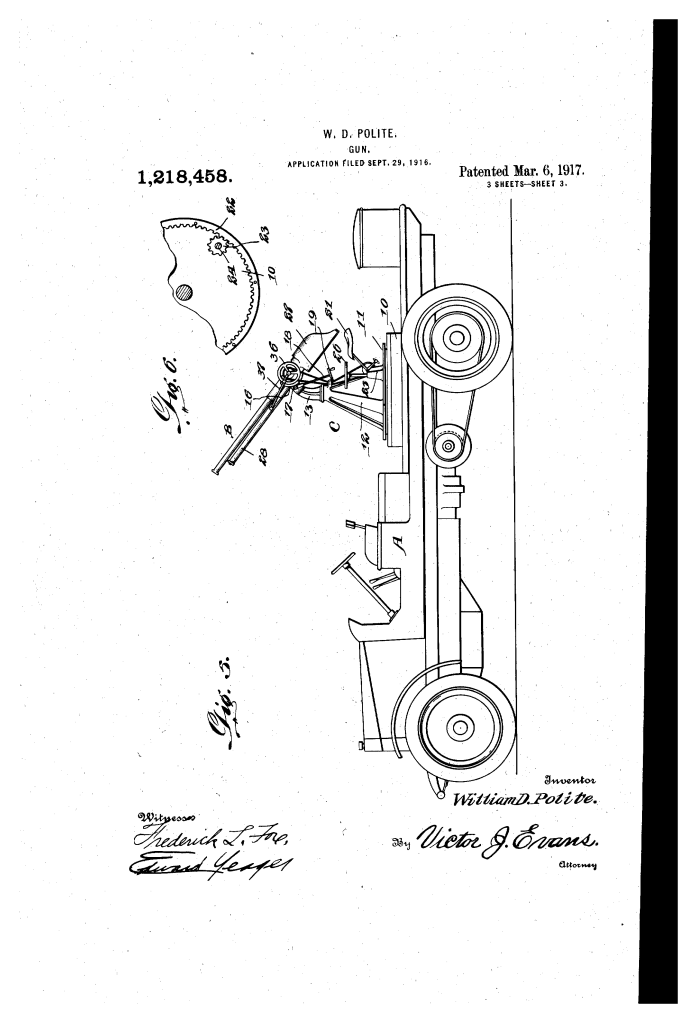
William D. Polite was an African American inventor based in Wilmington during the early 20th century. His 1917 patent arrived at the height of World War I, a time when anti-aircraft technology was in its infancy. Polite’s gun was a masterpiece of mechanical coordination, integrating high-speed cycling with human-factors engineering. By mounting the gun on a motorized vehicle or ship and providing a dedicated operator’s seat with foot-controls, he anticipated the mobile, rapid-response defensive systems that would become essential in modern warfare.
Key Mechanical Components & Functions
The gun utilizes a complex linkage of sprockets and cams to automate the firing cycle.
1. The Foot-Operated Firing Cycle (31, 32)
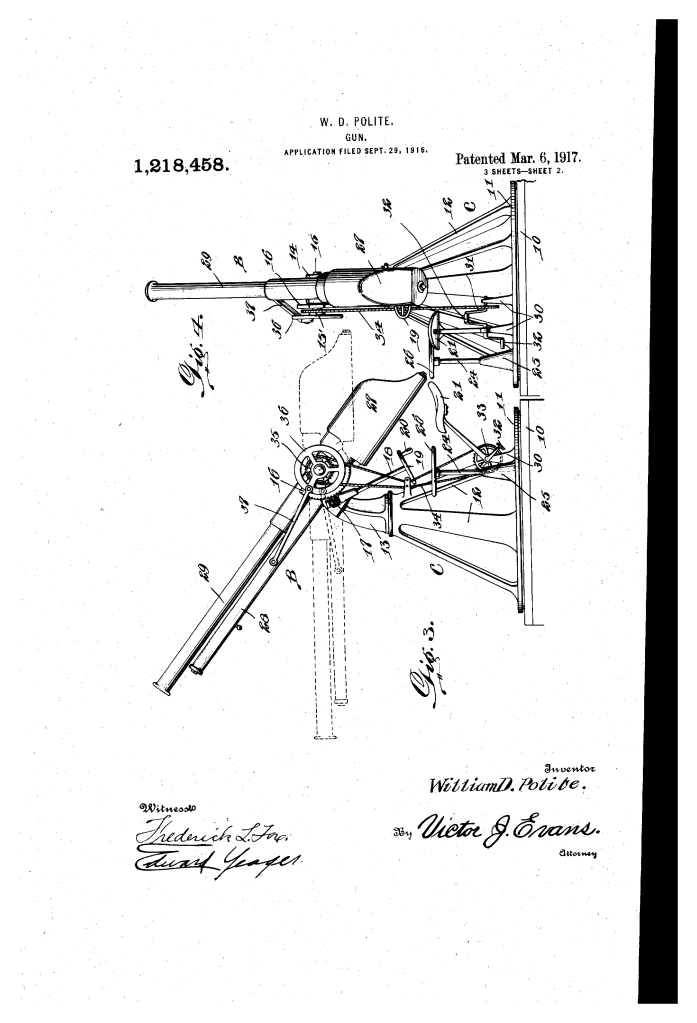
- Crank Shaft and Pedals: The operator sits in a dedicated seat (21) and operates a crank shaft (31) via foot-pedals (32).
- Chain Drive: This rotates a sprocket (33) and endless chain (34) connected to a large eccentric wheel (36).
- Function: As the wheel turns, an operating rod (37) moves the breech block and magazine unit back and forth along the barrel. This “pedal-power” allows for continuous, rapid firing without the operator needing to manually cock or load the weapon.
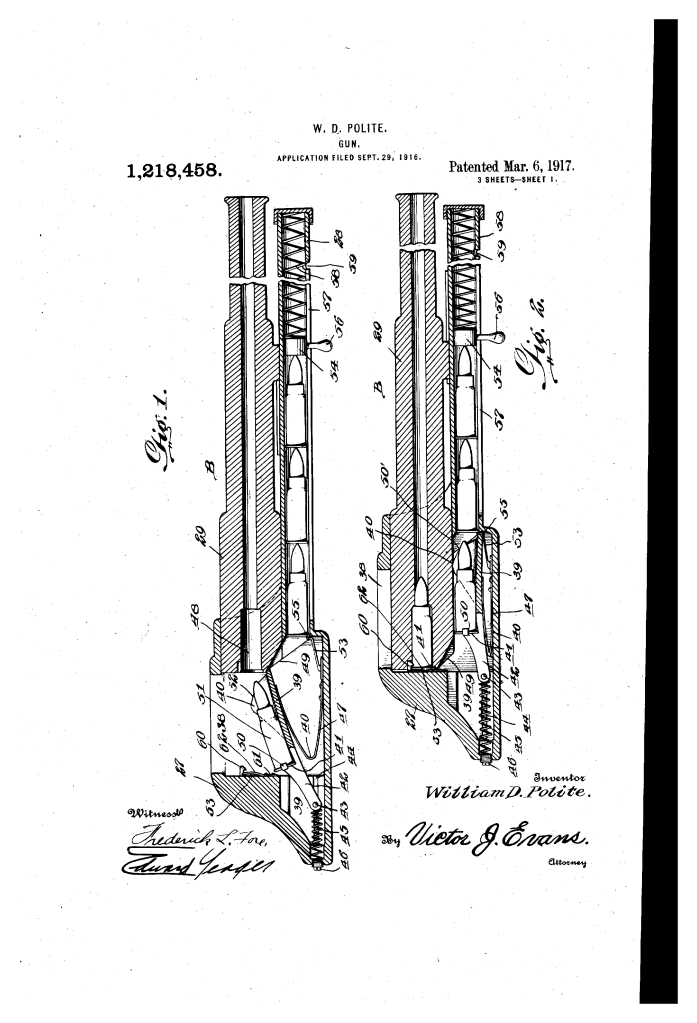
2. The Automatic Shell Lifter (39-43)
Inside the breech block is a U-shaped shell lifter.
- Spring-Loaded Pivot: The lifter is mounted on a pivot pin (43) that slides in guide grooves (44).
- Mechanism: When the breech block moves back, a V-shaped spring (47) and an expansion spring (45) coordinate to tilt the lifter up.
- Function: This positions a new shell precisely behind the firing chamber (48). As the block moves forward, it pushes the shell into the barrel and resets the lifter for the next cycle.
3. Automatic Loading and Ejection (53, 60, 61)
- The Magazine (28): A spring-pressed follower (54) pushes shells forward. A spring detent (53) acts as a gate, allowing only one shell to be “ejected” from the magazine onto the lifter at a time.
- The Ejector Hook (60): After firing, as the breech block moves rearward, a hook-like element (60) grabs the base of the spent shell.
- The Expulsion Spring (61): A Y-shaped spring (61) is compressed during the forward stroke.
- Action: When the spent shell is pulled clear of the barrel, the spring snaps back to its normal shape, physically kicking the empty casing out of the top of the breech block.
4. The Precision Mounting System (10, 16)
- Horizontal Adjustment: A circular base (10) with internal rack teeth (22) allows the entire gun to rotate 360 degrees.
- Vertical Adjustment: An arcuate rack bar (16) and worm gear (17) allow the operator to tilt the gun upward at steep angles.
- Utility: These controls are operated by hand-wheels (20, 26), allowing the operator to track fast-moving aircraft while their feet drive the firing mechanism.
Improvements Over Existing Artillery
| Feature | Standard 1910s Quick-Firers | Polite’s Anti-Aircraft Gun |
| Operator Control | Manual loading and hand-cranked firing. | Foot-pedal driven cycle; leaves hands for aiming. |
| Loading Speed | Reloading often required pausing fire. | Continuous magazine feed with automatic lifting. |
| Ejection | Spent casings dropped or were pulled manually. | Forced spring-ejection clears the chamber instantly. |
| Mobility | Rigid ground mounts. | Designed specifically for motorized vehicle/ship integration. |
Significance to Defense Technology
William D. Polite’s gun is a landmark in the history of rapid-fire automation and ergonomics.
- Human-Machine Interface: By delegating the repetitive, high-energy task of cycling the action to the legs (which are stronger and have more endurance than arms), Polite practiced early biomechanical optimization.
- Mobile Defense Architecture: His design for a vehicle-mounted, high-angle gun was a direct precursor to the “technical” and mobile anti-aircraft platforms used in every conflict since.
- Sequential Spring Logic: The way Polite used multiple springs (V-shaped, Y-shaped, and expansion) to time different parts of the loading cycle without complex electronic sensors is a textbook example of mechanical timing.
- Rapid Reciprocation: The unitized breech and magazine movement ensured that the center of gravity stayed relatively stable during firing, a critical factor for maintaining accuracy when shooting at moving aerial targets.
