

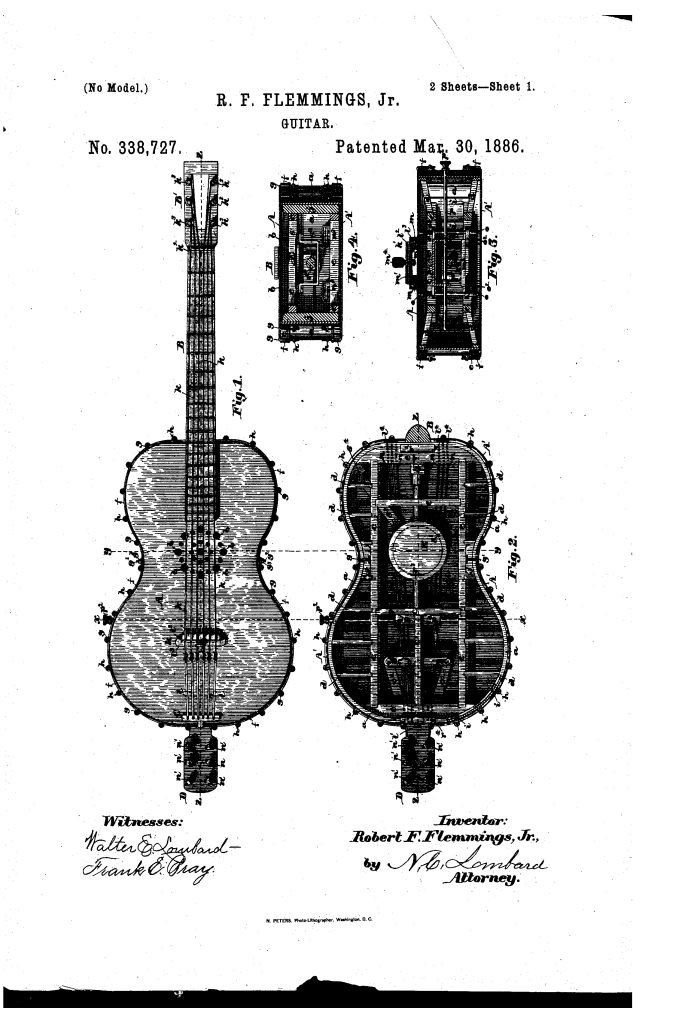
Euphonica Guitar (Robert F. Flemmings, Jr., No. 338,727)
The patent by Robert F. Flemmings, Jr. of Melrose, Massachusetts, describes an improvement in musical instruments, specifically a stringed instrument he termed the Euphonica (Patent No. 338,727, 1886). While shaped like an ordinary guitar, the Euphonica was designed to provide a much higher volume and “sweetness” of tone, along with increased sensitivity to the player’s touch.
Inventor Background: Robert F. Flemmings, Jr.
Robert F. Flemmings, Jr. was an African-American inventor and musician who was highly active in the late 19th-century Boston music scene. His invention of the Euphonica is a rare example of high-level musical instrument engineering by a Black inventor during this period. Flemmings sought to bridge the gap between the resonant, percussive qualities of a banjo and the melodic complexity of a guitar. His patent demonstrates a deep understanding of acoustics, sympathetic resonance, and mechanical linkage.
Invention and Mechanism (Simplified)
The Euphonica replaces the traditional wooden top and back of a guitar with vellum (parchment) heads and incorporates a secondary “hidden” set of strings inside the body.
1. Dual Vellum Heads and Bracing
- Vellum Heads: Instead of a wooden soundboard, the Euphonica uses two parchment or vellum heads stretched over the wooden sides ($a$).
- Metal Clamping System: To prevent the intense tension of the drum-like heads from crushing the wooden frame, Flemmings designed a metal band and pull-down brackets.
- Function: This allows the user to tune the tension of the vellum heads independently, much like a banjo, to achieve the desired resonance.
2. Sympathetic Interior Strings (Key Innovation)
- Interior Strings: Inside the body, nearer to the lower head, is a second series of strings.
- Tuning Pegs: These strings are tuned via pegs located on an external arm at the base of the instrument.
- Function: These strings are tuned to the same pitch as the exterior strings. When the exterior strings are played, the interior strings vibrate through sympathetic resonance, significantly increasing the instrument’s volume and harmonic depth.
3. Acoustic Transmission and Regulation
- Vibratory Posts: To ensure both heads work together, spring-loaded posts are placed between the upper and lower vellum heads.
- Function: Any vibration on the top head is physically transmitted through the posts to the bottom head, activating the entire air chamber and the internal strings simultaneously.
- The Reverberant: Beneath the sound-hole perforations ($b$) is a reverberant—a small, independent disk of thin vellum mounted on a spring arm.
- Function: This acts as a sound regulator, vibrating in unison with the air inside to “gauge” and enrich the sound emitted from the instrument.
4. The Mechanical Twanger (Internal Tuner)
- Picker-Arm: Since the internal strings cannot be touched by hand, Flemmings invented a twanging device.
- Function: A rod with a leather-covered “finger” projects inside the body. By sliding and rotating a knob outside the guitar, the musician can “pluck” the internal strings to hear their tone while tuning them.
Concepts Influenced by This Invention
Flemmings’ Euphonica influenced the science of instrument acoustics and the development of hybrid string instruments.
- Sympathetic Resonance Engineering: The use of internal, Slaved strings to bolster acoustic volume is a concept found in rare classical instruments (like the Viola d’amore). Flemmings modernized this for a popular instrument, influencing later designs of “resonator” and “12-string” guitars.
- Mechanical Sound Regulation: The “reverberant” is a precursor to modern acoustic baffles and passive radiators used in high-end audio speakers to control air movement and tone.
- Hybrid Material Construction: By combining the guitar’s neck and shape with the banjo’s tensioned vellum system, Flemmings contributed to the evolution of the banjo-guitar (banjitar) and other cross-genre instruments.
- Internal Mechanical Actuation: The “mechanical twanger” is an early example of using remote linkages to interact with enclosed systems, a principle now common in various types of industrial and musical “remote” interfaces.
