
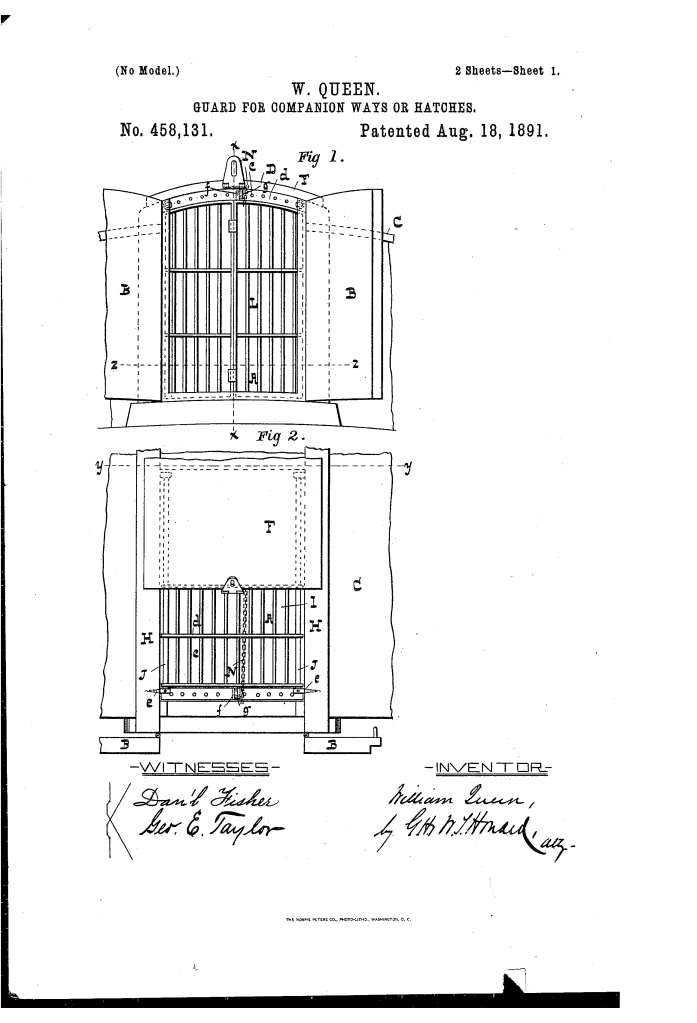
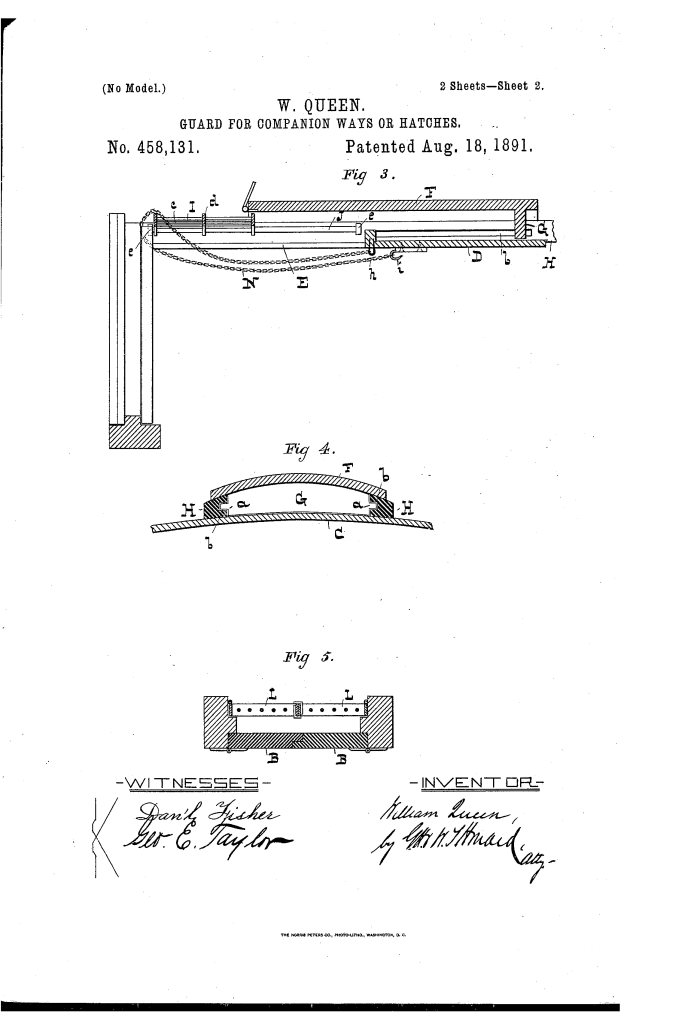
Guard for Companion Ways or Hatches (1891)
U.S. Patent No. 458,131, granted on August 18, 1891, to William Queen, introduces a dual-purpose security and ventilation system for maritime vessels. Queen, a resident of Baltimore, Maryland, designed this apparatus to address a common vulnerability on ships: the need for fresh air in the cabin versus the risk of unauthorized entry.
This invention provided a secondary, “barred” barrier that allowed air to circulate through the companionway while keeping the cabin secure from “thieves” when the heavy wooden doors were left open.
The Innovation: The Barred Secondary Barrier
In the 19th century, cooling a ship’s cabin required opening the main hatch (the companionway), which left the interior exposed. Queen’s invention integrated a set of supplementary grated doors and a sliding grating directly into the existing structure of the companionway.
1. The Sliding Roof Grating (I)
Situated directly beneath the solid wooden shutter (F), this grating consists of iron rods and cross-pieces. It slides along bars (J) attached to the sides of the companionway. This allows the solid roof to be retracted for light and air while maintaining a metal ceiling that prevents anyone from climbing in through the top.
2. The Folding Grated Doors (L)
Beneath the standard wooden doors (B), Queen installed a pair of folding metal gates. These doors feature a “lapping” edge, meaning they interlock when closed.
3. The Integrated Locking System
The design features a clever alignment where the vertical doors meet the sliding roof grating:
- External Locking: An eye (f) on the doors registers with an eye (g) on the roof grating, allowing the entire unit to be secured with a single padlock from the deck.
- Internal Security: For sailors sleeping below, a chain (N) connects the doors and the roof grating to a hook (i) on the interior, ensuring the cabin is “burglar-proof” from the inside.
Technical Components
The system is designed to be “supplementary,” meaning it fits within the footprint of the original wooden cabinetry without requiring a complete rebuild of the hatch.
| Component | Function |
| Sliding Grating (I) | A horizontal metal barrier that prevents entry through the roof while allowing ventilation. |
| Folding Doors (L) | Vertical barred gates that secure the front of the companionway. |
| Guide Bars (J) | Side-mounted tracks that allow the roof grating to slide smoothly. |
| Chain & Hook (N, i) | The “fail-safe” interior locking mechanism for the occupants’ safety. |
| Tongues & Grooves (a, b) | Ensures the solid wooden shutter remains aligned while moving over the grating. |
Security vs. Ventilation
Queen’s patent provided a quantifiable improvement in the quality of life for merchant sailors and ship owners. Before this invention, the choice was binary:
- Closed Doors: Total security, but the cabin became stiflingly hot and lacked oxygen.
- Open Doors: Maximum airflow, but the cabin and its contents (often including the captain’s instruments and personal effects) were defenseless.
By using iron rods and cross-pieces, Queen created a “cage” environment that offered the same protection as a locked wooden door without the heat retention.
About the Inventor: William Queen
William Queen was an inventor based in Baltimore, a major hub of American maritime activity in the late 1800s.
- Collaborative Innovation: Queen assigned half of the patent rights to John H. Butter, a common practice at the time to secure the capital needed for manufacturing and distribution.
- Maritime Impact: His work reflects the transition of maritime safety from simple locks to integrated mechanical security systems. Baltimore’s shipyards were instrumental in testing such domestic maritime improvements.
Summary of Claims
The patent explicitly claims:
- A pair of folding grated doors used as a supplement to ordinary wooden doors.
- A sliding grated shutter in the roof of the companionway, also acting as a supplement to the wooden shutter.
- A locking device (the chain and eyes) that integrates both the doors and the shutter into a single, closed security unit.
