
Guard Attachment for Beds, &c. (1895)
U.S. Patent No. 544,381, granted on August 13, 1895, to Lewis A. Russell, addresses a multi-purpose safety and protection problem for domestic furniture: how to efficiently secure a adjustable, retractable protective guard or netting over a bedstead, cot, or baby carriage.
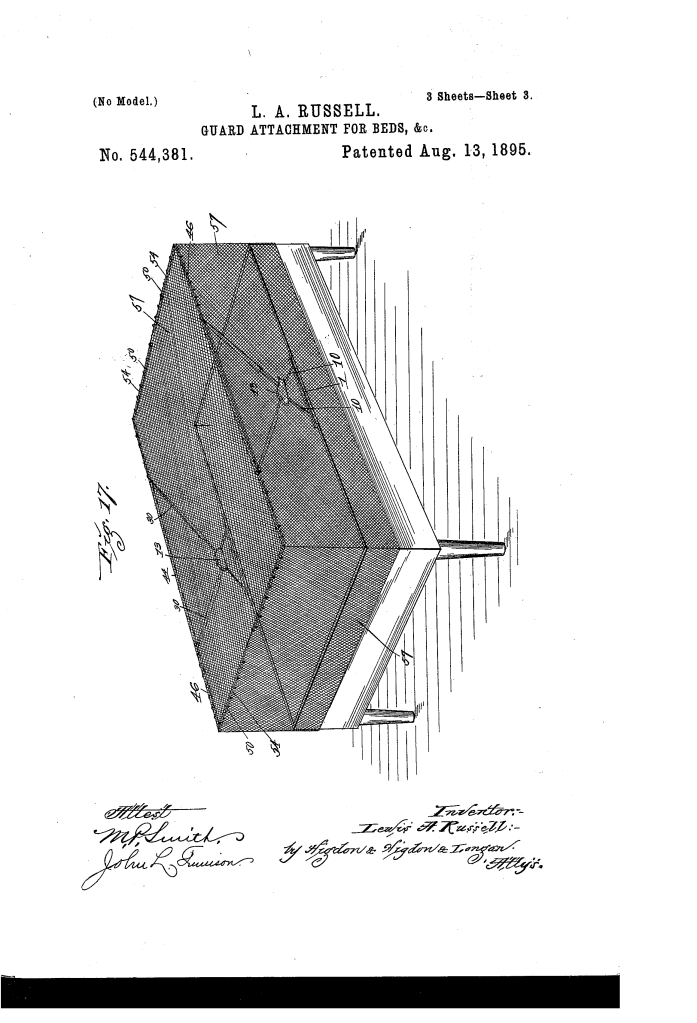
This invention solved a common 19th-century nuisance and safety concern. Before widespread window screening and modern climate controls, infant safety and insect protection required bulky, rigid, and stationary frames. Russell developed a highly adjustable, telescoping mechanics system that could be easily collapsed entirely out of the way when not in use, or extended to wrap around a bed or carriage to keep children from falling out while excluding mosquitoes and other insects.
The Core Design: The Telescoping Frame and Casing
The brilliance of Russell’s apparatus is its mechanical versatility. It relies on an adjustable base and a pivoting casing containing an intricate arrangement of spring-loaded arms and triggers that lock into place, allowing the guard to expand both vertically and horizontally.
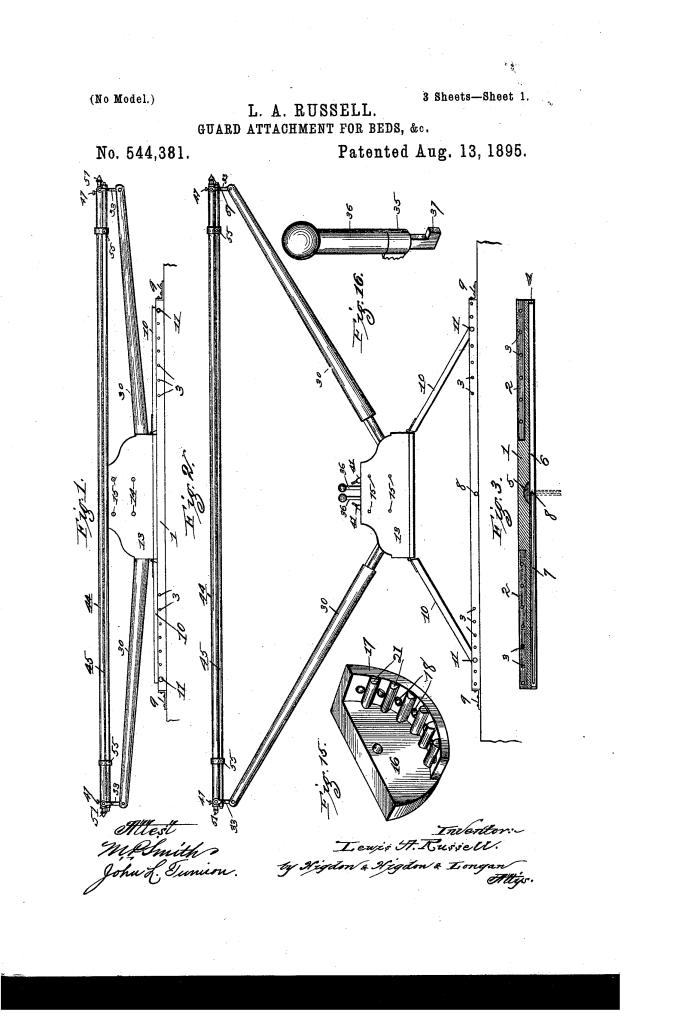
- The Elevating Casing (12)The structural core is an L-shaped casing that houses the internal spring mechanics and guide tracks. This casing is connected to a base-bar by adjustable bars, meaning the entire system can be raised or lowered to match the height of different beds or cots.
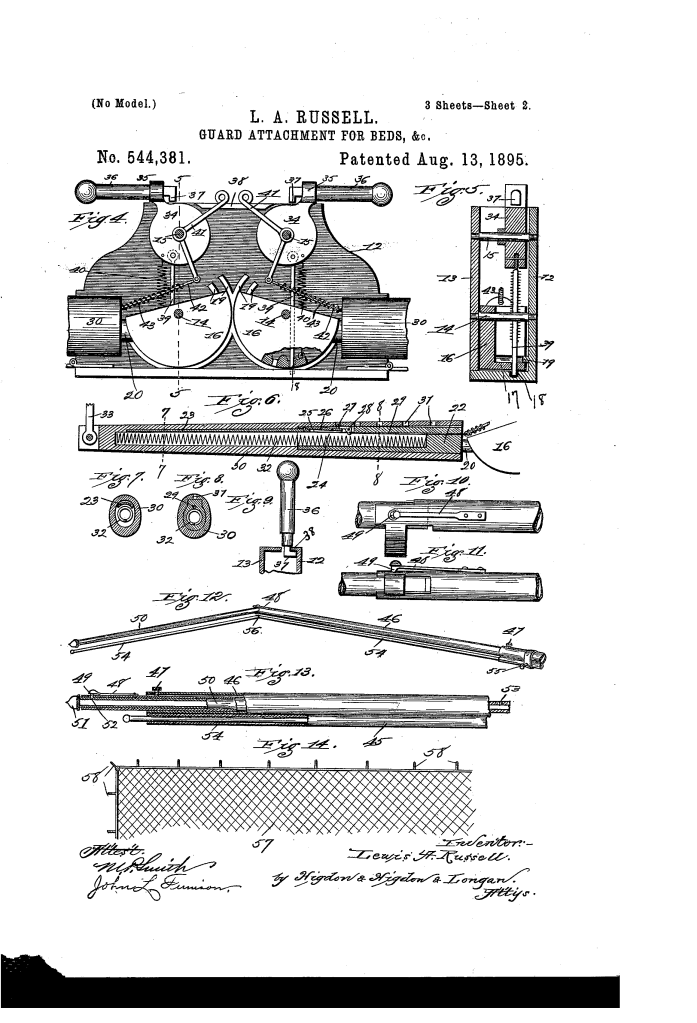
- The Spring-Loaded Telescoping Arms (22, 30)To project the frame outward, Russell used a set of hollow main arms that slide over inner guides. Internal coil springs push the outer arms forward automatically once a series of external levers or bell-crank triggers release the safety catches.
How the Apparatus Functions
The deployment process follows a strict mechanical sequence to smoothly transition the guard from storage to full protection:
| Step | Action | Safety & Practical Purpose |
| 1. Elevation | The operator removes locking pins from the base-bar and slides the main bars inward to raise the casing to the required height. | Adapts the structural height of the guard to the specific bed or carriage being used. |
| 2. Rotation | The main arms are swung upwardly into a vertical plane, and a set of rotating catches lock into the casing flange. | Establishes the rigid vertical upright pillars needed to suspend the protective net or screen. |
| 3. Extension | The operator pulls external bell-crank triggers to release internal spring catches, allowing coil springs to push the hollow arms outward. | Projects the framing structure outward to create the upper overhead perimeter. |
| 4. Perimeter Framing | Extension tubes and jointed rods are pulled from the main assembly and turned at a 90-degree angle. | Allows the frame to extend partially across the head and foot of the bed for wrap-around coverage. |
Technical Components
- Base-Bar (1): The foundation piece that clips or straps directly onto the side rail of the bedstead or carriage frame. It features longitudinal grooves and apertures for step-by-step height adjustments.
- Bell-Crank Triggers (28, 41): Mechanical linkages that allow the operator to disengage internal hidden spring-latches effortlessly from a single external control point.
- Jointed Rods (54) & Net (57): A specialized three-section rod system featuring integrated hinge joints. This allows a heavy-duty safety net (to prevent falls) or fine mesh (for insect defense) to slide cleanly around the corners of the furniture.
- Slotted Stabilizing Rods (6): Hidden safety bars on the under-carriage that can slide outward to act as outriggers, preventing lightweight assemblies like baby carriages from accidentally overturning when the guard is deployed.
Historical and Scientific Impact
Lewis A. Russell’s design was a remarkably sophisticated example of late 19th-century consumer engineering, focusing heavily on space-saving utility and safety.
- Industrial Ergonomics: At a time when home apparatuses were typically fixed and heavy, Russell’s reliance on spring-assisted extension and telescoping components foreshadowed modern adjustable consumer goods and medical bed designs.
- Public Health and Child Safety: By creating a dual-purpose frame capable of handling both coarse safety netting and fine mesh, the device simultaneously addressed infant mortality risks linked to falls from high cots and insect-borne illnesses.
- Mechanical Efficiency: The use of independent, multi-directional telescoping tracks allowed a massive 3D enclosure canopy to collapse entirely into a compact, flat profile flush against the side rail of a bed when out of use.
About the Inventor: Lewis A. Russell
Lewis A. Russell was an innovative African American inventor operating out of St. Louis, Missouri during the post-Reconstruction era of American industrial expansion.
- The Era of Black Ingenuity: Russell’s work in the 1890s placed him among a vital wave of Black inventors who successfully navigated the strict patent application system to secure legal intellectual property rights for their mechanical breakthroughs.
- Focus on Practical Architecture: Operating out of a major Midwestern logistics hub, Russell focused his creative talents on refining everyday domestic mechanisms, proving that high-efficiency mechanical engineering could be effectively integrated into standard household furniture.
Summary of Claims
The patent explicitly claims:
- A guard attachment featuring an adjustable base-bar, an elevating casing, operating arms, and a system of telescoping interior tubes.
- The combination of a main structural tube with a secondary lower tube housing multi-section sliding rods.
- The inclusion of specialized slotted outrigger bars on the underside of the base-bar designed to prevent structural overturning.
