
Guard Attachment for Beds, Cots, &c. (Lewis A. Russell, No. 544,381)
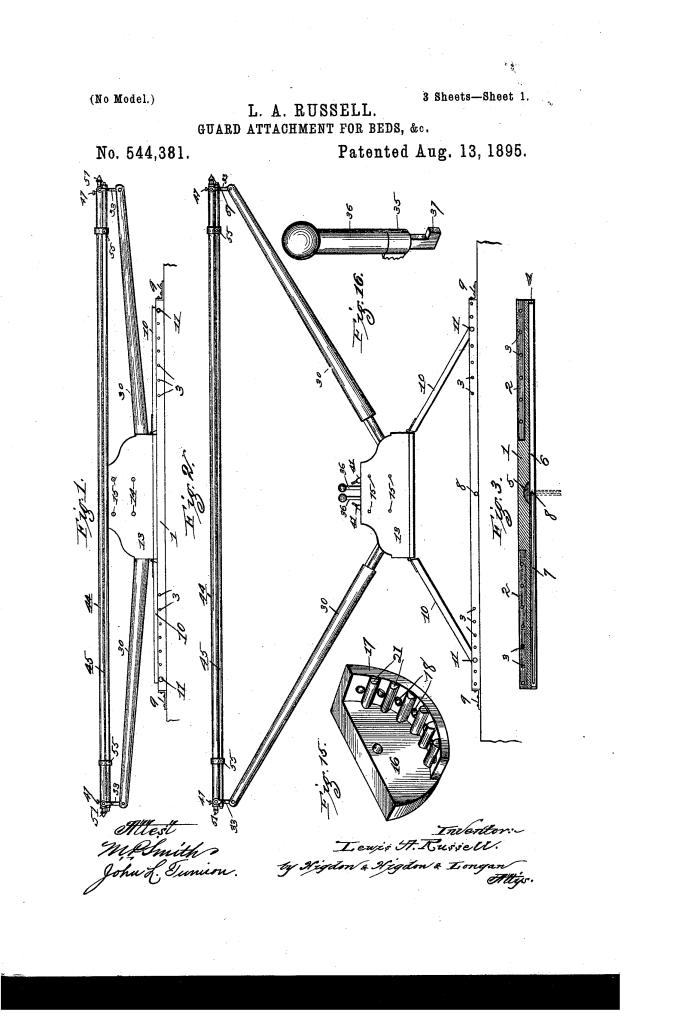
The patent by Lewis A. Russell of St. Louis, Missouri, describes a Guard Attachment for Beds, Cots, Baby-Carriages, &c. The invention is a complex, adjustable frame designed to support a net, which can serve to prevent a child or person from falling out, or to exclude insects like mosquitoes. The device is designed to be easily and expeditiously opened and closed to be thrown into or out of use.
Invention and Mechanism
The attachment is a multi-stage, telescoping, and hinged support frame that can be extended over the entire bed or carriage. A pair of these attachments is used, one for each side of the bed.
1. Base and Elevation
- Base-Bar (1): A bar (wood or metal) that straps onto the edge of the bed or cot.
- Movable Bars (10): These bars slide in grooves (2) in the base-bar (1).
- Function: By sliding the bars (10) toward the center and fixing them with pins (11), the casing (12) is elevated from the bed, bringing the attachment into its ready position.
- Anti-Tipping Rods (6): Slotted rods housed in the underside of the base-bar. When attached to a baby-carriage, these rods can be slid out and thrown into vertical planes to prevent the carriage from being overturned.
2. Main Support Arms and Extension
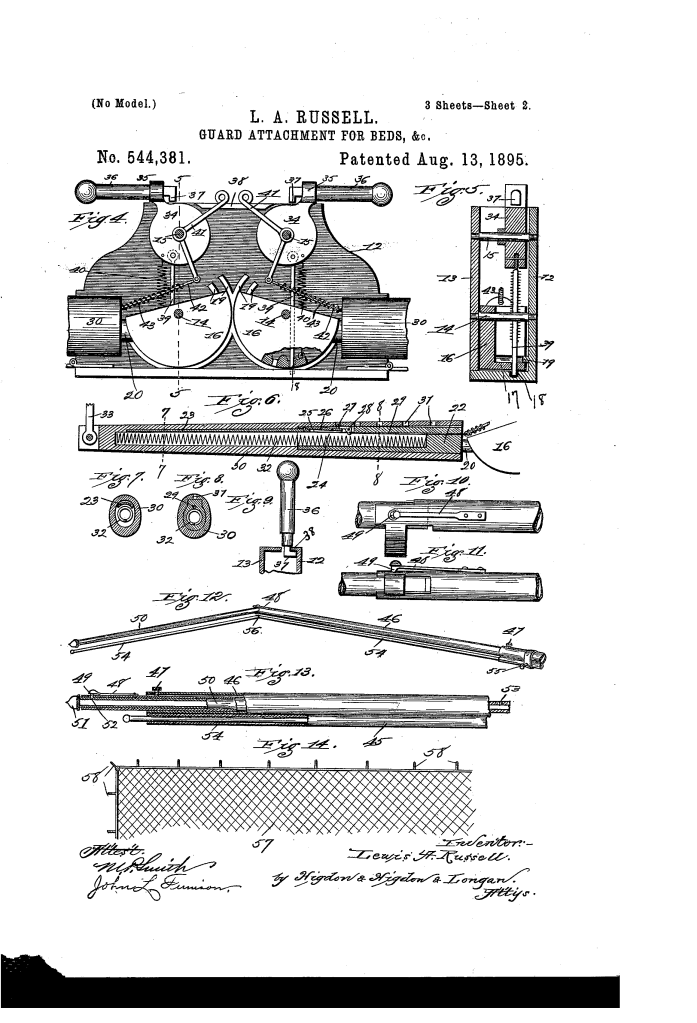
- Casing (12): An L-shaped casing that houses the main operating mechanisms.
- Vertical/Main Arms (14): Arms that swing up from the casing (12) and are held in vertical positions by engaging catches (36) under a flange (38).
- Telescoping Arms (30, 22): The main arms (14) contain mechanisms that propel hollow arms (30) outward over inner arms (22).
- Latch System: The arms are held in place by spring-catches (26) that engage a series of apertures (31) and are released by bell-crank triggers (28), which are pulled by rods (29, 42) connected to bell-cranks (41) in the casing.
- Propulsion: When the catches are released, expansive coil-springs (32) force the hollow arms (30) outward, quickly extending the support.
3. Final Extension and Net Hanging
- Main Tube (44): A tube whose ends are pivotally connected to the outer ends of the arms (30).
- Telescoping Tubes (46, 50): A series of tubes that telescope out from the ends of the main tube (44).
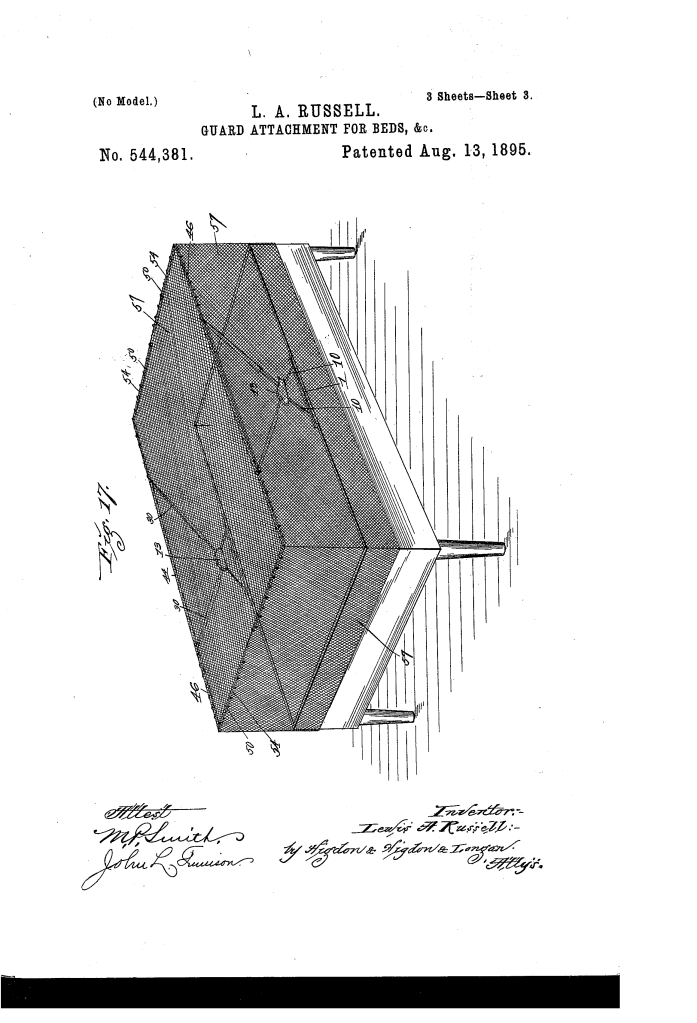
- Swivel Function: The outermost tubes (50) have spring-catches (48) that allow them to be locked and then turned at right angles to the tubes (46), enabling the frame to extend partially across the foot and head of the bed (see Fig. 17).
- Jointed Rods (54) and Net (57): Removably fixed to the frame are jointed rods (54) that can be swung on hinges (56).
- Function: The net (57) is hung upon these rods (54), which extend around and over the top of the bed or carriage, completing the guard enclosure.
Historical Significance and the Inventor
Lewis A. Russell’s 1895 patent reflects the 19th-century focus on both domestic safety and health, especially for infants and children.
- Child Safety: The primary market for such an apparatus would have been safety for young children, preventing falls from beds or cribs, a necessity in the Victorian-era home.
- Health and Comfort (Mosquitoes): The ability to use the attachment to support a fine-mesh net to “exclude mosquitoes and other noxious insects” was a significant health feature, particularly in an era where insect-borne diseases were poorly understood but common.
- Mechanical Complexity: The attachment is an example of the late 19th-century tendency to solve complex problems (full-perimeter, adjustable enclosure) using elaborate mechanical linkage and telescoping parts. The sheer number of hinges, catches, springs, and rods reflects high ambition for functionality in a single, consumer product.
Core Concepts Utilized Today
The attachment’s design principles—quick deployment, multi-stage extension, and secure locking—are fundamental to modern portable gear.
- Quick-Release Telescoping Systems: The use of spring-propelled telescoping tubes (30, 50) released by bell-crank triggers (28) is a complex precursor to modern push-button or cam-lever quick-release mechanisms used in everything from camera tripods and lighting stands to camping tent poles, where rapid deployment is essential.
- Convertible/Modular Enclosures: The design that allows the frame to be swiveled and extended (tubes 50 and rods 54) to create a full perimeter enclosure is reflected in modern convertible cribs, portable playpens, and specialized insect netting systems that adapt to different mattress sizes or serve dual functions (crib and play area).
- Integrated Safety/Stabilization: The inclusion of the anti-tipping rods (6) on the base-bar demonstrates the principle of integrating the safety system directly into the main support structure, a feature common in modern car-seat bases and stabilizing feet for tall, narrow furniture.
