

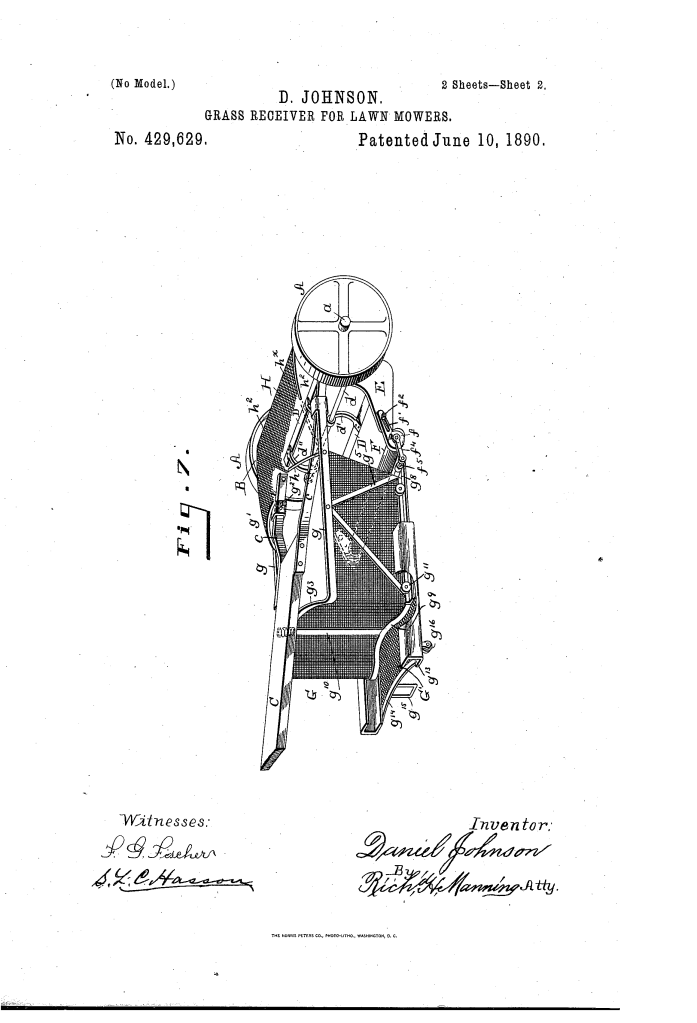
Grass Receiver for Lawn Mowers (1890)
U.S. Patent No. 429,629, granted on June 10, 1890, to Daniel Johnson, introduces an improved attachment for the common lawn mower: a rear-mounted grass catcher. While lawn mowers were becoming more common in the late 19th century, they often left clippings scattered across the turf to decay.
Daniel Johnson, an inventor based in Kansas City, Missouri, sought to refine the “grass receiver” by making it more stable, adjustable, and easier to empty. His design focused on balancing the weight of the clippings so the mower remained easy to maneuver, even when the basket was full.
The Innovation: Suspension and Stability
The primary problem with early grass catchers was their tendency to make the mower “tippy” or difficult to push. Johnson’s patent solved this through a sophisticated suspension system that distributed weight between the mower’s handle and the rear roller.
1. The “Spring-Loaded” Support
Johnson added a coiled spring (g¹⁵) that connected the rear of the receiver directly to the mower handle. This acted as a shock absorber and weight-distributor, preventing the weight of the grass from dragging the back of the receiver along the ground.
2. The Foot-Stirrup Dump System
One of the most practical features was the sliding bottom (G¹). Instead of detaching the whole heavy unit to empty it, the operator could simply use the foot-stirrup (g¹³).
- By placing a foot in the stirrup and pulling the mower back, the bottom would slide open on frictionless rollers (g⁹).
- The grass would drop neatly in a pile, allowing the operator to continue without bending over.
How the Apparatus Functions
The receiver was designed to work in harmony with the mechanical action of the mower:
- Collection: As the mower is pushed, the rotary cutters (D) throw grass particles rearward and upward.
- Containment: A hinged wire shield (H) sits over the cutters. This prevents wind from blowing the clippings away and funnels them directly into the mouth of the receiver.
- Adjustment: Using thumb-screws (g⁴), the operator could adjust the height of the receiver to match the height of the grass being cut, ensuring a tight fit against the mower frame.
Key Technical Components
The assembly utilized lightweight but durable materials to keep the mower portable:
| Component | Function |
| Woven-Wire Netting (g⁸) | The primary material for the basket; allowed air to flow through while trapping grass. |
| Angle-Plates (g⁷) | Provided the structural “skeleton” of the receiver and served as tracks for the sliding bottom. |
| U-Shaped Guides (g¹⁰) | Mounted on the sliding bottom to ensure it stayed aligned with the rollers during dumping. |
| Feed-Roller Brackets (f) | Provided the lower mounting point, connecting the receiver to the mower’s rear axle. |
| Transverse Support (g⁵) | A curved metal strip that rested across the mower handle to keep the basket centered. |
Historical Context
Daniel Johnson’s work represents the “Golden Age” of American mechanical innovation. During this period, inventors were focused on refining tools for the growing middle class and their suburban landscapes.
- Labor Saving: Before these attachments, “manicured” lawns required a two-step process: mowing and then manual raking. Johnson’s invention integrated these into a single motion.
- Design for Durability: The use of “haloethylenic” materials (like the Teflon in later patents) didn’t exist yet; instead, Johnson relied on clever geometry and high-quality wire-work to ensure the receiver didn’t rust out or collapse under the weight of wet grass.
About the Inventor: Daniel Johnson
Daniel Johnson was a resident of Kansas City, Missouri. This 1890 patent was an improvement on a previous design he had filed in 1887, showing a persistent dedication to perfecting the mechanics of yard maintenance. His focus on “frictionless” movement—using rollers and precisely machined guides—mirrored the industrial advancements of the railroad and bicycle industries of the same era.
Summary of Claims
The patent explicitly claims:
- A grass-receiver with an adjustable upper portion attached to the forked ends of the mower handle.
- A suspension spring connecting the rear of the receiver to the handle to balance the weight of the load.
- An intermediate transverse support that prevents the receiver from swaying side-to-side during use.
- A pivotally attached shield that covers the cutters to direct the flow of grass and protect the clippings from the wind.
