

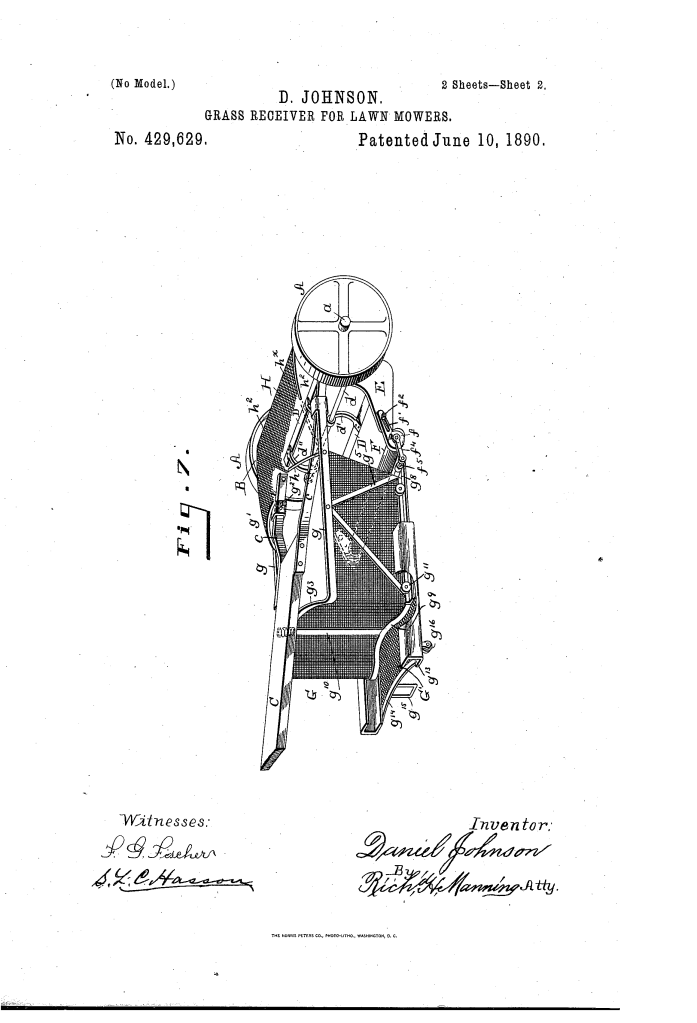
Daniel Johnson’s patent for a “Grass-Receiver for Lawn-Mowers,” No. 429,629, describes an attachment designed to collect grass clippings. The invention consisted of a wire-netting basket that could be attached to the rear of a lawnmower. It featured several key innovations: a sliding bottom for easy dumping, rollers for smooth operation, and an adjustable spring-and-bracket system that suspended the basket from the mower’s handle. This design ensured the weight of the clippings was distributed and could be adjusted for different mower types. It also included a shield to prevent grass from scattering back onto the ground.
Societal Impact
While a seemingly minor invention, Johnson’s grass receiver was part of a larger trend in the late 19th century toward more convenient and specialized domestic tools.
- Abolishing Drudgery: Before grass catchers, homeowners had to rake up clippings by hand after mowing, a time-consuming and tedious chore. Johnson’s invention mechanized this part of lawn care, making the entire process faster and less physically demanding. This was part of a broader shift toward simplifying domestic labor.
- A Growing Middle Class: The patent is a reflection of the rising American middle class. As more people owned homes with yards, the market for tools that made maintenance easier grew. Inventions like this one were a small but important part of the consumer revolution, providing new products that appealed to a desire for efficiency and convenience.
- The Inventor’s Legacy: Daniel Johnson was an African American inventor who also held a patent for a similar device in 1887. His work is another example of a Black inventor contributing to the fabric of American technological and economic life during a period of significant racial discrimination. His grass receiver, though not a world-changing invention, demonstrates the ingenuity that was applied to even the most mundane problems of everyday life. The patent, which is signed with an “X” mark, suggests he may not have been literate, making his successful navigation of the patent system a remarkable achievement and a testament to his determination.
