
Grain Refinement of Beryllium (1964)
U.S. Patent No. 3,117,001, granted on January 7, 1964, to Frank A. Crossley, introduces a metallurgical breakthrough in the production of as-cast beryllium. By using a specialized “inoculation” process, Crossley solved one of the most frustrating characteristics of the metal: its tendency to form large, brittle crystals during cooling.
At the time of this invention, Crossley was a prominent metallurgist at the IIT Research Institute (formerly the Armour Research Foundation) in Chicago. His work was instrumental in transforming beryllium from a difficult, fragile material into a viable component for high-tech industrial applications.
The Innovation: Seeded Solidification
When molten beryllium cools and solidifies naturally, it develops a coarse grain structure. These large crystals make the metal incredibly brittle and prone to structural failure. Crossley discovered that by adding specific “seeds” to the molten metal, he could force the beryllium to crystallize into much smaller, tighter grains.
The invention identifies two primary inoculants that act as these crystal seeds:
- Tungsten Carbide (WC)
- Titanium Diboride ($TiB_2$)
Why Inoculation Works
The process relies on a phenomenon called heterogeneous nucleation. For the seeds to work, they must meet two strict criteria:
- Wettability: The molten beryllium must be able to “wet” or coat the particles rather than bead up and ignore them.
- Insolubility: The particles must not dissolve completely. Crossley specified using powders of approximately -300 mesh. If the powder is too fine, it dissolves into the melt; if it remains solid, it acts as a platform for beryllium crystals to grow.
Key Components & Composition
The patent outlines a specific ratio to achieve the desired metallurgical properties:
| Component | Proportion (by weight) | Function |
| Beryllium | Balance (approx. 97%–99.9%) | The base structural metal. |
| Tungsten Carbide | 0.1% to 3.0% | Acts as a nucleation “seed” to produce fine grains. |
| Titanium Diboride | 0.1% to 3.0% | Alternative seed; can be used alone or mixed with WC. |
| Particulate Size | ~300 Mesh | Ensures the seeds stay solid enough to facilitate crystal growth. |
Performance: Strength Through Microstructure
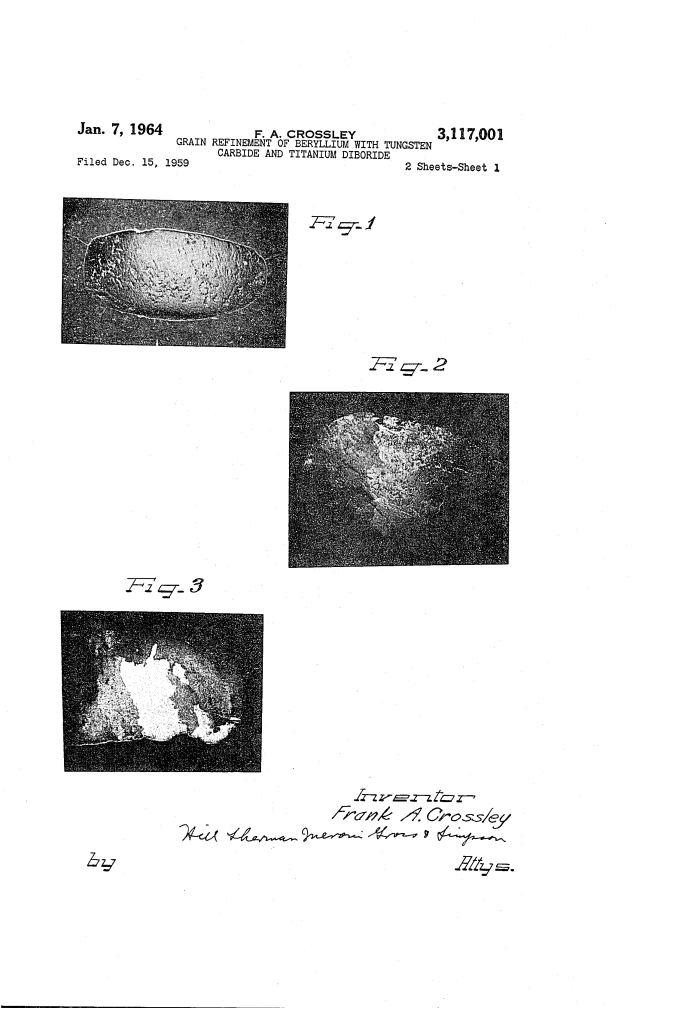
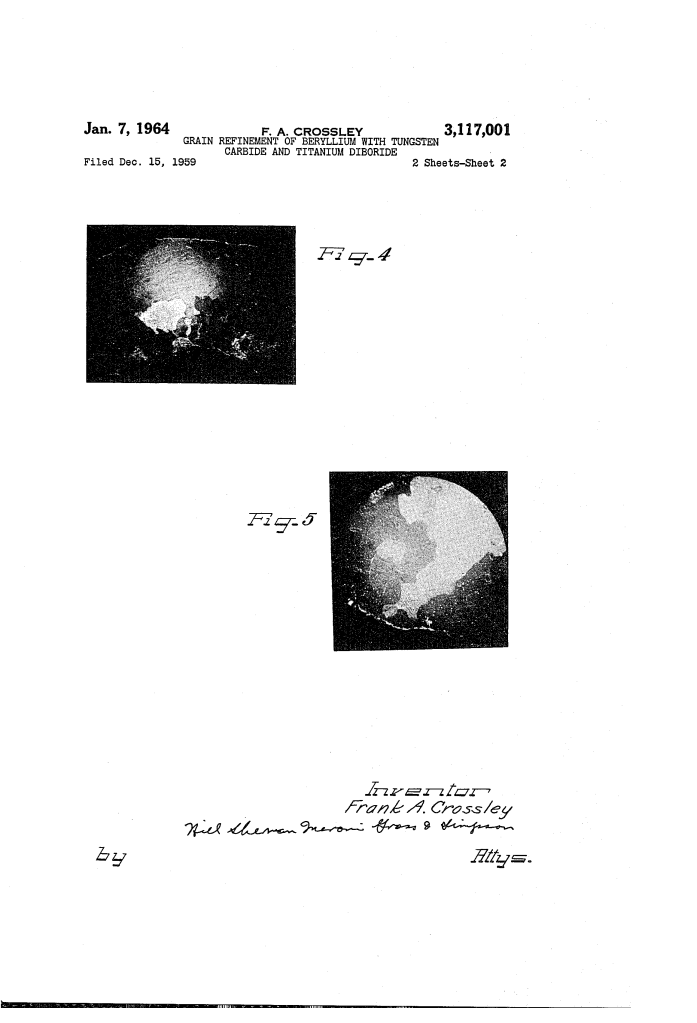
The primary evidence for this invention’s success was visual and structural. Under polarized light, unalloyed beryllium shows massive, jagged grains. In contrast, the inoculated beryllium displays a significantly refined, dense surface.
- Standard Beryllium: Characterized by “coarseness of grains,” which is a direct indicator of poor physical properties and high brittleness.
- Crossley’s Beryllium: Exhibits “exceptionally fine grain structure,” leading to improved ductility and strength.
Technical Note: Crossley’s patent includes photographic evidence (Figures 1–5) showing the dramatic shift in grain size at 5.5X and 25X magnification, proving that the seeds successfully “refined” the metal at the point of contact.
The Manufacturing Process
Crossley detailed several methods for introducing the inoculants into the beryllium:
- The Button Method: Consolidating beryllium pieces into a “button” via resistance melting, then placing that button atop the inoculant powder and remelting it.
- The Mold Lining Method: Coating the inside of a casting mold with the inoculant powder before pouring the molten beryllium.
- Direct Addition: Adding the particulate directly to the melt prior to the solidification phase.
About the Inventor: Frank A. Crossley
Frank Alphonso Crossley was a pioneer in titanium and beryllium metallurgy and one of the first African Americans to earn a Ph.D. in metallurgical engineering (Illinois Institute of Technology, 1950).
- Career: Much of his career was spent at the IIT Research Institute and later at Lockheed Missiles & Space Company.
- Specialization: He was a world-renowned expert in titanium alloys, holding numerous patents that improved the materials used in aerospace and aircraft engines.
- Legacy: Crossley was a tireless advocate for minority representation in the sciences and was posthumously recognized for his contributions to the “Titanium Age.” His work on grain refinement helped pave the way for beryllium’s use in everything from X-ray windows to aerospace heat shields.
Summary of Claims
The patent explicitly protects:
- A composition of beryllium containing 0.1% to 3% by weight of tungsten carbide or titanium diboride.
- The process of producing fine-grain as-cast beryllium by adding these specific materials to the molten state.
- The use of particulate seeds to act as nucleation points during the cooling process.
