

Grain Binder (1892)
U.S. Patent No. 469,279, granted on February 23, 1892, to Peter D. Smith of Springfield, Ohio, describes an automated machine designed to solve one of the most labor-intensive tasks of 19th-century farming: binding cut grain into organized sheaves.
While later binders used twine, Smith’s innovation was a self-contained system that literally manufactured its own “binding rope” out of the grain it was harvesting. This eliminated the need for external binding materials and allowed for a continuous, automated workflow from the moment the grain was cut until the completed sheaf was ejected.
The Innovation: The “Self-Made” Straw Rope
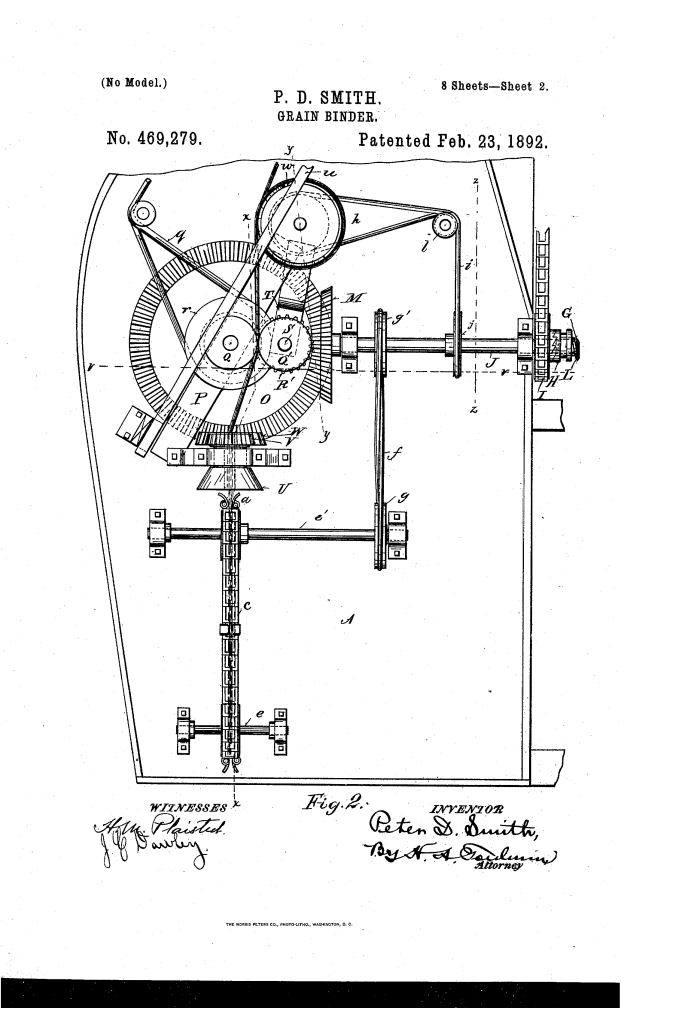
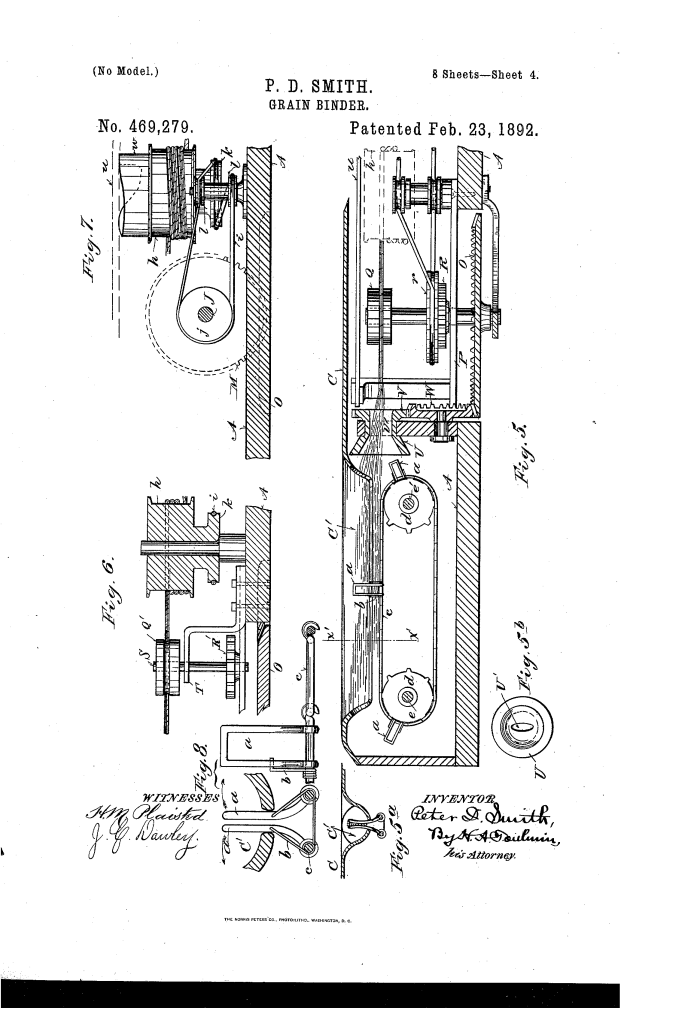
The most striking feature of Smith’s design is the Twister (U). Instead of using pre-purchased string, the machine harvests a “wisp” of the incoming grain and processes it into a functional cord.
- Clamping Mechanism: Spring-loaded clamps (a) mounted on a carrier belt travel through an inclined slot in the platform. The narrowing edges of the slot force the clamps shut, grabbing a stream of grain.
- The Twister: This grain is fed into a rotating, dish-faced piece with an elliptical opening. As the grain passes through, it is twisted into a tight, durable rope.
- The Measuring Drum: The rope is wound around a drum (h) that measures the exact length needed for a single sheaf before a knife (w) severs it.
How the Apparatus Functions
The machine operates in a synchronized cycle, coordinating the harvest with the binding mechanism:
| Step | Action | Purpose |
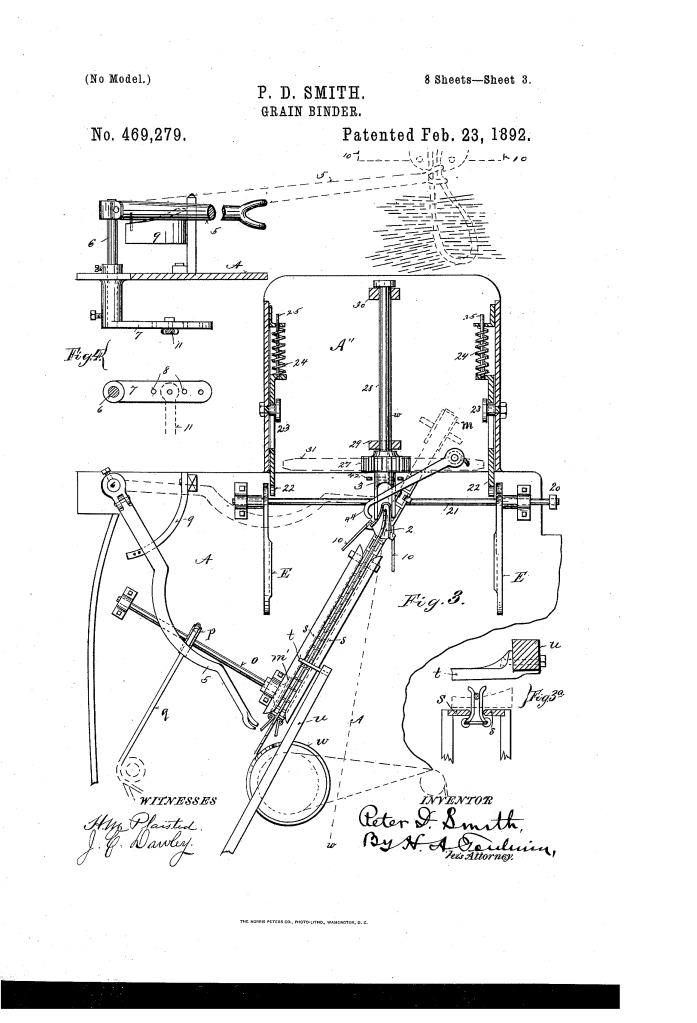
| 1. Collection | A drop-rake (D) sweeps cut grain into packing or “crook” arms (E). | Gathers the loose grain into a dense sheaf shape. |
| 2. Encirclement | A carrier arm (5) engages the rear end of the severed straw rope and brings it around the sheaf. | Positions both ends of the binding rope into the knotter. |
| 3. Compression | The crook arms press the grain against spring-loaded “yieldable abutments” (22). | Ensures a tight bind without breaking the machine if the sheaf is unusually large. |
| 4. Knotting | The Knotter-Fork (3) rotates to coil the rope ends together. | Creates a secure, mechanical twist-knot. |
| 5. Ejection | A “tucker” (49) pins the knot into the sheaf as the arms release. | Clears the machine for the next cycle and drops the bound sheaf. |
Key Mechanical Components
- Yieldable Abutments (22): These are spring-backed slides that act as a “safety valve.” If the machine gathers a very thick bundle of grain, these slides move backward to prevent the metal packing arms from snapping under the pressure.
- Heart-Shaped Cam (17): A specialized timing gear that converts the continuous rotation of the master wheel into the specific, intermittent “back and forth” motion required to move the carrier arms.
- The Knotter-Fork (3): A four-pronged rotating head that captures the two ends of the straw rope and twists them into a coil.
Historical and Industrial Impact
Peter D. Smith’s invention represented a bridge between manual labor and the fully mechanized “combine” era.
- Resource Efficiency: By using the crop itself as the binding agent, farmers saved significant money on twine and wire (which was often dangerous if accidentally eaten by livestock).
- Precision Timing: The use of the Active Oxygen Method (comparatively, in the mechanical sense) of timing via the master wheel meant the machine could handle varying speeds of the horse-drawn reaper without losing its rhythm.
- Reliability: The inclusion of “yielding” parts allowed the machine to work in fields with inconsistent crop density, making it practical for real-world agricultural conditions.
About the Inventor: Peter D. Smith
Residing in Springfield, Ohio, Peter D. Smith was part of a vibrant community of Midwestern inventors during the “Golden Age” of agricultural patenting. Springfield was a major hub for the manufacture of reapers and farm implements (home to companies like Champion Reaper), and Smith’s work on the Grain Binder contributed to the city’s reputation as the “Agricultural Implement Capital of the World.”
Summary of Claims
The patent explicitly covers:
- A platform with a slotted opening that uses mechanical geometry to close clamps on grain.
- A revoluble twister with a flattened opening to create rope from raw straw.
- The combination of a measuring drum and cutting knife to automate band length.
- The spring-shifter and tucker mechanism that secures the knot and ejects the sheaf using the machine’s return-stroke energy.
