

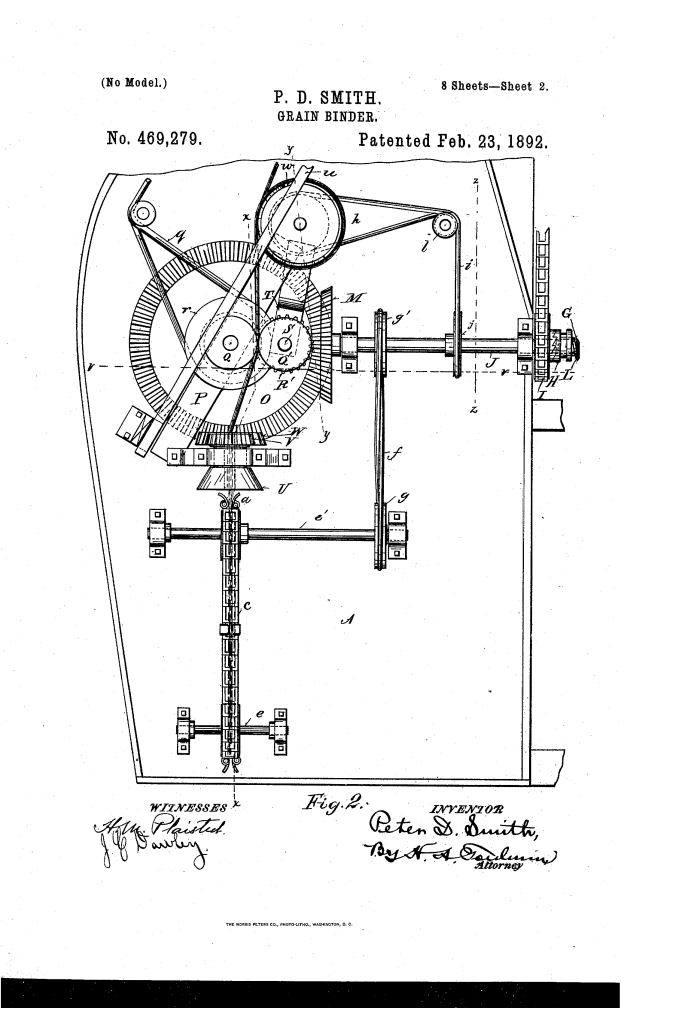
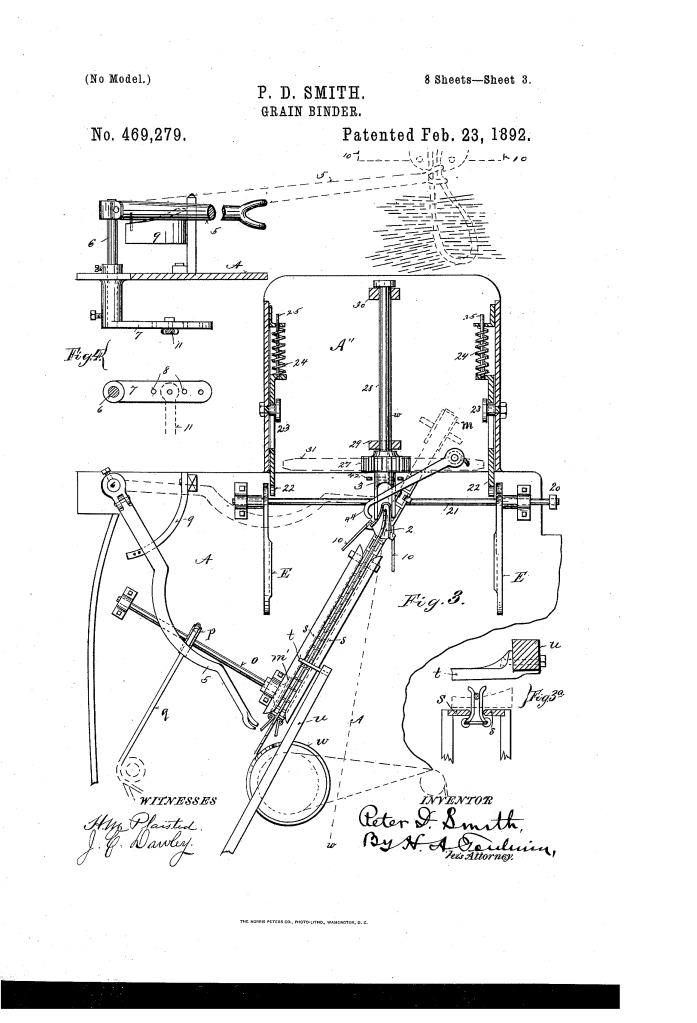
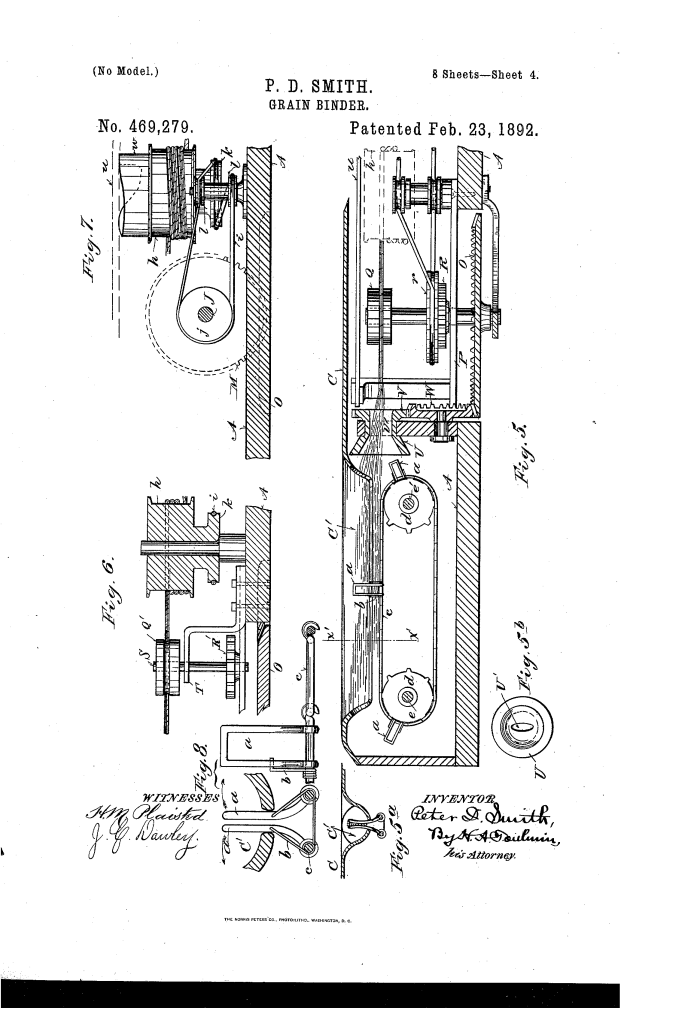
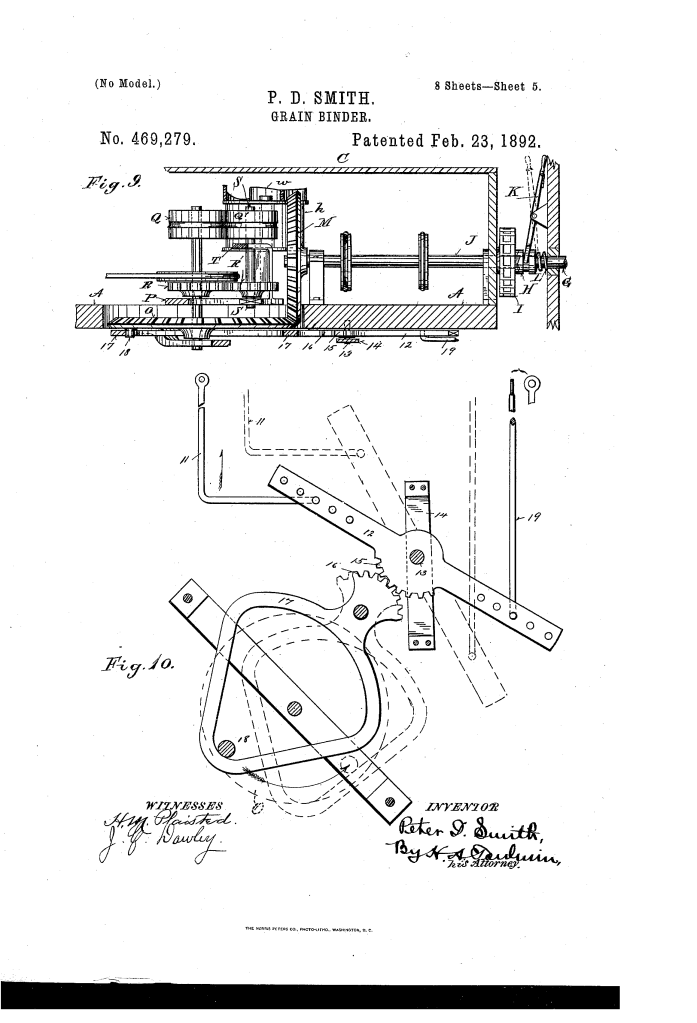

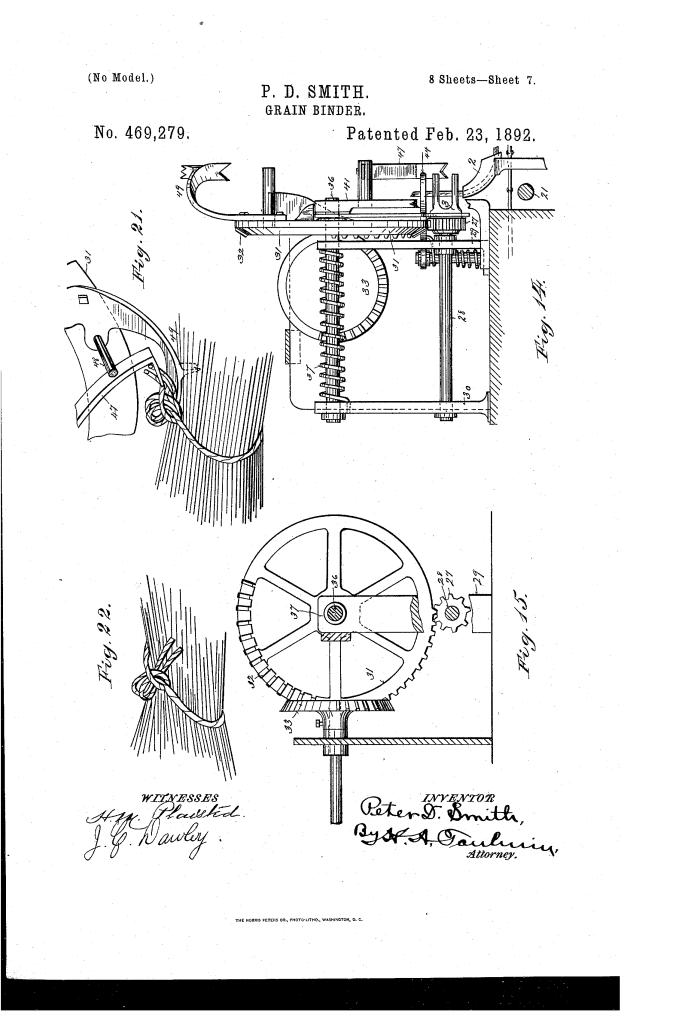
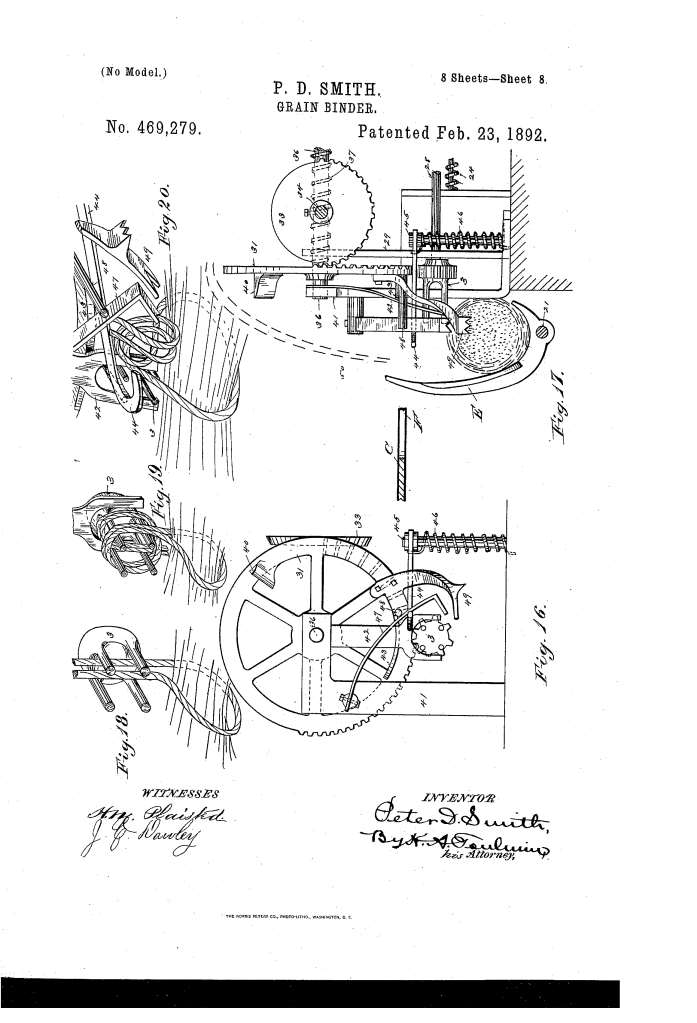
Peter D. Smith’s patent for a Grain Binder, No. 469,279, describes a highly complex and innovative machine designed to streamline the grain harvesting process. Patented on February 23, 1892, this invention was a major step in the mechanization of agriculture. Unlike previous binders that used twine, Smith’s machine created a binding rope directly from the grain itself.
The machine’s intricate, multi-step process was entirely automated:
- Rope-Making: A series of clamps on a conveyor belt would collect a wisp of cut grain and feed it into a “twister”—a revolving piece with a flattened opening that twisted the grain into a continuous rope.
- Measuring and Cutting: This grain rope was then drawn onto a winding “measuring drum,” which would spool out a precise length for a single sheaf. A cutting mechanism would then sever the rope at the correct length.
- Sheaf Formation: A drop-rake would periodically sweep the harvested grain onto packing arms, which compressed the grain into a sheaf. These arms had “yielding abutments” that could slide back, preventing the arms from breaking if a particularly large sheaf was collected.
- Knotting: A swing-arm would then carry the back end of the grain rope to a knotter-fork. The fork would twist the two ends together and a series of cams, hooks, and a “tucker” would complete the knot. Once the knot was tied, the sheaf would expand, tightening the knot and causing a barbed hook to eject the bound sheaf from the machine.
Societal Impact and Legacy
Smith’s grain binder was a powerful example of the kind of innovation that transformed American agriculture in the late 19th century.
- Revolutionizing Agriculture: The invention was a major improvement over manual labor, which was slow and physically demanding. By automating the entire process of cutting, binding, and ejecting grain, it drastically increased the speed and efficiency of the harvest, allowing farmers to cultivate larger tracts of land with less labor.
- The Rise of “Big Agriculture”: The invention of machines like this one was a key factor in the development of large-scale, commercial farming. It helped turn agriculture into a mechanized industry, contributing to a more abundant and reliable food supply for a rapidly growing nation.
- The Inventor’s Legacy: The patent record for Peter D. Smith does not contain information about his life beyond his residence in Springfield, Ohio. However, his work stands as an example of the thousands of inventors who created devices that, while not household names, were foundational to America’s industrial and agricultural dominance.
