
Gong and Signal Chair (Miriam E. Benjamin, No. 386,289)
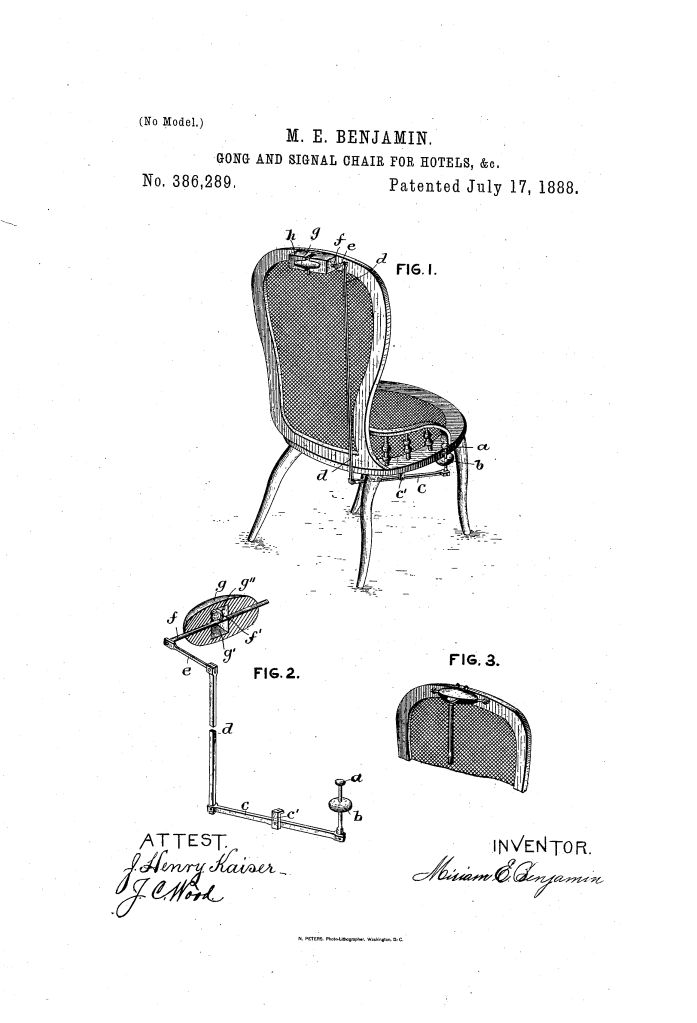
The patent by Miriam E. Benjamin of Washington, D.C., describes a Gong and Signal Chair for Hotels, Restaurants, etc. (Patent No. 386,289, 1888). This invention is a mechanical notification system integrated into furniture, allowing a guest to discreetly summon an attendant. Benjamin’s primary objective was to increase efficiency in hospitality and deliberative settings (like Congress) by reducing the number of staff required. Her innovation provided a dual notification: an audible gong and a visual ball signal, eliminating the need for unseemly hand-clapping or shouting.+1
Inventor Background: Miriam E. Benjamin
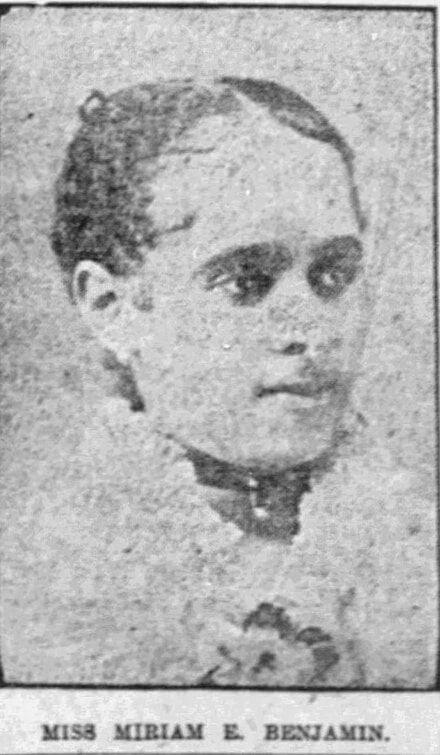
Miriam E. Benjamin (1861–1947) was a pioneering African American inventor and educator. She was only the second Black woman to receive a U.S. patent. Living in the nation’s capital, she observed the chaotic “page” system in the halls of Congress and the labor-intensive service in hotels. Her invention was a sophisticated response to the “waiter problem,” where she calculated that her system could reduce staff requirements from one waiter per three guests to one per fifteen. Her engineering mind sought to balance high-society etiquette with industrial efficiency.
Key Mechanical Systems & Components
The chair utilizes a series of connected levers to translate a vertical push into a rotational display.
1. The Actuation System (b, c, c’)
- The Push-Button Gong (b): A gong attached to the side of the seat features a vertical rod with a knob.
- The Fulcrum Lever (c): The vertical rod presses onto a horizontal lever (c) which is pivoted on a bridge (c’) beneath the seat.
- Function: This acts as a first-class lever. When the guest pushes the button down, the far end of the lever moves upward, initiating the signal chain.
2. The Transmission Linkage (d, e, f)
- Connecting Rod (d): A vertical rod runs up the back of the chair, connected to the lever via a hinge.
- The Crank (e) and Rock-Shaft (f): The top of rod d is joined to a crank (e), which is fixed to a horizontal rock-shaft (f) at the top of the chair.
- Function: This converts the upward linear motion of the rod into a rotational movement of the shaft.
3. The Visual Signal (g, h, j) (Key Innovation)
- The Signal Ball (g): A ball (or disc) serves as the visual indicator, housed within a metal plate (h) with an opening.
- The Hook (j): An outwardly curved hook on the axle (f) holds the ball.
- Action: When the shaft rotates, the hook throws the ball forward. One side of the ball is colored (typically red) and the other is dark. The rotation hides the dark side and displays the red signal to the waiter.
Improvements Over Standard Service Methods
| Feature | Standard 1880s Service | Benjamin’s Signal Chair |
| Summoning Method | Shouting, hand-clapping, or rapping tables. | Silent visual signal and a discreet gong. |
| Labor Efficiency | 1 waiter per 3–4 guests. | 1 waiter per 12–15 guests. |
| Guest Comfort | Noisy and disruptive. | Adds convenience and maintains etiquette. |
| Versatility | Limited to fixed dining rooms. | Can be used on revolving chairs, desks, or for hospital invalids. |
Significance to Engineering and Modern Life
Miriam E. Benjamin’s signal chair influenced the development of remote service indicators and human-machine interfaces.
- The Flight Attendant Call Button: The fundamental logic of Benjamin’s invention—a localized button that triggers a visual “latched” signal for a centralized attendant—is exactly how modern airplane call buttons work today.
- Mechanical Logic Chains: The use of a lever-crank-shaft sequence to change the state of a display is a foundational concept in mechanical instrumentation and early automation.
- Ergonomics: Benjamin’s note that the rod could be lengthened to elevate the signal, or placed near the floor for foot operation, shows an early understanding of universal design (accessibility for those who cannot use their hands).
- Industrial Efficiency: Her focus on reducing overhead costs through technological assistance is a cornerstone of modern Service Engineering.
