
Gas Well Sulfur Removal by Diffusion Through Polymeric Membranes (1970)
U.S. Patent No. 3,534,528, granted on October 20, 1970, to James H. Porter of Boston, Massachusetts (assigned to Abcor, Inc., of Cambridge, Massachusetts), describes a membrane-based gas separation method for removing toxic, corrosive hydrogen sulfide from high-pressure “sour” natural gas wells. Across North America and worldwide, vast reserves of natural gas remained capped and unproduced because they contained between 2% and 40% hydrogen sulfide. Conventional chemical scrubbing required feeding roughly 2.9 moles of monoethanolamine (MEA) for every mole of hydrogen sulfide removed—making high-sulfur wells prohibitively expensive to operate. Meanwhile, prior membrane gas separation concepts suffered from the enormous energy cost of mechanically compressing feed gas to create a pressure gradient across a polymer film. Porter solved both economic barriers simultaneously by harnessing the natural reservoir pressure of the gas well itself (typically 500 to 17,000 pounds per square inch) to drive hydrogen sulfide selectively through bundles of microscopic hollow silicone-copolymer fibers.
The Core Design: Reservoir-Powered Hollow-Fiber Permeation
The brilliance of Porter’s system lies in pairing shell-and-tube capillary membrane geometry with free geological wellhead pressure to separate sour gas streams without energy-intensive compressors or massive chemical scrubbers.
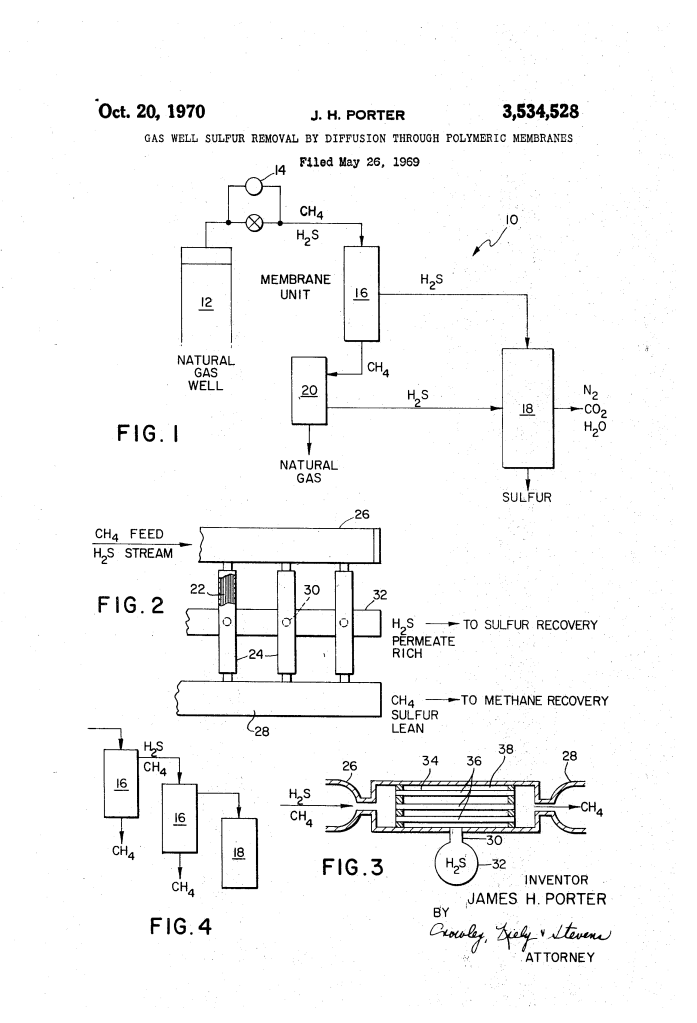
- Free Reservoir Pressure Gradient (12, 14) Rather than burning fuel to run high-pressure gas compressors, the system taps directly into a capped high-pressure natural gas well (12). A pressure-reducing valve (14) steps down and stabilizes the raw reservoir pressure—such as regulating a 3,000 psi well down to a steady 2,000 psi operating feed pressure—providing the exact partial-pressure (activity) gradient needed to push hydrogen sulfide across the polymer barrier at virtually zero compression cost.
- Microscopic Hollow Capillary Fiber Bundles (22, 34) Inside the membrane permeation unit (16), bundles (22) containing tens of thousands of hollow silicone-copolymer capillary fibers (34)—such as polydimethylsiloxane—are potted at both ends inside parallel pressure tubes (24). Each individual fiber measures roughly 4 feet long with an inside diameter of about 1 mil (0.001 inch) and an outside diameter of about 2 mils (0.002 inch). Compared to flat membrane sheets, these microscopic hollow tubes deliver vastly greater surface area per unit volume while withstanding extreme internal gas pressures without rupturing.
- Selective Diffusion & Two-Stream Recovery (18, 20) As raw sour gas enters the inner bores (feed zone 36) of the capillary fibers from feed header (26), hydrogen sulfide dissolves into and diffuses rapidly through the silicone-copolymer walls into the outer shell space (permeate-rich zone 38), while methane and heavier hydrocarbons remain largely inside the fibers. The concentrated hydrogen sulfide exits through tube nipple (30) and conduit (32) to a sulfur recovery unit (18) (such as a Claus process plant), while purified, sulfur-lean methane exits through conduit (28) to a methane recovery unit (20).
Key System Components and Materials
Porter’s process integrates wellhead pressure regulation, high-density polymer capillary modules, and downstream chemical recovery:
| Component | Reference | Function |
| Natural Gas Well & Reducing Valve | 12, 14 | Supplies sour gas at 500–17,000 psi and regulates feed pressure (e.g., 2,000 psi) to drive selective membrane permeation. |
| Membrane Permeation Unit | 16, 24 | Shell-and-tube style housing containing parallel pressure tubes (24) packed with potted bundles of hollow capillary fibers (22, 34). |
| Silicone-Copolymer Capillary Fibers | 34 | Microscopic hollow tubes (polydimethylsiloxane, polyolefins, or elastomers) that selectively pass hydrogen sulfide over methane. |
| Permeate-Rich Conduit & Sulfur Unit | 18, 30, 32 | Collects concentrated hydrogen sulfide (45%–65%) from outer zone (38) and routes it to a Claus unit for elemental sulfur recovery. |
| Sulfur-Lean Conduit & Methane Unit | 20, 28 | Delivers upgraded methane (reduced to 0.5%–8% hydrogen sulfide) for final polishing with minimal monoethanolamine scrubbing. |
Performance: Upgrading Sour Natural Gas
Porter demonstrated the separation efficiency using a representative sour gas stream containing 70% methane and 30% hydrogen sulfide entering the capillary feed zone at 2,000 psi:
- Raw Wellhead Feed Stream: 70% methane, 30% hydrogen sulfide (at 3,000 psi well pressure, regulated to 2,000 psi).
- Sulfur-Lean Product Stream (Conduit 28): Hydrogen sulfide drops from 30% down to roughly 2% (ranging between 0.5% and 8%), slashing downstream amine scrubbing requirements by over 90%.
- Permeate-Rich Byproduct Stream (Conduit 32): Hydrogen sulfide concentrates from 30% up to roughly 55% (ranging between 45% and 65%), creating an ideal rich feedstock for elemental sulfur recovery or multi-stage membrane enrichment (FIG. 4).
The Gas Sweetening Process
The continuous separation workflow operates in four integrated stages:
| Step | Action | Chemical & Thermodynamic Purpose |
| 1. Pressure Regulation | Raw sour gas flows from well (12) through reducing valve (14) into feed header (26). | Establishes a constant, high-differential partial pressure across the fiber walls using natural geological energy. |
| 2. Selective Membrane Permeation | Gas travels through the interior bores (36) of tens of thousands of capillary fibers (34). | Hydrogen sulfide diffuses through the silicone-copolymer walls into outer zone (38) faster than methane. |
| 3. Sulfur Extraction | Permeate-rich gas exits nipple (30) via conduit (32) to sulfur recovery unit (18) (or secondary membrane stages). | Oxidizes concentrated hydrogen sulfide into sulfur dioxide and converts it into marketable elemental sulfur. |
| 4. Methane Polishing | Sulfur-lean methane exits via conduit (28) to methane recovery unit (20). | Removes trace remaining hydrogen sulfide (0.5%–8%) economically via small-scale monoethanolamine absorption. |
Historical and Industrial Impact
Granted in October 1970—just ahead of the 1970s energy crisis and tightening clean-air regulations—James H. Porter’s patent helped launch modern polymeric hollow-fiber membrane gas separation in the petrochemical and energy industries.
- Unlocking Stranded Sour Gas Reserves: By eliminating the prohibitive chemical cost of bulk amine scrubbing on high-sulfur fields, membrane pre-separation made previously uneconomical gas wells commercially viable.
- Protecting Catalysts & Preventing Corrosion: Beyond wellhead gas sweetening, Porter identified that placing silicone membrane modules upstream of catalytic reactors prevented sulfur poisoning of expensive platinum and rhodium catalysts while curbing pipeline corrosion and sulfur-dioxide air pollution.
- Foundation of Industrial Hollow-Fiber Gas Membranes: Assigned to Abcor, Inc. (a pioneering Boston-area membrane technology firm), Porter’s shell-and-tube hollow-fiber architecture foreshadowed widespread commercial membrane systems used today for natural gas sweetening, hydrogen recovery, and nitrogen generation.
About the Inventor: James H. Porter
James H. Porter (1933–2013) was a distinguished African American chemical engineer, educator, and entrepreneur based in Boston, Massachusetts. Educated at MIT—where he earned his doctorate in chemical engineering and later served as an associate professor in the Department of Chemical Engineering—Porter founded Energy & Environmental Engineering, Inc. (E3I) and collaborated with pioneering membrane developer Abcor, Inc. Throughout his career, he authored influential research and patents on clean fuel processing, fluidized-bed combustion, sulfur emission control, and membrane separation technologies, bridging academic chemical engineering with real-world industrial and environmental solutions.
Summary of Claims
The patent explicitly claims:
- A method of separating hydrogen sulfide from a naturally occurring high-pressure methane gas stream (55% to 98% methane and 2% to 45% hydrogen sulfide) introduced into a membrane feed zone at between 500 and 3,000 pounds per square inch.
- The use of semipermeable hollow capillary fibers composed of silicone copolymers (specifically polydimethylsiloxane and its copolymers) or olefinic resins (polyethylene or polypropylene) to diffuse hydrogen sulfide selectively into a permeate-rich zone.
- Withdrawing and recovering elemental sulfur from the permeate-rich stream—including multi-stage membrane processing—while recovering purified methane from the permeate-lean stream.
- Polishing trace residual hydrogen sulfide from the permeate-lean stream via monoethanolamine absorption and utilizing the desulfurized stream in metal-catalyst processes without catalyst poisoning.
