
The Multi-Functional Game Table (William R. Davis, No. 362,611)
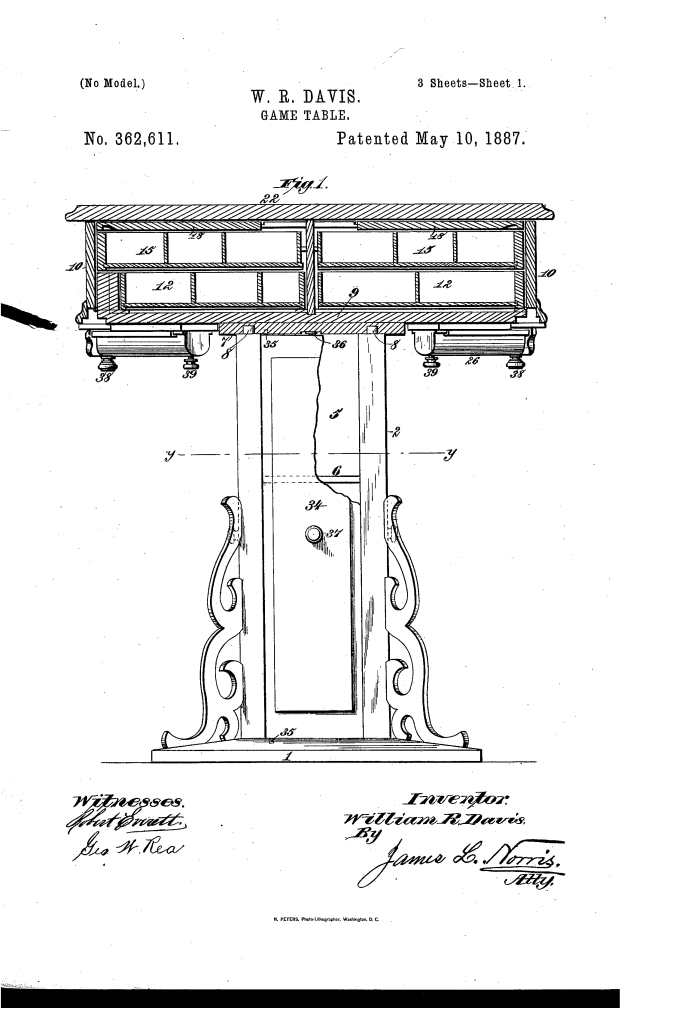
The patent by William R. Davis of New York, N.Y., describes an advanced Game Table (Patent No. 362,611, 1887). This invention is a masterwork of 19th-century furniture engineering, designed to be an “all-in-one” entertainment hub. It integrates storage for gaming implements, built-in scoring mechanisms, and specialized auxiliary features for the comfort of players—all while maintaining a compact, elegant footprint.
Inventor Background: William R. Davis
William R. Davis was an African American inventor based in New York City during the late 19th century. His patent, filed in 1886, reflects the Victorian era’s fascination with complex, “mechanical” furniture that maximized utility within urban living spaces. Davis’s design shows a sophisticated grasp of modular storage and spatial geometry, ensuring that the table could serve as a liquor cabinet, a card table, and a chess station simultaneously without one feature interfering with another.
Key Mechanical Components & Functions
The table is built upon a central pedestal and features a square top with multiple layers of moving parts.
1. The Pedestal Storage (5)
- Central Space: The pedestal (2) is hollowed out to create a space (5) divided by a shelf.
- Accessibility: Accessible via a swinging panel (34), this area was specifically intended for the storage of liquors, cigars, or other hospitality items.
2. The Tiered Drawer System (12, 15)
The table utilizes two separate levels of drawers to organize game pieces.
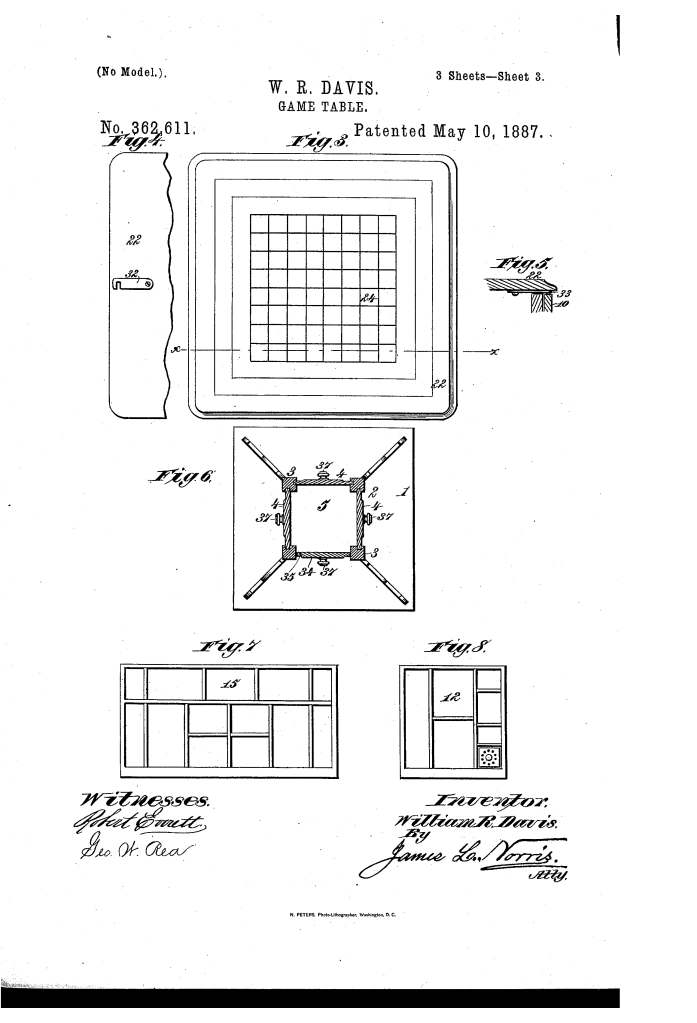
- Lower Tier (12): This level contains four separate drawers (12), each occupying half of the table’s frontage on each side. These are divided into compartments (14) for cards, chessmen, and counters.
- Upper Tier (15): Above the first level are two wider drawers that slide in opposite directions, providing larger storage areas for bulky items.
3. The Hinged Scoring Leaves (10)
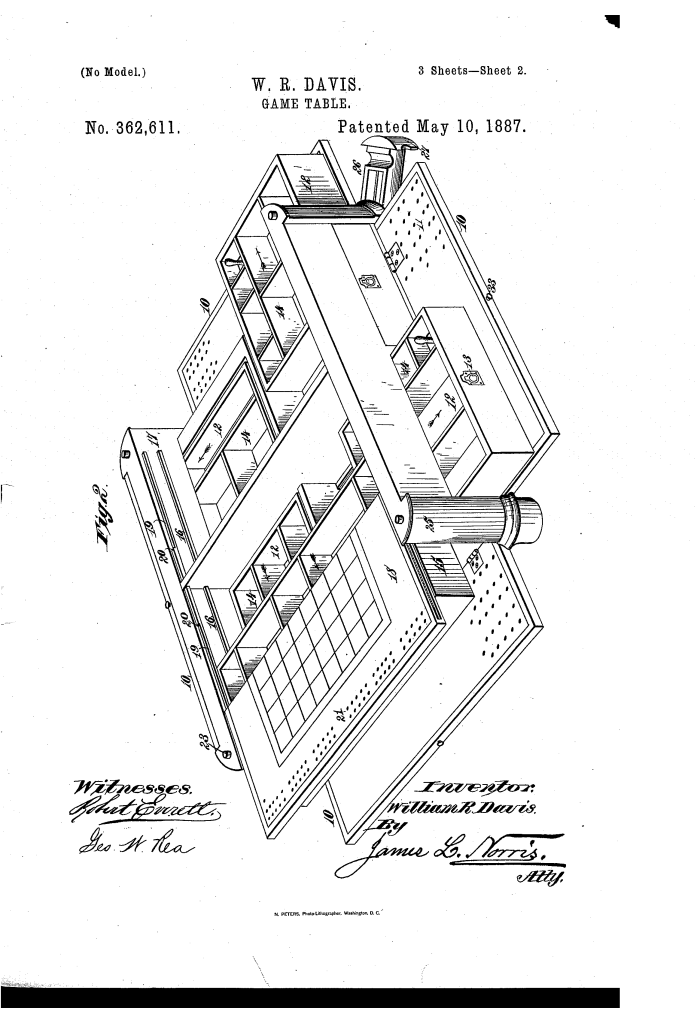
- Dual-Purpose Fronts: On all four sides of the table, leaves (10) are hinged to the bottom. When flipped up, they conceal the drawers.
- Integrated Scoring: When flipped down, the inner face of each leaf reveals a series of apertures (11).
- Function: These act as built-in cribbage boards or counting-peg registers, allowing players to keep score directly on the table structure.
4. Sliding Game Boards (18)
- Modular Playing Surface: Between the drawers and the fixed top is a board made of two sliding sections (18).
- Versatility: These sections can be pulled out entirely and used as separate boards or joined together to form a full-sized checkerboard or chess surface.
5. The “Smoker’s” Trays (26) (Key Innovation)
At each corner of the table, beneath the ornamental newels (25), are diagonal auxiliary trays (26).
- Function: These trays slide out to provide a match compartment (28) and an ash-tray (29).
- Wire Scraper (30): Davis included a wire crossing the ash space to facilitate removing ash from cigars.
- Cigar Groove (31): A dedicated notch to hold a lit cigar safely when the player’s hands are occupied by cards or game pieces.
Improvements Over Standard Furniture
| Feature | Standard 1880s Tables | Davis’s Game Table |
| Organization | Pieces kept in separate boxes; often lost. | Integrated, multi-tier drawers for all components. |
| Scoring | Required separate pads or boards. | Hinged flip-down leaves with peg-counting holes. |
| Cleanliness | Ashes and matches cluttered the surface. | Diagonal sliding ash-trays with cigar rests. |
| Footprint | Required large space for multiple boards. | Modular, sliding sections integrated into the frame. |
Significance to Furniture History
William R. Davis’s game table is a prime example of the “Patent Furniture” movement. During this time, inventors sought to create “Swiss Army Knife” versions of household objects. By integrating the lateral movement of the drawers with the diagonal movement of the corner trays, Davis ensured that all features could be used at once without clashing. This logic of high-density utility is a precursor to modern space-saving furniture design.
