
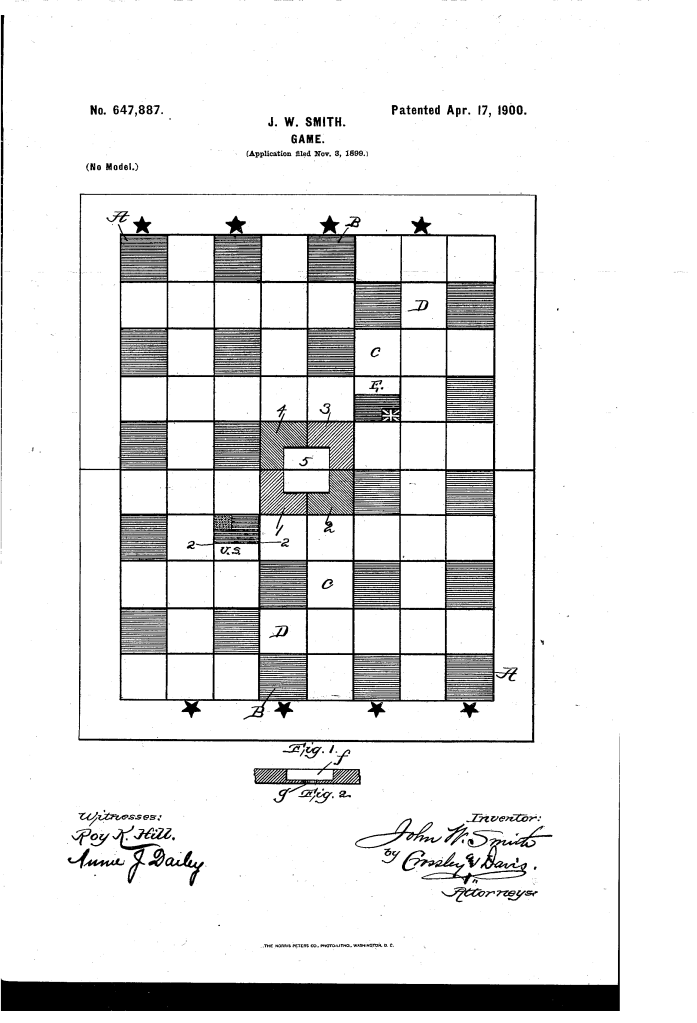
Game (John Winsor Smith, No. 647,887)
The patent by John Winsor Smith of Boston, Massachusetts, describes a game (Patent No. 647,887, 1900) that is an improvement on the general character of checkers. The object is to give increased interest and zest to the game by making it more difficult than ordinary checkers while adding a military aspect.
Inventor Background: John Winsor Smith
John Winsor Smith was an inventor focused on leisure and entertainment products at the turn of the 20th century. His invention reflects the popular appeal of abstract strategy games and the widespread use of military and conquest themes in consumer goods of the era.
Invention and Mechanism (Simplified)
The invention is a specialized game board that introduces central obstacles and specific entry/exit rules, drastically changing the flow of movement from standard checkers.
- The Board Layout:
- The board contains spaces arranged like a checkerboard.
- Central Stronghold: The most prominent feature is a central group of five spaces arranged in a square (spaces 1, 2, 3, 4, 5).
- Fortress (5): The innermost of these five spaces is termed the fortress.
- Color-Spaces (U S and E): At opposite corners of the board, there are removable blocks (or tiles) that can be colored to represent national flags (e.g., U S and E). The board is recessed and perforated so these blocks can be pushed out from the bottom and changed.
- Special Movement Rules (Key Innovation):
- Initial Play: The game starts like checkers, with diagonal movement and jumping.
- The King Line: To be crowned (“kinged”), a man must enter only one of the spaces designated by a star (impregnable spaces cannot be entered).
- Fortress Entry: To score points and enter the central Fortress (5), a man must:
- Be crowned (kinged).
- Pass through the enemy’s colors (U S or E).
- Pass through one of the adjacent stronghold spaces (1 or 3).
- Jumping into the Fortress: A crowned player who reaches an enemy stronghold space (1 or 3) may jump over the enemy man occupying that space directly into the Fortress (5), capturing the man in the process.
- Scoring: Points are awarded for reaching the Fortress (e.g., five points) and potentially for the total move.
- Military Aspect: The rules and terminology (stronghold, fortress, colors) are designed to add a military aspect and increase the game’s complexity and “zest.”
Concepts Influenced by This Invention
Smith’s game influenced subsequent game design by pioneering the use of fixed, central obstacles and state-dependent movement rules to increase strategic complexity.
- Fixed Obstacles and Flow Redirection: The introduction of the centralized “stronghold” (spaces 1–5) influenced the design of board games where fixed geometric obstacles (like blocked squares, mountains, or central structures) redirect movement and make the most direct path forbidden, forcing players to use complex perimeter strategies.
- State-Dependent Objectives: The rule that a player must be “crowned” (must achieve a prior state) before they can attempt the ultimate objective (entering the Fortress) influenced the design of modern strategy games that use upgrade or rank requirements to unlock powerful game actions or winning conditions.
- Non-Destructive/Modular Board Components: The use of removable color-blocks in the recessed and perforated board influenced the design of modern board games that incorporate modular or interchangeable tiles to alter the game’s landscape or rules.
- Thematic Overlay for Complexity: The use of military terminology and special rules to add a narrative layer to an abstract game system influenced the design of subsequent war games and strategy games built upon simple mechanical foundations.
