
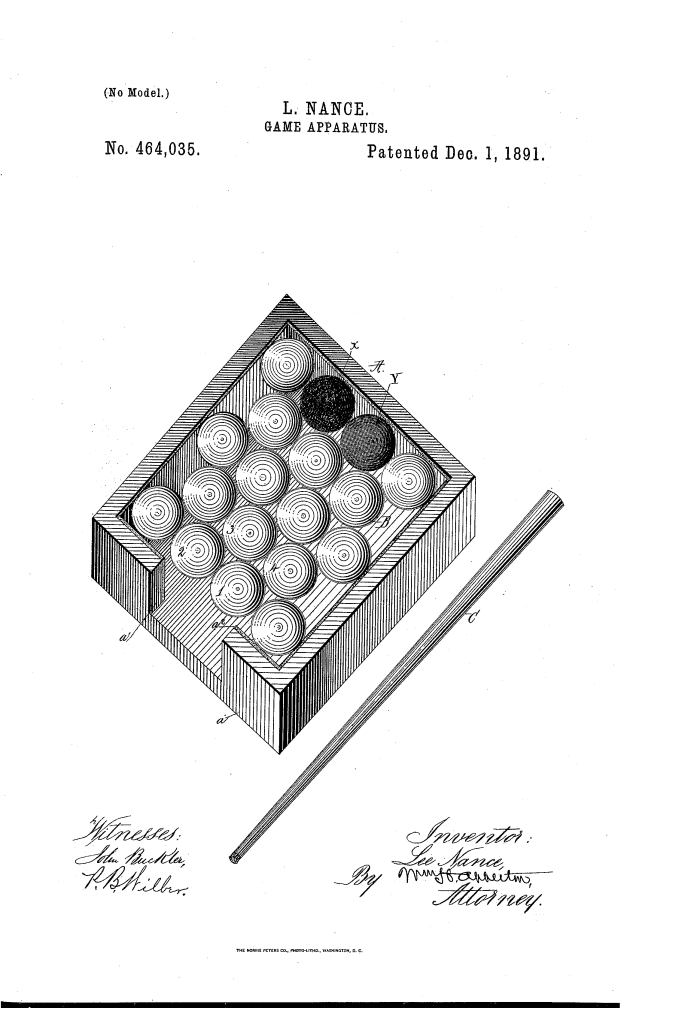
Game Apparatus (1891)
U.S. Patent No. 464,035, granted on December 1, 1891, to Lee Nance, describes a tabletop game of skill designed to test a player’s precision with a cue. Unlike many board games of the era that relied on dice or chance, Nance’s invention was a proto-billiards challenge that required “carom shots” (bank shots) and a steady hand.
Nance, a resident of Jersey City, New Jersey, intended to create an inexpensive yet intellectually and physically stimulating apparatus that forced players to calculate angles and force within a confined space.
The Design: The “Tight-Fit” Receptacle
The core of the Nance game is a rectangular, open-top box filled with balls that fit so closely together they are nearly immobilized. This “close order” arrangement is the primary obstacle of the game.
- The Box (A): A rectangular enclosure with a single opening (a) in one of the side walls.
- The Opening: Critically, the opening is wider than one ball but narrower than two. This prevents players from simply shoving multiple balls out at once and forces them to target balls individually.
- The Balls (B): The standard set consisted of eighteen balls arranged in a specific alternating pattern (three rows of four and two rows of three) to ensure a perfectly snug fit.
- The Cue (C): A small, tapering rod—similar to a pool cue—held like a pen or pencil to strike the balls.
How the Game Functions: The Art of the Carom
Because the balls are packed tightly against the walls, most of them cannot be pushed straight out. The player must use the physics of the “carom” to win.
- The First Shot: The first ball can only be ejected by causing it to “carom” (bounce) off the corner of the opening.
- The Domino Effect: After the first few balls are cleared, the remaining balls (like ball #4) still cannot be pushed directly out. The player must strike one ball into another, or bounce a ball off the interior walls (which could be cushioned with elastic lining) to guide it toward the exit.
- The Penalty: If a player strikes the box with the cue or moves the apparatus with their hands, their turn immediately ends.
- The Objective: In the standard version, each player has a “marked ball.” The first person to eject their specific ball—without accidentally ejecting their opponent’s ball—wins.
Technical Specifications
Nance’s patent was highly mathematical, ensuring the game provided a consistent level of difficulty through geometry.
| Component | Function |
| The Receptacle (A) | The “arena.” Its length and width are calibrated so that 18 balls fit with zero “slop” or extra space. |
| Cushioned Lining (a’) | An optional elastic interior that adds “bounce,” allowing for more complex bank shots. |
| Marked Balls (X & Y) | Distinctively colored or numbered balls used to identify “home” pieces for different players. |
| Opening ($a$) | Sized at slightly less than two ball-diameters to ensure a bottleneck effect. |
| The Cue (C) | The interface; its tapering shape allows for fine-tuned control over the “strike” point on the ball. |
Historical Significance
Lee Nance’s “Game Apparatus” represents a sophisticated shift in 19th-century leisure.
- Precision Over Power: The game penalized “heavy-handed” players. Moving the box resulted in a loss of turn, teaching players the value of “finesse” over force.
- Mathematical Layout: By specifying that a ball’s diameter must be exactly one-fourth the width of the receptacle, Nance brought industrial-grade precision to the toy industry.
- Adaptable Scoring: Nance outlined multiple ways to play, from a simple “first to exit” race to a “numerical count” game (totaling 136 points), making it versatile for children and adults alike.
About the Inventor: Lee Nance
While history often overlooks 19th-century Black inventors, Lee Nance’s presence in Jersey City during the 1890s places him in a vibrant corridor of American innovation.
- The Patent Process: Securing a patent in 1891 required not just a good idea, but the literacy and capital to navigate the federal legal system. Nance’s successful application proves he was a man of significant technical and social standing.
- The “Black Edison” Era: Nance operated during the same decade as Granville T. Woods, contributing to a legacy of African American inventors who transformed everyday life through both industrial machinery and social entertainment.
Summary of Claims
The patent explicitly claims:
- A rectangular open-top receptacle combined with a series of balls that “closely fit” the space.
- The specific geometry of the opening, being less than two ball-diameters wide to create a mechanical challenge.
- The use of cushioned walls within the receptacle to facilitate carom shots.
