
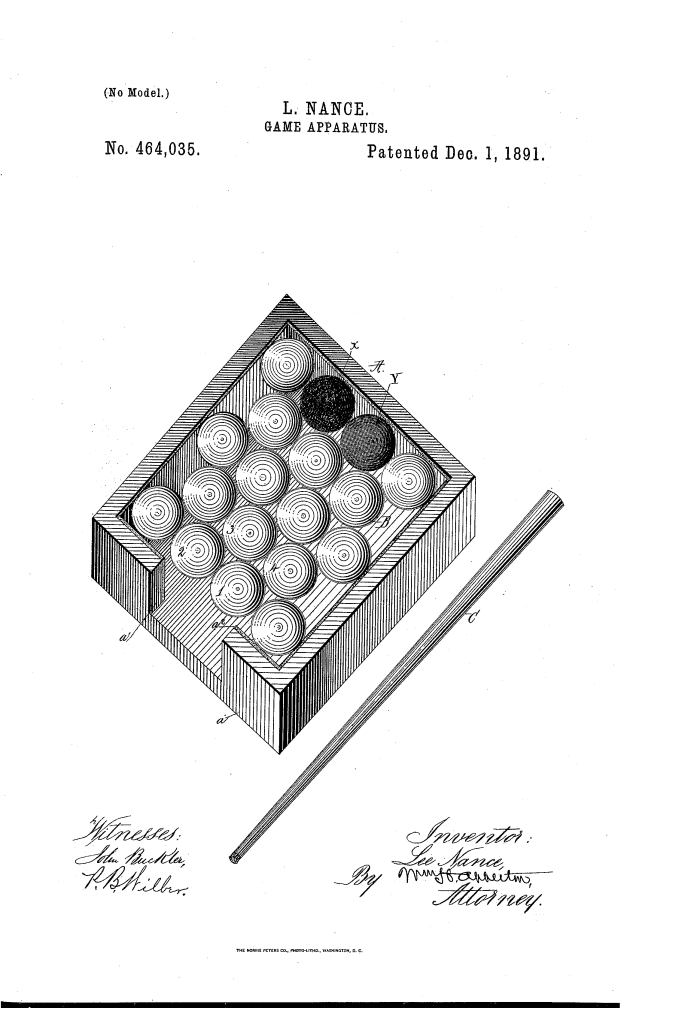
Game Apparatus – Patent No. 464,035
Inventor: Lee Nance, of Jersey City, New Jersey.
Patent Number: 464,035
Date of Patent: December 1, 1891
Description: Lee Nance’s patent for a “Game Apparatus” describes a simple, portable game designed to simulate billiards or pool. The apparatus consisted of:
- A rectangular open-top box with an opening on one side, which served as the playing area.
- A series of eighteen balls that were designed to fit snugly inside the box, with the diameter of each ball being exactly one-fourth the width of the box.
- A cue for a player to strike the balls.
The game’s objective was for players to skillfully use the cue to eject balls one at a time through the side opening. Because of the tight fit of the balls, players were often required to make carom shots (bouncing one ball off another) to successfully pocket a ball. The patent also describes different ways to play, including scoring by the number on the balls or by which player could eject their designated marked ball first.
Societal Impact
Nance’s invention was a creative response to the popularity of cue sports in the late 19th century. Billiards and pool were expensive to play, requiring a large table and specialized equipment found mostly in saloons and dedicated halls.
- Democratization of Games: Nance’s apparatus provided a portable, inexpensive way for people to play a game of skill similar to pool in their own homes. This made a popular pastime accessible to a much wider audience, bypassing the cost and the social environment of professional billiard halls.
- Entertainment in the Home: The late 19th century saw a rise in domestic entertainment as an alternative to public leisure spaces. Inventions like this one contributed to this trend by bringing games and recreational activities directly into the home.
- The Inventor’s Legacy: Lee Nance was an African American inventor. While little is publicly known about his personal life beyond this patent, his invention is a testament to the ingenuity of Black innovators in developing products for the consumer market. His work, though perhaps a novelty, is part of the broader story of how Black inventors contributed to American culture and technology in the face of significant societal barriers.
