

Gallium-Wetted Movable Electrode Switch (1968)
U.S. Patent No. 3,377,576, granted on April 9, 1968, to Edwin Langberg and Louis W. Roberts, describes an ultra-high-capacity vacuum power switch engineered to interrupt high-voltage power mains without electrical arcing or mechanical contact degradation. Edwin Langberg, based in Lexington, Massachusetts, and Louis W. Roberts, an accomplished physicist and microwave electronics expert based in Boston, Massachusetts, assigned the patent to Metcom, Inc., of Salem, Massachusetts.
This specific invention solved a persistent dual dilemma in heavy electrical power distribution: switches handling massive electrical loads suffer from destructive contact arcing, surface pitting, and contact welding when contacts part. While encasing switches in an ultra-high vacuum suppresses gas-ionization breakdown, solid electrodes still suffer from severe field-emission arcing and pitting. Furthermore, mechanical linkages that push through physical vacuum seals are prone to rapid vacuum leaks, while dry metal-on-metal sliding contacts rapidly seize without specialized low-vapor-pressure lubrication.
The Innovation: The Gallium-Wetted Magnetic Actuation System
Langberg and Roberts bypassed troublesome mechanical shaft seals, dry sliding friction, and contact pitting by combining three elements: an evacuated envelope, contactless external magnetic actuation, and a conductive, self-healing liquid gallium film.
Unlike conventional liquid-metal switches that relied on mercury—whose high vapor pressure causes gas ionization and breakdown in high-voltage fields—the inventors introduced elemental gallium. Gallium possesses a vapor pressure lower than solid silver, enabling long-term vacuum operation at or below 10^-6 mm Hg.
Why Gallium Metal?
- Self-Healing Contact Interface: As contacts separate or close under high potential, the intense electrical field acts on liquid metal rather than solid copper or tungsten, eliminating contact pitting, craters, and erosion.
- Ultra-Low Vapor Pressure: Gallium maintains an extremely low vapor pressure in liquid form, preventing volatile metal vapor clouds that initiate high-voltage glow discharges or sustain arcs across an open switch.
- High-Vacuum Conductive Lubricant: Melting at just 30 C, gallium liquefies to form a low-friction, high-conductivity sliding interface between moving electrodes, eliminating dry galling and seizure in a vacuum environment.
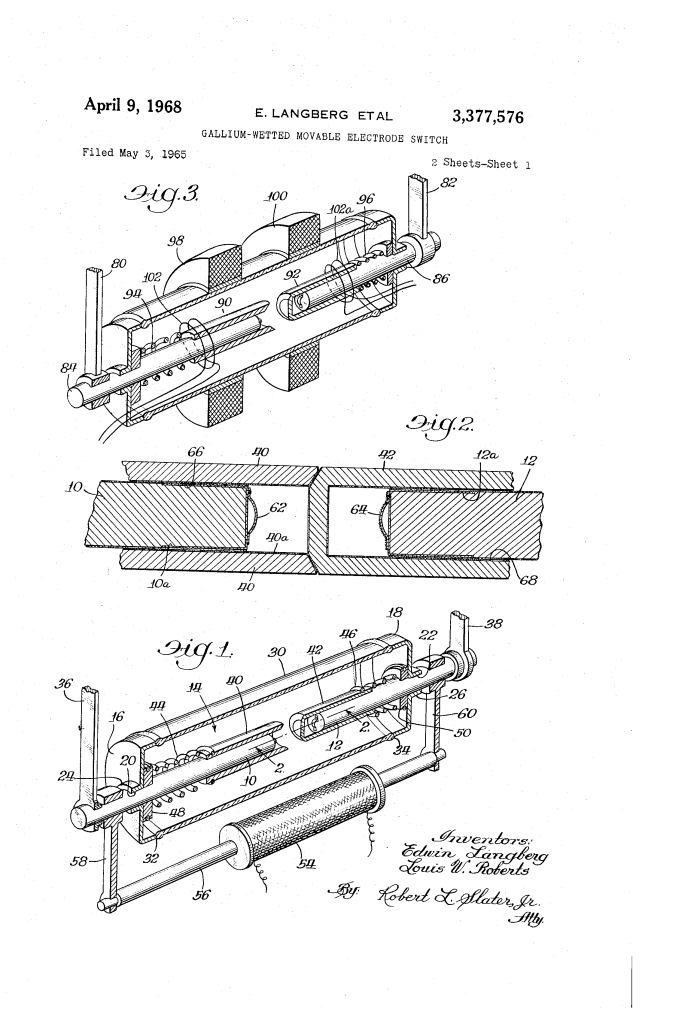
- Thermal Maintenance: Initial heating from an integrated internal filament (102) or external heater liquefies the film, after which normal electrical I^2R current flow through the electrodes generates ample heat to maintain the liquid metal state during service.
Key Mechanical and Electrical Components
The high-power switch is constructed from vacuum-compatible, refractory, and ferromagnetic materials:
| Component | Schematic Callout | Function in Switch Assembly |
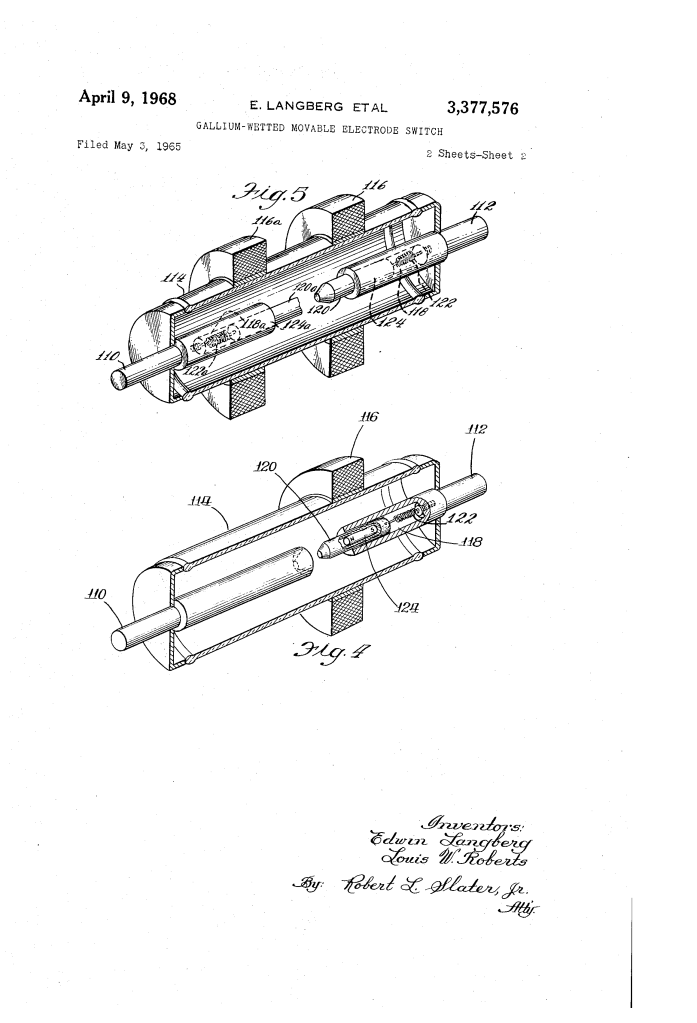
| Stationary Electrodes | 10, 12 (or 84, 86 / 110, 112) | Massive coaxial copper conductors routed into the vacuum envelope to carry primary grid currents to power bus bars (36, 38). |
| Movable Electrodes | 40, 42 (or 90, 92 / 120) | High-magnetic-permeability ferromagnetic cylinders (e.g., 420 stainless steel) that slide coaxially along the stationary conductors. |
| Tungsten Wear Cladding | 10a, 12a, 40a, 42a | Flame-sprayed thin tungsten coatings applied across sliding contact faces to provide wear resistance and arcing endurance. |
| Gallium Metal Film | 66, 68 | Low-viscosity, self-healing liquid metal layer wetting the electrode interfaces to deliver low junction resistance and lubrication. |
| Vacuum Envelope | 14 (or 88 / 114) | Hermetically sealed housing combining high-dielectric cylinder (30) with metal end caps (16, 18) holding a vacuum of 10^-6 mm Hg or better. |
| External Solenoid Actuators | 54 (or 98, 100 / 116) | Exterior electromagnetic coils that project flux through the envelope wall to slide internal electrodes together without physical vacuum penetrations. |
| Restoring Tension Springs | 44, 46 (or 94, 96 / 122) | Helical springs biasing movable electrodes away from each other to enforce rapid, clean snap-action opening when coils de-energize. |
| Cushion Springs | 62, 64 | Mechanical stop dampers positioned on stationary electrodes to absorb dynamic impact momentum during rapid closure and release. |
How the Apparatus Functions
The switch executes contact closing and circuit interruption via contactless electromagnetic induction:
| Step | Action | Operational Purpose |
| 1. Liquefaction | Internal heating element 102 or ambient warm-up brings the gallium film to or above 30 C. | Ensures gallium metal is fully liquefied and wets sliding conductor surfaces. |
| 2. Magnetic Coil Energization | Direct current powers external solenoid coil 54 (or coils 98, 100), projecting flux into magnetic flux conductors 58, 60. | Establishes strong opposite-polarity magnetic poles in movable electrodes 40 and 42. |
| 3. Contact Closure | Magnetic attraction pulls movable electrodes 40 and 42 together across the central gap, overcoming return springs 44 and 46. | Completes the high-current circuit through the gallium-wetted, flame-sprayed tungsten surfaces. |
| 4. Circuit Interruption | External solenoid current is interrupted; magnetic field collapses instantly. | Return springs 44 and 46 snap electrodes 40 and 42 back into retracted positions. |
| 5. Arc Suppression | Liquid gallium film absorbs field emission; ultra-low vapor pressure and 10^-6 mm Hg vacuum suppress ionized conduction paths. | Extinguishes the electric arc across the widening gap without pitting metal surfaces or creating line transients. |
Technical and Industrial Impact
Edwin Langberg and Louis W. Roberts’s invention resolved long-standing limitations in high-voltage, large-current circuit breaker design:
- Sealed Vacuum Integrity: By actuating ferromagnetic plungers via external magnetic fields, the design dispensed with mechanical push-rods and flexible metal bellows, eliminating the primary cause of vacuum envelope failure.
- Indefinite Contact Longevity: Pitting and splattering of solid copper or silver contacts routinely caused premature switch failure in substations. Liquid gallium’s self-healing action ensured persistent surface smoothness and low junction contact resistance.
- Rapid High-Voltage Hold-Off: Combining a 10^-6 mm Hg vacuum with low-vapor-pressure liquid metal prevented the formation of lingering ionized plasma channels, providing clean, high-speed interruption of power mains.
About the Inventor: Louis W. Roberts
Louis Wright Roberts was an eminent African American physicist, mathematician, and research executive whose career spanned foundational contributions across government, defense, and industrial electronics:
- Research and Industry Leadership: Holding an M.S. in physics from the University of Michigan, Roberts served as chief scientist and executive for multiple microwave physics companies, including Metcom, Inc., earning eleven patents on high-power microwave tubes, radar switches, and plasma devices.
- NASA Transportation Systems Center: Roberts later served as the Director of Energy and Environment and subsequently Director of the U.S. Department of Transportation’s Volpe National Transportation Systems Center in Cambridge, Massachusetts, directing major research programs in air traffic control automation, satellite navigation, and transit safety.
- Academic and Professional Legacy: A Fellow of the IEEE and an active mentor to minority scientists and engineers, Roberts bridged the worlds of theoretical optics, solid-state physics, and commercial electronics during the height of the Cold War and the Space Race.
Summary of Claims
The patent explicitly claims:
- An electrical switch comprising an evacuated high-dielectric envelope, a pair of coaxially aligned spaced fixed electrodes, high-magnetic-permeability hollow sliding electrodes mounted over the fixed electrodes, a lubricating, self-healing film of gallium metal wetting the electrode surfaces, and external solenoids to actuate the sliding electrodes across the gap.
- An evacuated power switch featuring internal heating elements to liquefy the gallium film and external magnetic coils to drive permanent-magnetic or ferromagnetic sliding electrodes into and out of contact.
- High-voltage switch configurations where a sliding cylindrical electrode is guided within a hollow central recess inside one or both fixed electrodes, wetted by a gallium film and magnetically actuated to make and break contact in a high vacuum.
