
Improvement in Gages (1895)
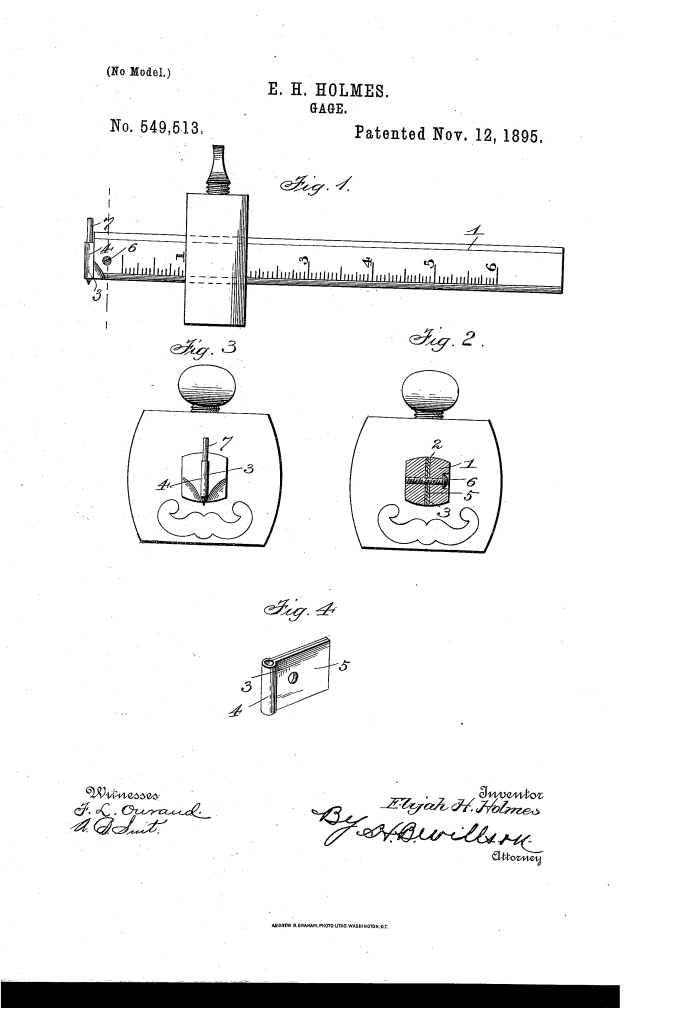
U.S. Patent No. 549,513, granted on November 12, 1895, to Elijah H. Holmes, describes a clever modification to a standard woodworking marking gage. Invented in Prairie View, Texas, this device was engineered to give craftsmen clear, unobstructed visibility of their work line as they carved out precise measurements.
This specific invention solved a tedious, everyday problem for carpenters and woodworkers: the inability to see the marking spur during operation. Traditionally, craftsmen had to blindly push or pull the gage and constantly lift or tilt the tool to check their progress, frequently resulting in over-scribed boundary lines for critical joints like mortises and tenons.
The Innovation: The Visible Marking Point
The brilliance of Holmes’s design lies in the structural modification of the tool’s head (the beam) combined with a specialized, secure clamping mechanism. By altering the geometry of the wood surrounding the cutting point, Holmes ensured the marker remained completely exposed to the user’s line of sight.
1. The Chamfered Sight Window
The end of the wooden beam near the marking point is chamfered—meaning it was shaved down into a concave slope on both sides of the cutting tool.
- This deliberate indentation extends about five-sixteenths of an inch in both directions.
- By cutting away the bulky wood that traditionally blocked the view, the craftsman can see the exact intersection of the marking point and the wood surface at all times.
2. The Split-Beam Tube Clamp
Traditional gages often relied on simple friction or top-mounted screws that could slip or obstruct the view. Holmes introduced a robust hardware solution:
- A metal clamp featuring a tubular sleeve to hold the marking needle, flanked by parallel, flat metal wings.
- The end of the wooden beam features a vertical slice (a saw-kerf) where these metal wings are inserted.
- A transverse screw draws the split halves of the wooden beam tightly together, locking the clamp and the marking needle into perfect alignment.
Key Structural Components
The tool is remarkably simple but precisely engineered, using a tight interplay between wood and metal components:
| Component | Function |
| Beam (1) | The main wooden body/shaft of the gage that guides the tool along the edge of the workpiece. |
| Saw-Kerf (2) | A precise slot cut into the end of the beam to accept the metal anchoring wings. |
| Tubular Clamp (3, 4, 5) | A single metal piece consisting of a sleeve (4) to hold the marking needle and flat wings (5) that anchor it into the beam. |
| Transverse Screw (6) | Passes completely through the width of the beam to squeeze the split wood tightly against the metal wings. |
| Marker / Scribing Point (7) | The sharp metal needle or spur that scores the line into the wood. |
Performance: Visibility and Precision
Holmes’s patent emphasizes efficiency and accuracy on the workshop floor, eliminating the guesswork of traditional layouts.
- Uninterrupted Workflow: The user no longer needs to turn or tilt the gage forward (“as in the old way”) to check the placement of the spur. This saves significant time during repetitive layout work.
- Flawless Joinery: Because the marking point is always visible, a carpenter can stop scribing exactly at the cross-lines, avoiding catastrophic over-cuts when prepping wood for mortise and tenon joints.
About the Inventor: Elijah H. Holmes
Elijah H. Holmes was an inventor and educator based in Prairie View, Waller County, Texas.
- Context: Operating in the late 19th century, Holmes lived and worked in Prairie View, the home of the historic Prairie View State Normal and Industrial College (now Prairie View A&M University).
- Industrial Artistry: His invention reflects the deep focus on industrial education, mechanics, and practical craftsmanship that characterized the era’s technical instructors, aiming to refine common hand tools for maximum efficiency and industrial training.
Summary of Claims
The patent explicitly claims:
- A gage featuring a beam with a specialized saw-kerf cut directly into its working end.
- A metal clamp composed of a central tube to house a scribing point, manufactured with parallel, laterally projecting wings designed to fit securely inside the beam’s kerf.
- A mechanical means (the transverse screw) to clamp the separated ends of the wooden beam tightly against the metal wings, ensuring the marker remains exposed to view and completely stationary.
