
Fountain Pen: William B. Purvis (Patent No. 419,065)
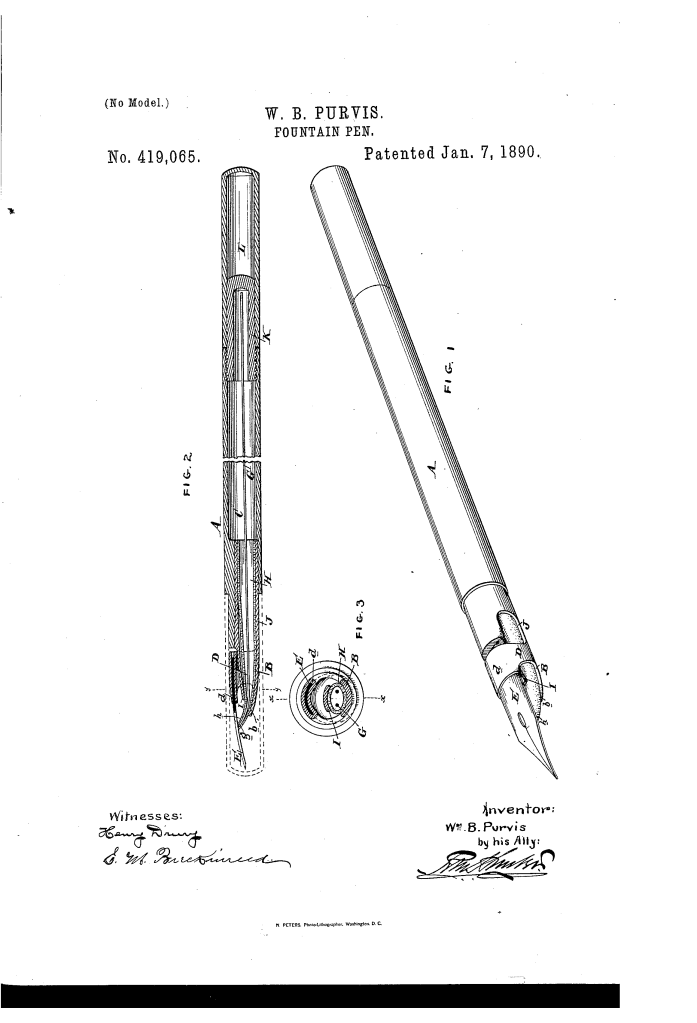
The patent by William B. Purvis of Philadelphia, Pennsylvania describes a Fountain Pen (Patent No. 419,065). This invention is a self-contained writing instrument featuring an internal ink reservoir and a pressure-activated feeding system that regulates ink flow through the mechanical action of writing.
The “Why”
In 1890, writing with a pen was a messy, intermittent affair. Standard pens required constant dipping into an external inkwell, while early “fountain” designs often suffered from two extremes: they either clogged completely or leaked (“blotted”) uncontrollably due to a lack of flow regulation. Purvis sought to create a pen that provided ink “in volume commensurate with the duty required”—meaning the pen would only provide ink when the nib was actually touching the paper, responding dynamically to the writer’s stroke.
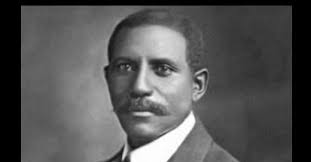
Inventor Section: William B. Purvis
William B. Purvis approached invention with the mindset of a systems optimizer. His engineering philosophy leaned heavily on the use of flexible, elastic materials to replace complex rigid gears. In the context of the late 19th century, Purvis was part of a vanguard of Black inventors who transitioned from agricultural improvements to high-precision consumer electronics and industrial tools. His fountain pen design showcases an early mastery of peristaltic action—using compression to move fluid—a principle still used today in medical heart-lung machines and high-end industrial pumps.
Key Systems Section
Peristaltic Feed Tube
- Modern Term: Flexible Delivery Line / Peristaltic Pump.
- Purvis utilized an elastic tube (H) connecting the reservoir (C) to the pen nib (E). Unlike gravity-fed pens, this tube requires physical deformation to “express” the ink, preventing accidental leaks when the pen is stationary.
Pressure-Point Activation
- Modern Term: Kinetic Actuator.
- The holder features a rigid “pressure-point” (I) and a flexible arm (B). As the writer presses the pen against the paper, the handle moves slightly, causing the rigid point to compress the elastic tube.
Internal Scavenger Wire
- Modern Term: Agitator / Anti-Clogging Filament.
- A thin wire (G) runs through the center of the elastic tube. This serves a dual purpose: it maintains the tube’s shape and acts as a cleaning mechanism to break up dried ink or sediment that would otherwise cause a clog.
Capillary Return System
- Modern Term: Passive Flow Regulation.
- Purvis designed the orifice so that if excess ink is expressed, capillary attraction and the vacuum created within the reservoir draw the surplus back into the tube, effectively “self-correcting” the flow.
Comparison: Dip Pens & Early Reservoirs vs. The Purvis Innovation
| Feature | Pre-1890 Dip/Fountain Pens | The Purvis Innovation |
| Ink Supply | External inkwell or gravity-heavy reservoir. | Internal Reservoir with stroke-based delivery. |
| Flow Control | Unregulated; prone to “blotting.” | Pressure-Activated (Ink flow matches writing speed). |
| Maintenance | Frequent cleaning; nibs dry out quickly. | Internal Wire (G) prevents clogs and sediment buildup. |
| Portability | High risk of leakage in pockets. | Elastic Seal and cap system for safe pocket carry. |
Significance
- Precursor to Modern Ballpoint Logic: While ballpoints use a rolling ball to control flow, Purvis’s idea of using the physical act of writing to “unlock” the ink supply remains a fundamental concept in stationery engineering.
- Fluid Dynamics: His use of pressure-point compression is a primitive but effective form of active flow control, a necessity in modern inkjet printing.
- Durability: The inclusion of an internal wire for maintenance anticipated the “user-serviceable” trends in 20th-century engineering.
- Commercial Success: Purvis’s design was one of the more successful early fountain pen patents, helping to stabilize the reputation of portable pens as reliable tools for professionals.
