
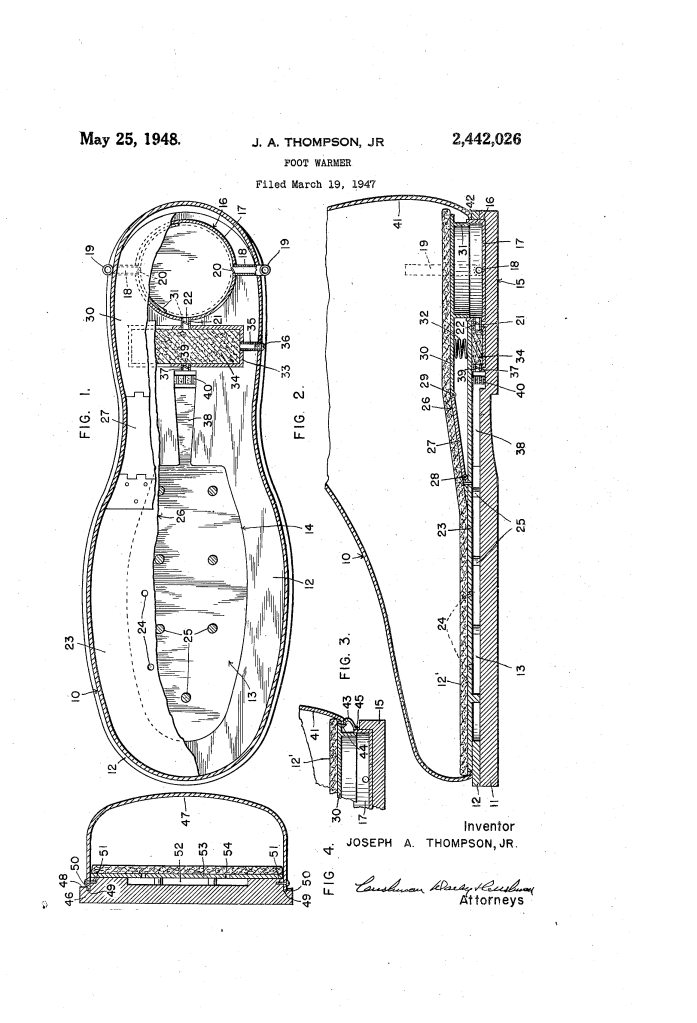
Foot Warmer, Joseph A. Thompson, Jr. (1948)
Patented in May 1948, this invention by Joseph A. Thompson, Jr. of Oklahoma City (U.S. Patent No. 2,442,223) is a fascinating example of “wearable technology” from the post-WWII era. Thompson designed a self-contained, chemically powered heating system built directly into the sole of a shoe.
Unlike modern foot warmers that rely on batteries or one-time-use chemical packets, Thompson’s design used a catalytic reaction triggered by the physical act of walking. It essentially turned the wearer’s heel into a miniature air pump that fueled a flameless heater located under the toes.
The “Why”
For people working in extreme cold—such as soldiers, hunters, or outdoor laborers—cold feet weren’t just uncomfortable; they were a safety hazard. Thompson wanted a solution that didn’t require external power or constant replacement of parts.
- The Problem: Standing or walking in snow and ice quickly drains heat from the feet through the soles of shoes.
- The Solution: A “Walking-Powered” heater. By using the pressure of each footstep to circulate air through a chemical catalyst, Thompson created a system that generates heat only when the wearer is active and moving.
Inventor Section: Engineering Philosophy
Joseph A. Thompson’s philosophy was Kinetic Catalysis. He integrated three distinct scientific principles into a single piece of footwear: Pneumatics (using the heel as a bellows), Chemistry (evaporating alcohol), and Catalytic Combustion (using platinum to generate flameless heat). His design is remarkably efficient because it uses the energy the wearer is already exerting while walking to power the heating cycle.
Key Systems Section
1. The Heel Piston (The “Engine”)
The “motor” of the shoe is located in the heel.
- Cylindrical Recess (16): The heel contains a metal cylinder (17) acting as a compression chamber.
- The Piston (31): Attached to a hinged plate (26, 30) under the wearer’s foot is a flange that acts as a piston.
- The Action: Every time the wearer steps down, the heel pushes the piston into the cylinder, forcing air forward. A spring (32) pushes the piston back up when the foot is lifted, sucking in fresh air through “snorkel” tubes (19) that extend up the side of the boot to prevent mud or water from entering the system.
2. The Vaporization Chamber
Before the air can provide heat, it must be “treated.”
- Alcohol Container (33): In the middle of the sole is a small tank filled with absorbent material (cotton or felt) saturated with alcohol.
- The Mixture: As the air from the heel is forced through this container, it picks up alcohol vapors. This creates a combustible, vaporized fuel-air mixture.
3. The Catalytic Pellet (The “Heater”)
This is the most innovative part of the patent—the use of a catalyst instead of a flame.
- Spongy Platinum (40): Positioned in the air passage is a perforated pellet of platinum black or spongy platinum.
- The Reaction: When the alcohol-saturated air hits the platinum, a catalytic reaction occurs. This generates significant heat without a flame.
- Safety: Because there is no fire, there is no risk of burning the shoe or the foot, but the air passing through the pellet becomes rapidly heated.
4. Heat Distribution
Once the air is heated, it needs to reach the foot.
- Air Compartment (13): The heated air flows into a hollow space between the inner and outer soles.
- Perforated Plate (23): A metal plate with holes (24) allows the warm air to rise up through the insole (12), which was typically made of felt or wool to insulate the foot while letting the heat pass through.
How it Works: The Step-by-Step Cycle
| Phase | Action | Result |
| Step Down | Heel compresses the piston (31). | Air is forced into the alcohol chamber (33). |
| Vaporize | Air passes through saturated cotton (34). | Air picks up alcohol vapors. |
| React | Vapor-air mix hits the platinum pellet (40). | Catalytic heat is generated instantly. |
| Warm | Hot air enters the sole compartment (13). | Heat rises through perforations to warm the toes. |
| Lift Foot | Spring (32) resets the piston. | Fresh air is sucked in through intake pipes (19). |
Significance
Thompson’s Foot Warmer is a precursor to modern specialized outdoor gear:
- Off-Grid Heating: It provided a way to stay warm in sub-zero temperatures without electricity, making it ideal for remote military or survival use.
- Ergonomics: The “hinged sectional member” was designed to be comfortable and flexible, ensuring the mechanical parts didn’t interfere with the natural gait of the wearer.
- Maintenance: The design included a “threaded plug” (36) so the user could easily refill the alcohol reservoir, much like filling a Zippo lighter.
Final Insight: Thompson’s use of “snorkel” pipes to keep the air intakes clear of mud shows a deep practical understanding of the environments where this shoe would be used. It wasn’t just a lab concept; it was a rugged piece of engineering designed for the real world.
