
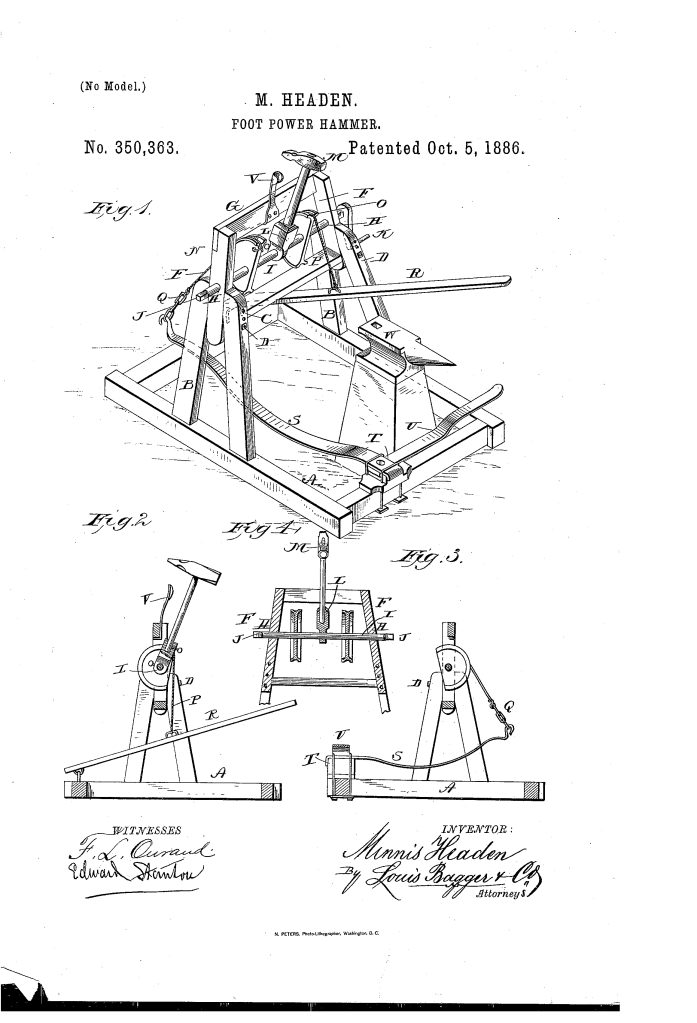
Minnis Headen, a resident of Christiansburg, Virginia, received U.S. patent #350,363 on October 5, 1886, for his “Foot Power Hammer.”1 This invention was a significant improvement for blacksmiths and other metalworkers who needed a more efficient way to operate a hammer.
Details of the Patent
The patent described a foot-operated power hammer designed to make forging and shaping metal a more efficient, less labor-intensive process.2 🔨
- The Invention: Headen’s device used a treadle (foot pedal) to drive a hammer head down onto an anvil.3 A system of springs was then used to lift the hammer back up, preparing it for the next strike.4
- Key Features: The design was notable for its simplicity and practicality. By using foot power, the user could free up their hands to manipulate the metal on the anvil. The adjustable frame of the hammer allowed the user to change the height of the hammer, making it suitable for a variety of tasks and different-sized anvils.5
- Problem Solved: Traditional blacksmithing required one person to swing a heavy sledgehammer while another held and shaped the metal. Headen’s invention allowed a single person to perform both tasks, increasing productivity and reducing the need for an assistant.
Significance of the Invention and Inventor
Minnis Headen was an African-American inventor from Virginia who, like many Black inventors of his era, worked in a society that often limited his opportunities. His “Foot Power Hammer” is a testament to his ingenuity and skill.
- Impact on Industry: While not a household name, Headen’s invention represents a crucial step in the mechanization of manual labor. His hammer made a demanding job more efficient and accessible, contributing to the broader industrial advancements of the late 19th century.
- Legacy as a Black Inventor: Headen’s patent is documented by historians who have worked to preserve the records of African-American inventors, such as Henry E. Baker of the U.S. Patent Office.6 His inclusion in these records ensures that his contribution to American innovation is not forgotten. His story highlights the perseverance of Black inventors who, despite facing significant systemic barriers, created practical and valuable tools that helped to build the nation.
