
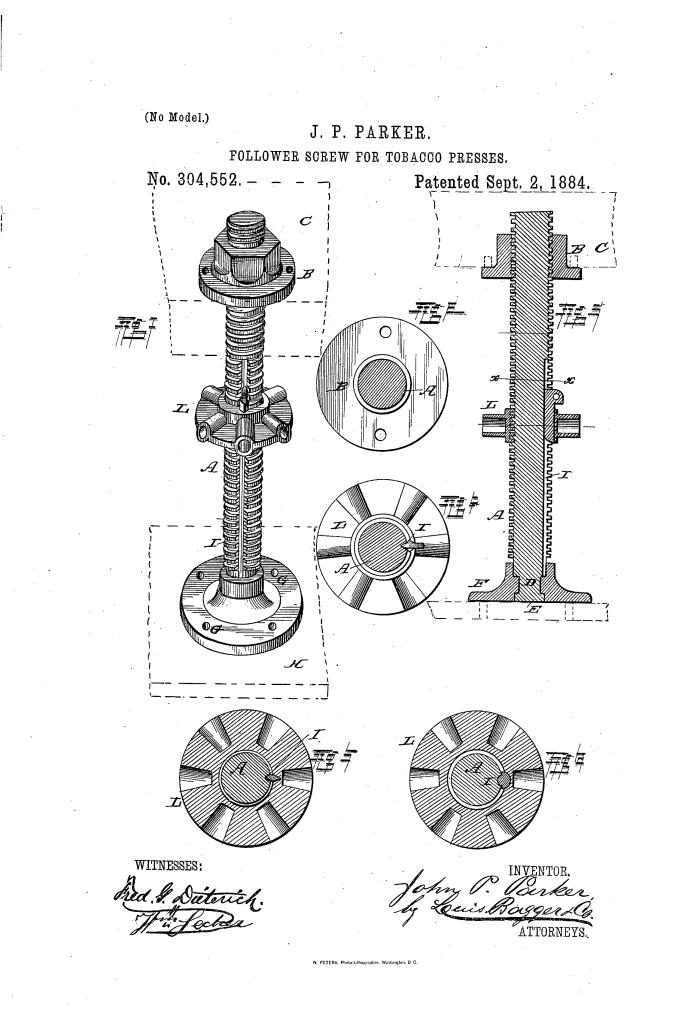
Follower-Screw for Tobacco Presses by John Percial Parker – 1884 – Patent No. 304,552
John Percial Parker received U.S. Patent No. 304,552 for a Follower-Screw for Tobacco Presses on September 2, 1884. His invention focused on an improvement to the mechanism used in presses designed to compact tobacco, typically for the purpose of baling or packaging it for shipment or storage.
Key Components and Improvements:
- Longitudinal Groove in the Screw (I): A significant feature of Parker’s design is a longitudinal groove cut along a substantial portion of the screw’s length. This groove is not merely superficial; it extends through the threads and deeply into the solid body or “barrel” of the screw.
- Lever-Nut (L): A specially designed lever-nut fits onto the screw. This nut has a corresponding groove on one side that matches the shape of the groove on the screw.
- Locking Device (Key/Pin): When the grooves on the screw and the lever-nut align, a properly shaped key, pin, or other locking device can be detachably inserted into them. This key connects the lever-nut to the screw.
- Recesses for Operating Lever: The marginal periphery of the lever-nut is equipped with a series of openings or recesses. These are designed to receive a bar or lever, which is used to operate the device and apply pressure.
- Collar and Shoulder: The patent also mentions a collar at the lower end of the screw, which lifts the follower-plate when raising it after pressing, and a shoulder at the lower end of the follower-screw that bears against the follower-plate during downward pressure.
Operation and Advantages:
The operation involves using a lever inserted into the recesses of the nut to turn the follower-screw, thereby lowering the follower-plate and compressing the tobacco. A key innovation addresses a common issue in previous presses: when the material being compressed interferes with the lever’s operation (because the nut has moved too far down the screw), the operator can simply release the key connecting the lever-nut to the screw. This allows the lever-nut to be turned independently on the screw until it reaches a higher position, where the lever can again be effectively used. The key is then re-inserted, and the pressing continues.
The main advantages claimed by Parker’s invention include:
- Avoiding Supplemental Blocks: This design eliminates the need for “supplemental blocks” between the follower and the follower-plate, which were often used in older presses when the lever could no longer operate effectively. This avoids “consequent delay in work.”
- Preventing Strain on Threads: By having the key’s pressure (caused by the lever’s action) bear upon the solid metal of the screw’s body (due to the deep groove), the design “prevents all possibility of strain upon the threads of the oval or diamond shaped” part of the screw, increasing its durability.
About John Percial Parker
John Percial Parker (circa 1858 – March 21, 1928) was a prominent African American inventor and businessman from Ripley, Ohio. Born enslaved in Virginia, he escaped to Ohio via the Underground Railroad before the Civil War. Despite his beginnings, Parker became a highly successful entrepreneur and inventor, securing patents for various industrial machines.
After the Civil War, Parker established his own foundry and machine company in Ripley, specializing in manufacturing products based on his own inventions. He was particularly known for his innovations in the tobacco industry, developing several machines that mechanized and improved processes like tobacco pressing, harrowing, and cotton planting. His success allowed him to employ both Black and white workers, a significant achievement for the time.
Parker was also active in his community, serving as a respected figure and demonstrating that African Americans could achieve significant economic and social standing despite the pervasive racism of the era.
Personal and Historical Significance of the Invention
Personal Significance for John Percial Parker:
- Reflection of His Expertise: This patent, along with his other inventions, highlights Parker’s profound understanding of mechanical engineering and the practical needs of the agricultural and industrial sectors, particularly the tobacco industry.
- Contribution to His Business: As an owner of a foundry and machine company, developing patented machinery like this follower-screw directly contributed to the products his company could manufacture and sell, enhancing his business success and reputation.
- Economic Empowerment: For Parker, patents were not just about invention; they were a means to economic independence and wealth accumulation, which was a rare and powerful achievement for an African American in the post-Reconstruction era. His inventions formed the backbone of his successful enterprise.
Historical Significance of the Invention:
- Advancement in Agricultural Mechanization: Tobacco pressing was a crucial step in preparing tobacco for market. Parker’s improved follower-screw contributed to the mechanization of this process, making it more efficient and less labor-intensive. This was part of a broader trend in the late 19th century to mechanize agriculture and industry.
- Impact on the Tobacco Industry: Even seemingly small improvements in machinery could have significant economic impacts on industries like tobacco, which were major economic drivers in parts of the U.S. Increased efficiency in pressing meant faster processing and potentially higher output.
- Showcase of African American Ingenuity in Industry: John Percial Parker is a prime example of an African American inventor who not only patented significant inventions but also successfully manufactured and marketed them. His work with the tobacco press is part of a larger body of work that demonstrates the vital, yet often overlooked, contributions of Black inventors to American industrial development. His story challenges narratives that limit the scope of African American achievement in the post-slavery period, showing how individuals like Parker overcame immense barriers to become industrial innovators and leaders.
- Early Entrepreneurial Success Story: Parker’s ability to transition from an enslaved person to a successful inventor and industrialist is a powerful historical narrative. His patents, like this one for the follower-screw, are tangible evidence of his remarkable journey and his impact on American industry.
