
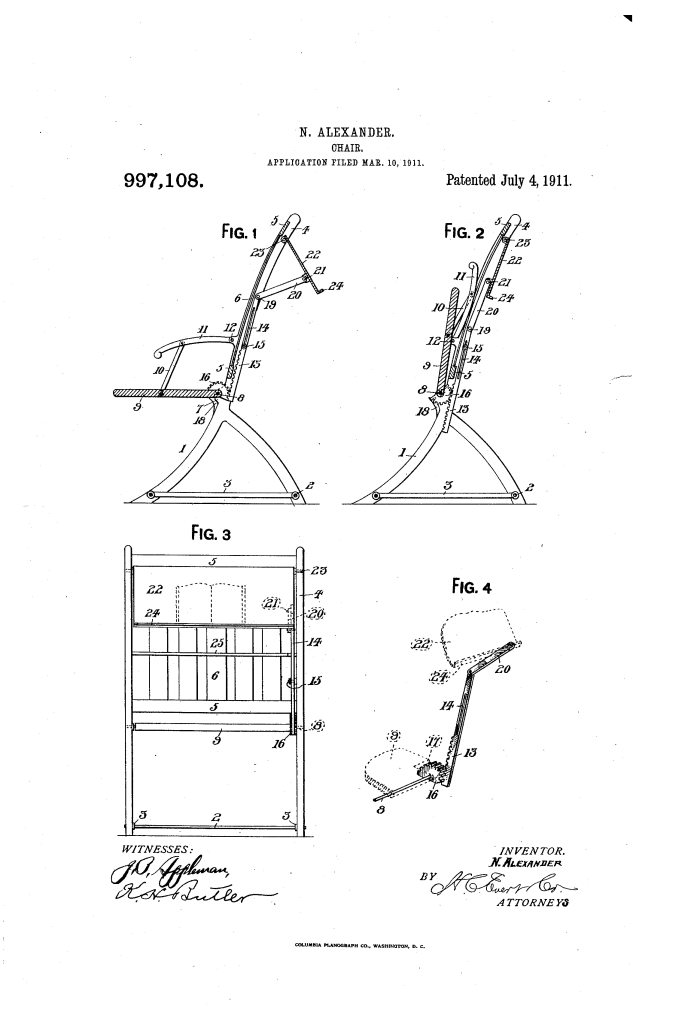
Chair (Nathaniel Alexander, No. 997,031)
The patent by Nathaniel Alexander of Lynchburg, Virginia, describes an improvement in Chairs (Patent No. 997,031, 1911). The invention is a specialized folding chair designed for churches, Sunday schools, and auditoriums. Its primary feature is a synchronized book rest that automatically deploys when the seat is lowered and folds compactly against the back when the seat is raised.
Inventor Background: Nathaniel Alexander
Nathaniel Alexander was an African-American inventor whose work focused on the intersection of utility and space management in public assembly spaces. His invention addressed the logistical challenge of providing hymn book supports in crowded choir lofts and church pews. By automating the book rest’s movement, Alexander ensured that the furniture would not obstruct aisles when not in use, demonstrating a keen understanding of both mechanical engineering and industrial design for public spaces.
Invention and Mechanism (Simplified)
The chair uses a gear-and-rack system to translate the rotational movement of the seat into the linear and rotational movement of the book rest.
1. The Automatic Actuating Mechanism (Key Innovation)
- Sector Gear (16) and Pivot Rod (8): The seat (9) is mounted on a transverse pivot rod (8). Fixed to this rod is a sector gear (16) (a partial gear).
- Sliding Rack (13): Mounted on the inner side of the chair frame is a sliding rack (13)—a flat bar with gear teeth.
- Function: When a person lowers the seat to sit down, the sector gear rotates, pushing the rack (13) upward.
- Link (20) and Book Rest (22): The top of the rack is connected to a link (20), which is attached to the book rest (22).
- Function: As the rack slides up, it pushes the link, which pivotally forces the book rest (22) to swing out into a horizontal position, ready to hold a book or hymnal.
2. Space-Saving Design
- Compact Folding: When the seat is raised (closed), the rack pulls the link downward, drawing the book rest flush against the back of the chair.
- Benefit: This prevents the rest from interfering with people passing between rows of chairs in tight auditorium or choir settings.
- Integrated Support: A ledge (24) on the rest prevents books from sliding off, and a secondary rod (25) provides a resting place for books against the chair’s slats when they are not in use.
3. Structural Stability
- Stops (18): The chair includes stops to limit the downward movement of the seat, ensuring it rests at a comfortable and safe angle.
- Pin-and-Slot (14, 15): The rack is held securely against the frame by a pin-and-slot connection, which allows for smooth vertical travel without the gear teeth slipping or becoming misaligned.
Concepts Influenced by This Invention
Alexander’s chair influenced subsequent designs in institutional furniture and mechanical automation by pioneering integrated motion-coupling.
- Kinematic Linkage in Furniture: The core concept of coupling two separate furniture functions (the seat and the desk/rest) through a hidden mechanical linkage influenced the design of modern lecture hall seating, stadium seats with retractable cup holders, and multi-functional “transformer” furniture.
- Sector Gear Applications: The use of a sector gear (16) to convert the limited rotation of a hinge into the linear travel of a secondary mechanism is a fundamental principle in mechanical engineering, often used in automotive steering and small-scale robotics.
- Space-Efficiency in Public Architecture: Alexander’s focus on “aisle clearance” in auditorium design influenced the development of fire safety and egress standards for public seating, where minimizing protrusions in high-traffic areas is critical.
- Automated Utility: The invention represents an early step toward “smart” furniture—objects that react to user presence or primary use (sitting) by preparing secondary utilities (the book rest) without extra effort.
