
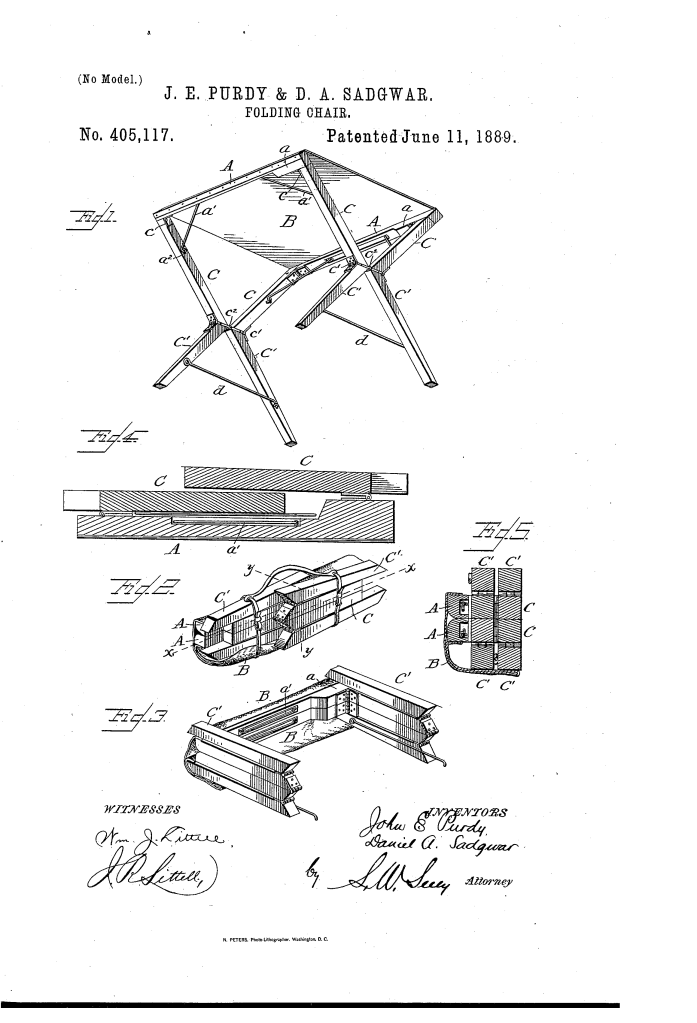
Folding Chair: J.E. Purdy & D.A. Sadgwar (Patent No. 405,117)
The patent by John E. Purdy and Daniel A. Sadgwar of Washington, District of Columbia, describes a Folding Chair (Patent No. 405,117), granted on June 11, 1889. This invention is a highly portable, collapsible seating solution featuring a segmented leg architecture that allows the device to fold along both its longitudinal and transverse axes, reducing it to the dimensions of its primary seat rails.
The “Why”
In the late 19th century, “camp stools” and portable chairs were often cumbersome. While they could flatten, they remained the full length and width of the seat frame, making them awkward for “artists, tourists, and travelers” to transport. Purdy and Sadgwar identified the need for a chair that didn’t just flatten but shrank—minimizing its footprint in both breadth and thickness to fit into a shawl-strap or small travel bag.
The Inventors: Engineering Philosophy
John E. Purdy and Daniel A. Sadgwar were Black inventors operating in Washington, D.C., during the post-Reconstruction era. This period was marked by the rise of Jim Crow laws, yet it also saw a surge in Black intellectual property as entrepreneurs sought economic independence.
Their engineering philosophy centered on mechanical efficiency through compound hinging. Rather than adding complex latches, they utilized the geometry of the chair itself to provide strength. Their design ensures that when in use, the weight of the sitter forces the “beveled joints” together, meaning the structural integrity relies on the solid wood members rather than the metal pins of the hinges—a principle of “passive stability.”
Key Systems Section
Compound Segmented Legs
- Modern Term: Bi-directional folding linkage.
- The legs are not solid poles but two-part members joined by a double-hinge joint. This allows the lower section of the leg to fold 180° back against the upper section, effectively halving the vertical height of the frame before the horizontal collapse begins.
Beveled Abutment Joints
- Modern Term: Compression load-bearing surfaces.
- The inventors designed the X-shaped intersection so the wooden faces “abut against each other.” This ensures that the shear force (vertical weight) is transferred through the timber. In modern engineering, this avoids “fastener fatigue,” where the metal screw would otherwise be the primary point of failure.
Longitudinal Rail Integration
- Modern Term: Recessed storage housing.
- The seat-frame strips (A) include “blocks” (a) and “grooves.” These allow the folded legs to overlap perfectly flat against the frame. By staggering the attachment points, the chair achieves a thickness no greater than the sum of the two rails and two leg segments.
Comparison Table: 19th Century Portability
| Feature | Standard Camp Stool (1880s) | Purdy & Sadgwar Innovation |
| Folding Axis | Single axis (Flattens only) | Dual axis (Flattens and shortens) |
| Portability | Requires hand-carrying or large straps | Fits in a “shawl-strap” or small bag |
| Structural Stress | Weight often rests on the hinge pin | Weight rests on “beveled” wood joints |
| Storage Volume | High (Length remains constant) | Ultra-Low (Reduces to ~12 inches) |
Significance
- Precursor to Modern “Quik-Fold” Furniture: The logic of collapsing a 3D frame into a 1D “bundle” is the direct ancestor of the modern collapsible camping chairs used today.
- Early Ergonomic Portability: It anticipated the needs of the modern “mobile” worker or hobbyist, prioritizing weight-to-strength ratios.
- Mechanical Simplification: By using a flexible canvas seat (B) as a tension member, they eliminated the need for a heavy, rigid seat, a staple in modern lightweight gear.
Technical Note: The structural integrity of the X-frame can be modeled by treating the legs as beams under compression, where the stability is maintained as long as the displacement vector of the load remains within the footprint defined by the four-point floor contact.
