
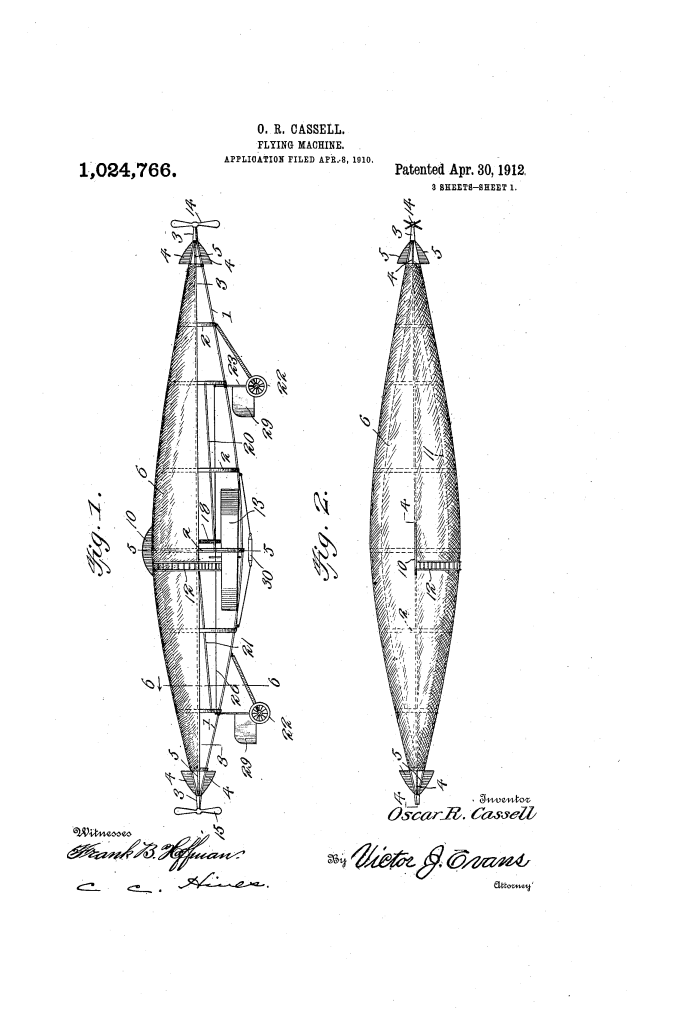
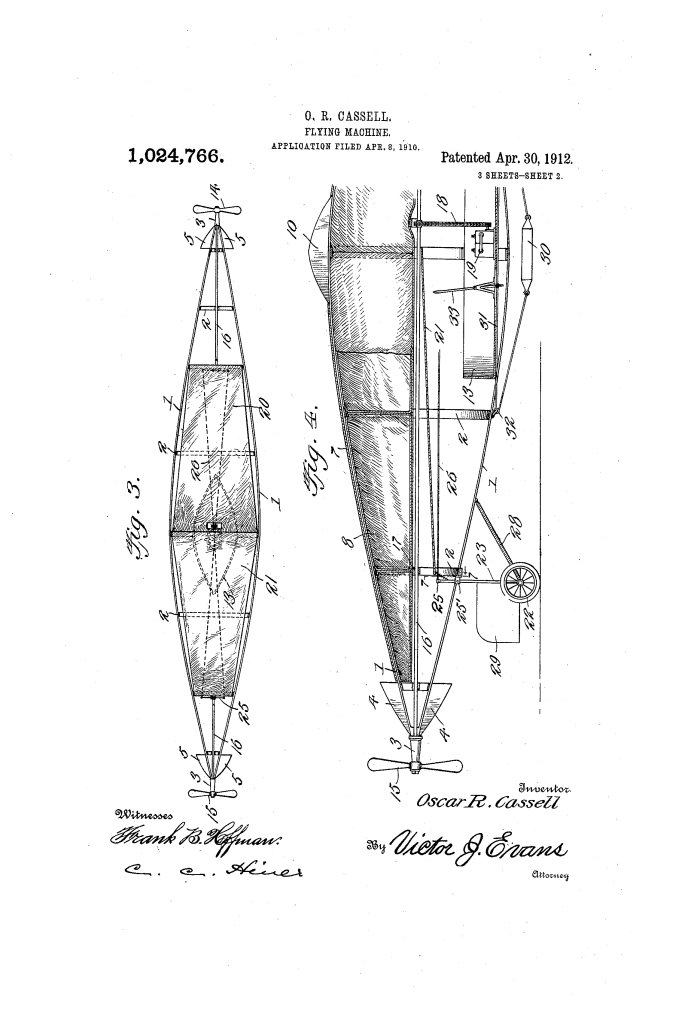
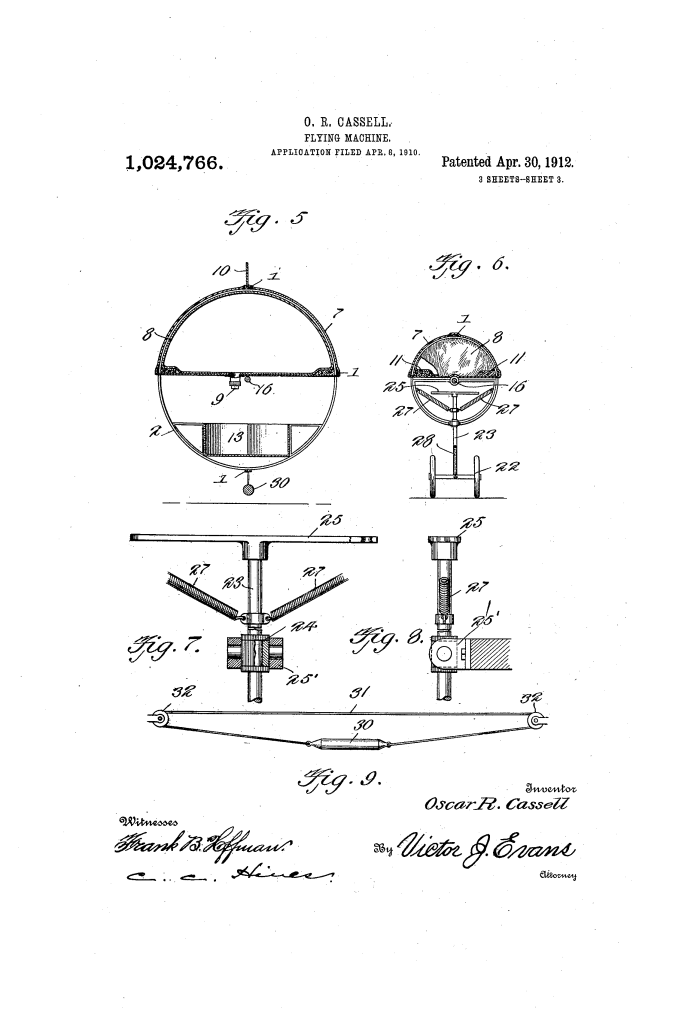
Flying Machine (Oscar R. Cassell, No. 1,024,766)
The patent by Oscar R. Cassell of New York, N.Y., describes a Flying Machine (Patent No. 1,024,766, 1912). This invention is a “composite” aircraft, meaning it combines the principles of an aerostat (a lighter-than-air craft like a dirigible) with those of an aeroplane (using wings and dynamic air pressure). Cassell’s design was highly advanced for its time, focusing on safety, stability, and amphibious survival.
Inventor Background: Oscar R. Cassell
Oscar Robert Cassell was an African-American inventor and architect based in New York City.1 His work in aviation during the “Golden Age” of flight represents a sophisticated attempt to merge two competing technologies of the era: the airship and the fixed-wing plane. As an architect, Cassell brought a structural rigor to his designs, utilizing a complex cigar-shaped frame and modular components to ensure the machine was both lightweight and durable. His patents demonstrate a visionary approach to early 20th-century transportation.
Invention and Mechanism (Simplified)
The machine is essentially a motorized glider supported by a massive, semi-rigid gas envelope.
1. The Composite Flotation Body
- Hybrid Sustentation: The upper half of the frame houses a semi-cigar-shaped body (6). This body acts as an aerostat (filled with lifting gas) and its flat bottom surface acts as an aeroplane (generating lift as it moves through the air).
- Sectional Gas Reservoir (8): Instead of one large tank, the reservoir is made of independent gas bags (8) arranged in a series.
- Function: This is a critical safety feature; if one bag leaks or is damaged, the others remain inflated, preventing the machine from falling suddenly.
2. Structural Frame and Stability
- Cigar-Shaped Frame: The machine is built around longitudinal stringers (1) and reinforcing transverse rings (2).
- Stabilizing Fins (4, 5, 10): To prevent the machine from wobbling or veering off course, it features vertical and horizontal fins at both the front and rear, along with a central top vane.
- Function: These act as “feathers on an arrow,” ensuring the craft travels in a straight, stable line.
3. Propulsion and Vertical Steering
- Tandem Propellers (14, 15): A central shaft (16) runs the length of the machine, powered by a motor (19) via a sprocket drive chain (18). It features a “pulling” propeller at the front and a “pushing” propeller at the rear.
- Shifting Weight (30): To steer the machine up or down (vertical steering), Cassell used a shifting weight (30) on an endless belt (31).
- Function: By moving the weight forward or backward, the aviator changes the center of gravity, causing the nose of the machine to tilt up (for ascent) or down (for descent).
4. Safety and Amphibious Features
- Cork Buoyancy Belt (11): A belt made of cork or other buoyant material surrounds the body.
- Emergency Ladder (12): If the machine is precipitated into water, the cork keeps it afloat. A ladder allows the occupants to climb from the boat-shaped car (13) up to the top of the buoyant body to await rescue.
Concepts Influenced by This Invention
Cassell’s flying machine influenced the evolution of redundant safety systems and aerodynamic stability.
- Redundant Lift Cells: The use of independent gas bags is a core principle still used in modern airships and blimps to ensure that a single puncture does not lead to total failure.
- Center of Gravity Steering: The method of shifting weights to control pitch influenced early glider designs and is still a concept used in weight-shift control aircraft like hang gliders.
- Composite Lift Theory: Cassell helped pioneer the “lifting body” concept—where the fuselage itself provides aerodynamic lift—a principle later used in supersonic jets and the Space Shuttle.
- Amphibious Safety: By integrating buoyancy belts and a boat-shaped car, he anticipated the development of “flying boats” and amphibious aircraft that could safely transition between air and water environments.
