
Float Operated Mechanism, James H. Crumble (1945)
James H. Crumble’s Float Operated Mechanism (U.S. Patent No. 2,384,536) is a mid-century vision of renewable energy. Patented just as World War II was ending, this device was designed to solve a timeless problem: how to capture the immense, rhythmic, but irregular energy of ocean waves and tides and convert it into a steady, usable source of power.
Crumble’s machine is essentially a “wave-to-electricity” converter. By using a battery of independent floats that “climb” the waves, his mechanism translates vertical oscillation into one-way circular rotation. This rotation is then filtered through a series of governors and springs to ensure the final output (like an electric generator) runs smoothly, even if the ocean is choppy.
The “Why”
Wave energy is notoriously difficult to harness because it is intermittent. A large wave provides a massive surge of power, followed by a lull. If you connected a generator directly to a wave float, the lights would flicker wildly or the machinery would break. Crumble’s goal was to create a mechanical buffer—a system that could “sip” energy from every wave, store the excess in springs, and release it at a constant, governed speed.
Inventor Section: Engineering Philosophy
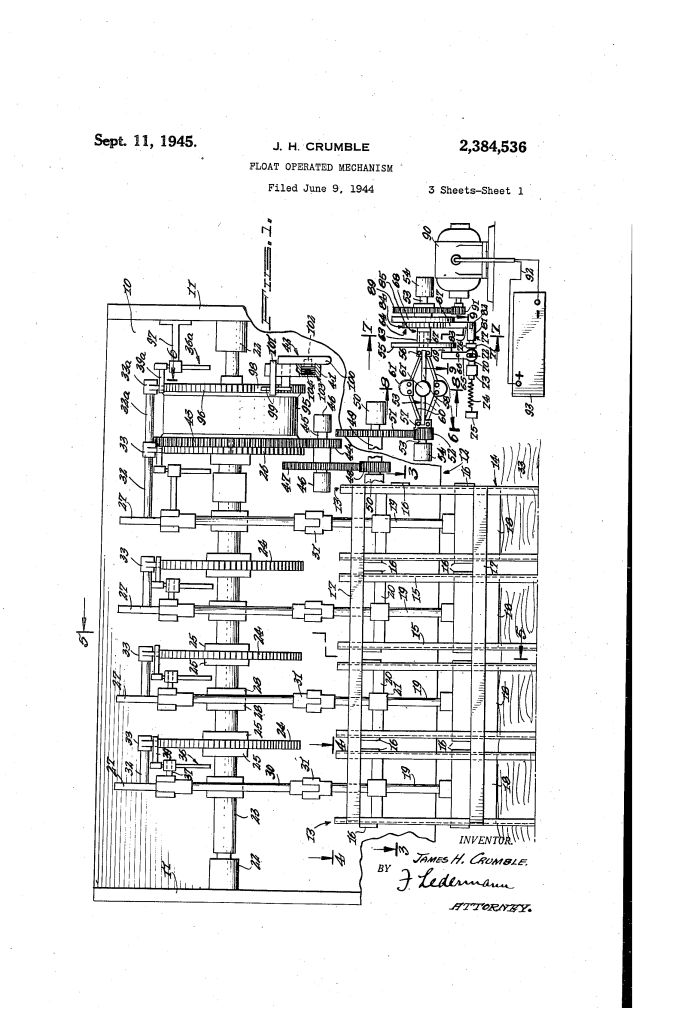
James Crumble’s philosophy was Incremental Accumulation. He realized that one giant float is hard to manage, but a “battery” of small floats (18) acting independently could provide a more continuous stream of energy. As one float is at the “crest” of a wave, another might be in the “trough.” By linking them all to a single Master Shaft (23) via one-way ratchets, the shaft receives a constant series of “kicks” from whichever float is currently rising.
Key Systems Section
1. The Ratchet-and-Crank Conversion
This is the heart of the “rectification” process—turning up-and-down motion into round-and-round motion.
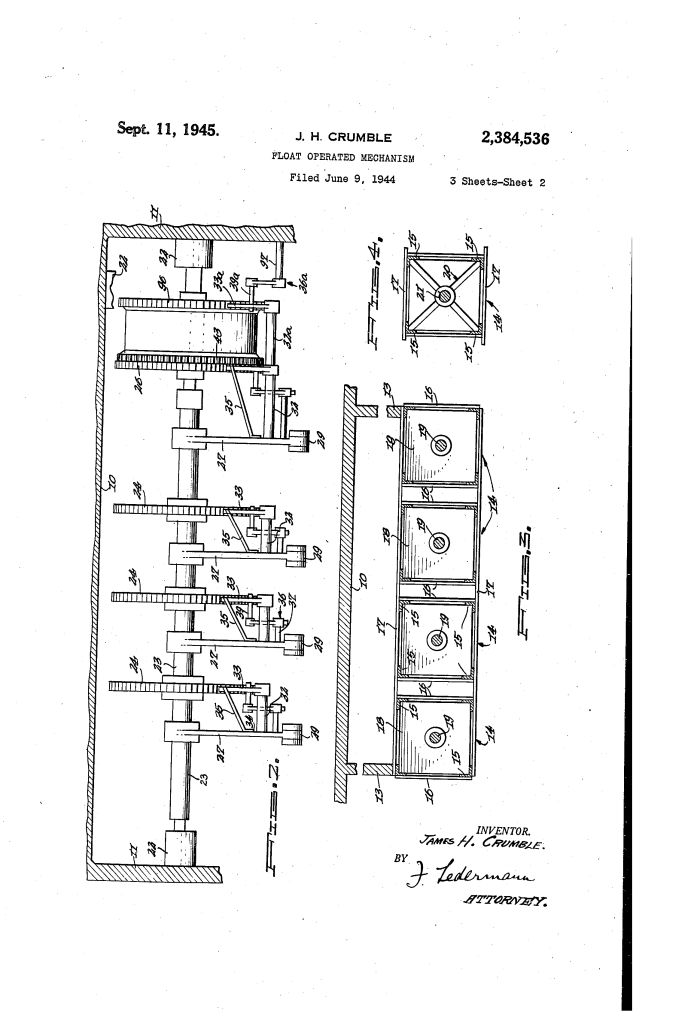
- The Float & Rod (18, 19): As a wave passes, the buoyant float rises inside a protective cage (14).
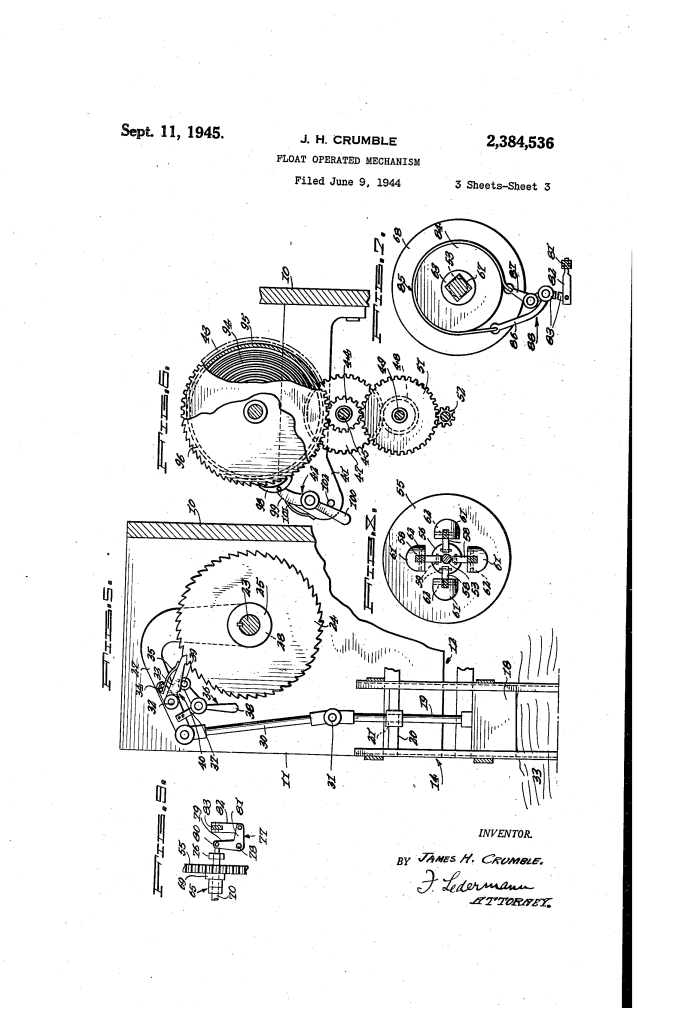
- The Goose Neck Crank (27): The rising float pushes a connecting rod (30) which rotates a crank arm pivoted on the main shaft.
- The One-Way Pawl (33): Attached to the crank is a spring-loaded pawl that “grabs” a ratchet wheel (24) keyed to the shaft.
- The Result: The shaft only turns in one direction. When the float falls back down into a wave trough, the pawl simply slides over the ratchet teeth (clicking), ready for the next lift.
2. The Power Storage Spring
Because waves don’t move at a constant speed, Crumble included a “mechanical battery.”
- The Spiral Spring (94): Instead of sending power directly to the gears, the shaft can be set to wind a large, heavy-duty spiral spring housed in a casing (95).
- Function: This spring acts as a reservoir. If the waves stop for a few minutes, the tension in the spring continues to turn the gears, providing a “ride-through” capability so the power output doesn’t drop to zero instantly.
3. The Centrifugal Governor & Brake
To turn a generator (90) at a steady RPM, the machine needs a “brain” to regulate speed.
- The Flyball Governor (61): As the shaft spins faster, weighted balls (61) swing outward due to centrifugal force.
- The Brake Linkage: This movement pulls a lever (65) that tightens a band brake (85) around a drum (84).
- The Logic: If the waves get too violent and the machine spins too fast, the brake automatically applies friction to slow it down. This ensures the generator produces a steady voltage (e.g., to charge a storage battery (93)).
4. The Cage and Frame Design
Crumble designed the unit to be modular and resilient.
- The Vertical Cages (14): The floats are encased in cages. This prevents lateral wave forces from snapping the piston rods and keeps the floats moving in a strictly vertical path.
- Adaptability: The patent specifies that this could be mounted to the side of a ship (harnessing the wake), or on a pier (harnessing the tide).
Comparison Table: Intermittent vs. Governed Power
| Feature | Raw Wave Motion | Crumble’s Mechanism |
| Motion Type | Vertical / Reciprocating. | Rotary / Unidirectional. |
| Consistency | Irregular (Wave-dependent). | Constant (Governor-regulated). |
| Energy State | “Use it or lose it.” | Storage capable (via Spiral Spring). |
| Output Type | Mechanical Surge. | Electrical / Battery Charging. |
| Protection | Vulnerable to storms. | Automatic braking for high speeds. |
Significance
James H. Crumble’s mechanism was an early ancestor to modern Wave Energy Converters (WECs):
- Off-Grid Potential: It offered a way for remote lighthouses or piers to generate their own electricity without coal or long-distance wires.
- Wartime Efficiency: Filed in 1944, the idea of capturing “free” energy from a ship’s wake or the tide was a valuable concept for a world facing fuel shortages.
- Mechanical Sophistication: Crumble successfully integrated three different mechanical states—reciprocation, rotation, and storage—into a single, cohesive unit.
Final Insight: While modern wave energy uses hydraulics and sophisticated electronics, Crumble’s purely mechanical approach was remarkably robust. It didn’t require a computer to manage—the laws of physics (centrifugal force and spring tension) did all the “thinking.”
