
Flexible Walled Wind Tunnel Nozzle (1960)
U.S. Patent No. 2,933,922, granted on April 26, 1960, to Stephen S. Davis, introduces a more efficient and cost-effective method for shaping the interior walls of wind tunnel nozzles. Stephen Davis, an engineer based in Washington, D.C., developed this system for the U.S. Navy to overcome the mechanical limitations of traditional supersonic testing environments.
This invention solved a frustrating engineering bottleneck: the extreme difficulty and expense of machining solid metal nozzle walls to precise aerodynamic curves, which—once cut—could not be easily corrected if airflow measurements showed errors.
The Innovation: Fluid-Pressed Templates
Before Davis’s patent, engineers used heavy mechanical or hydraulic jacks to bend flexible metal walls into the desired shape. However, these jacks created “point pressure,” causing tiny discontinuities or “bumps” in the metal that ruined the precision of high-speed air testing.
Davis’s breakthrough was to replace the heavy jacks with air or fluid pressure. By creating a pressurized chamber behind a flexible metal plate, the fluid pushes the plate with perfectly uniform force against a pre-cut template, ensuring a smooth, mathematically perfect curve across the entire surface.
How the Nozzle Functions
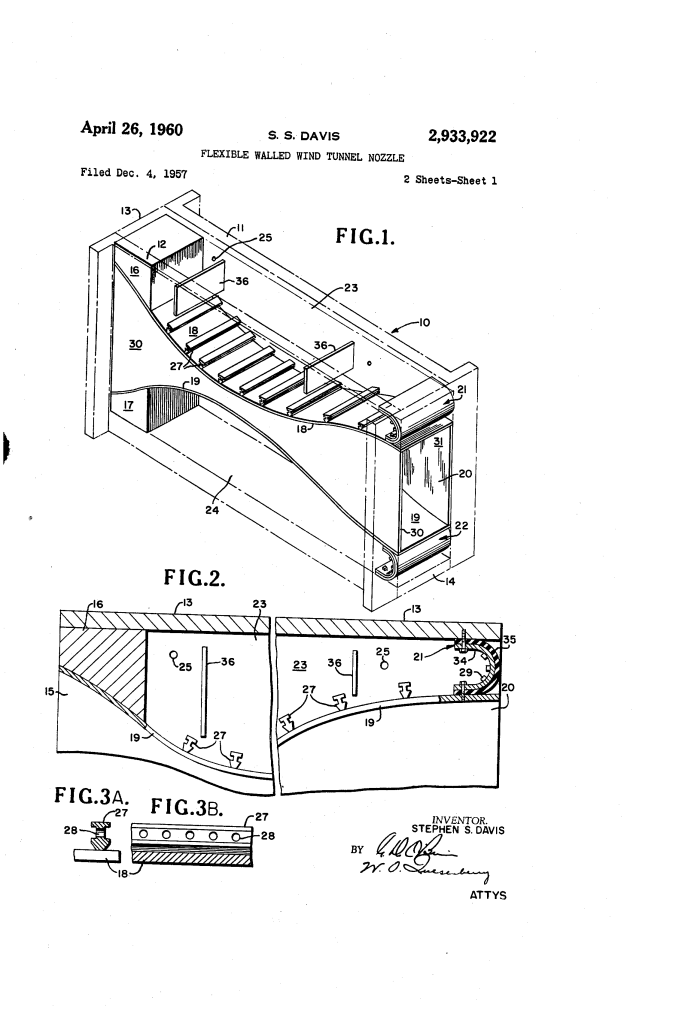
The apparatus uses a “sandwich” design to create a rectangular duct where air can be accelerated to subsonic, transonic, or supersonic speeds.
- The Flexible Plates (18, 19): Thin, rectangular metal sheets that can bend longitudinally but are reinforced with stiffening ribs (27) to prevent them from bulging outward or twisting.
- The Templates (30, 31): Precisely pre-cut steel “guides” that represent the theoretically correct curve for a specific Mach number. These are bolted to the side walls of the tunnel.
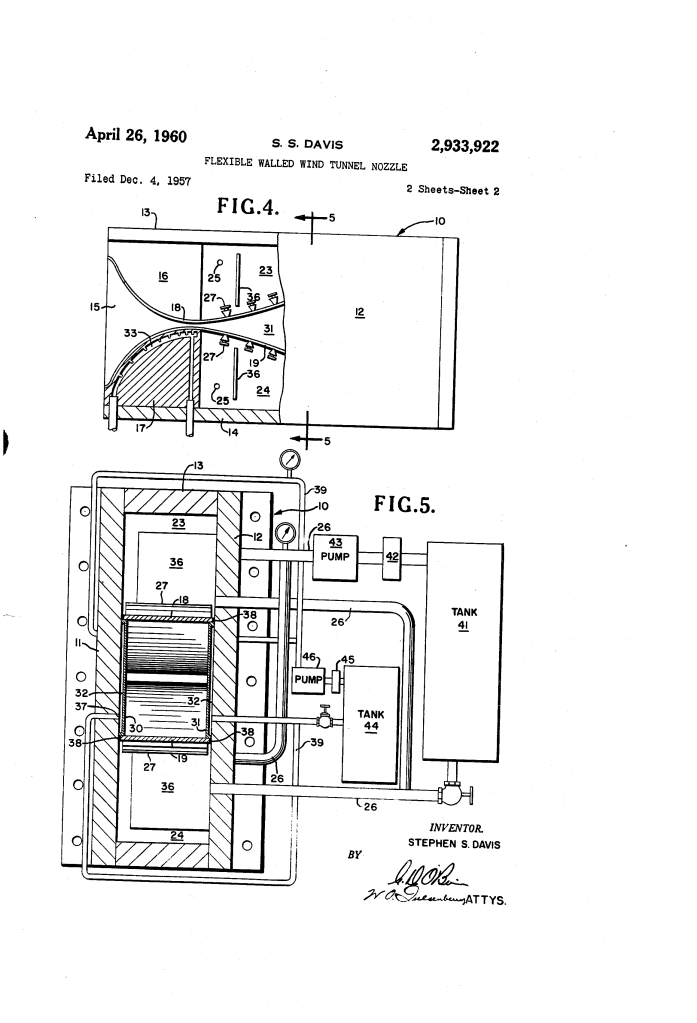
- Pressure Chambers (23, 24): Sealed areas behind the flexible plates. When a pump (43) forces fluid into these chambers, the plates are pressed tightly against the curved edges of the templates.
- Flexible Bellows (21, 22): Spring-steel and rubber seals that allow the plates to shift and bend without leaking the pressurized fluid into the wind tunnel’s test section.
Key Technical Components
- Uniform Load Distribution: Unlike jacks that push at specific spots, the fluid pressure acts on every square millimeter of the plate equally, eliminating “ripples” in the airflow.
- Temperature Control: By circulating temperature-controlled fluid (like Sunvis 900 oil) through the chambers and additional channels (32) in the templates, Davis could control the temperature of the nozzle walls. This prevents heat radiation from the walls from interfering with the data collected from models being tested.
- Easy Recalibration: If a different air speed is needed, technicians can simply swap out the templates for a new shape and re-pressurize the system.
Mathematical Precision
Davis used specific formulas to ensure the plates wouldn’t rupture under the stress of bending:
- Plate Thickness ($d$): Calculated using $d = \frac{2SR}{E}$, where $S$ is stress, $R$ is the radius of curvature, and $E$ is the modulus of elasticity.
- Required Pressure ($P$): Determined by $P = \frac{2yEd}{l^4}$ (where $y$ is deflection and $l$ is length).For a standard four-foot nozzle, Davis proved that a remarkably low pressure (less than 0.5 lbs/sq. in.) was enough to perfectly mold the steel to the template.
About the Inventor: Stephen S. Davis
Stephen S. Davis was a prominent engineer and educator, significantly involved in government-sponsored aerospace research during the Cold War.
- Military Research: As the patent was granted under Title 35, the U.S. Government held royalty-free rights to the technology, highlighting its importance to national defense and the burgeoning space race.
- Academic Contribution: Beyond his inventions, Davis was known for his leadership at Howard University, where he served as the Dean of the School of Engineering and Architecture, mentoring generations of Black engineers.
- Legacy: His work bridged the gap between theoretical aerodynamics and practical mechanical design, making advanced supersonic research accessible to more laboratories by slashing the cost of nozzle production.
Summary of Claims
The patent explicitly claims:
- A nozzle structure using fluid pressure to force flexible plates against the edges of pre-shaped templates.
- The inclusion of stiffening ribs to prevent transverse flexing while allowing longitudinal movement.
- A dual-fluid system where one fluid controls the shape (pressure) and a second fluid, circulating through internal channels, controls the thermal environment of the wind tunnel.
