
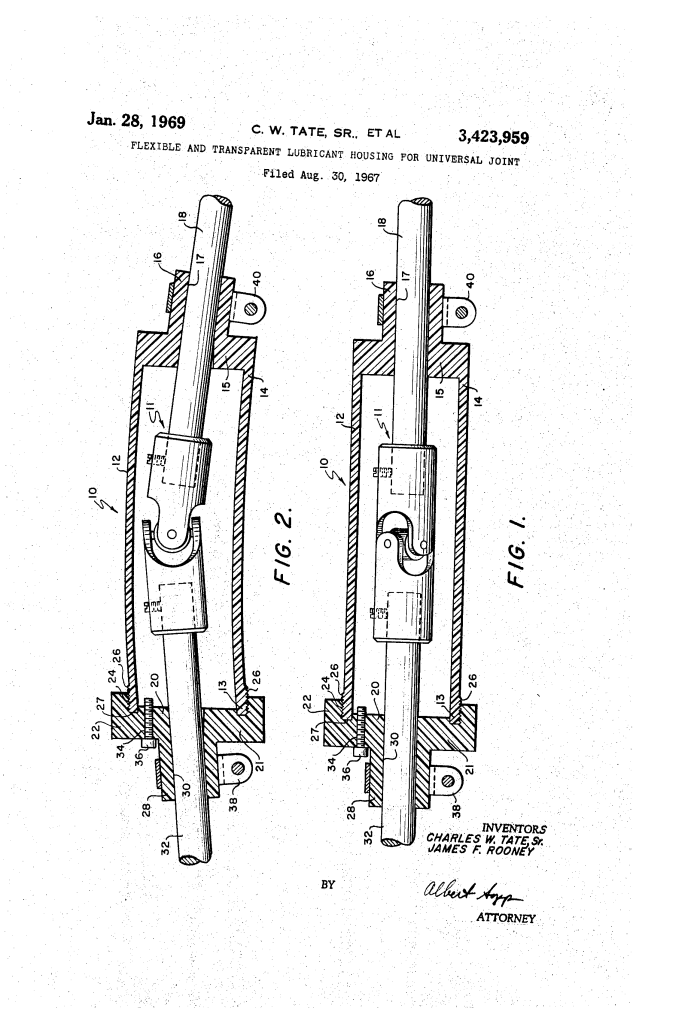
Flexible and Transparent Lubricant Housing for Universal Joint (1969)
U.S. Patent No. 3,423,959, granted on January 28, 1969, to Charles W. Tate, Sr. et al., describes a sturdy, flexible, and transparent lubricant enclosure engineered for high-speed universal joints.
This specific invention solved a persistent problem in mechanical power transmission: universal joint covers routinely failed under the extreme mechanical stresses of high-speed rotation, preventing visual inspection of the joint’s condition and creating severe safety hazards if parts broke apart during operation.
The Innovation: The Variable-Thickness Elastomeric Housing
Conventional flexible boots and joint covers were either opaque, prone to rupture at elevated RPMs, or suffered from “ballooning” under centrifugal forces. The breakthrough of Tate et al. was a molded enclosure made from a high-tensile, transparent polyurethane elastomer with differential wall thicknesses.
By engineering thick terminal walls and rugged stem sections alongside a thinner, flexible cylindrical side wall, the design forces the mechanical bending stresses to concentrate where the material is strongest.
Why Differential Thickness?
Stress Absorption: When the joint operates at an angle, the primary bending stress is absorbed by the thick, rugged stem portions rather than fatiguing the main body.
Minimal Distortion: The central cylindrical side wall undergoes only slight, negligible flexing, which avoids fatigue cracking and maintains structural stability.
Containment Shielding: The high tensile strength stops the housing from ballooning at speeds reaching 8,000 RPM and safely catches flying metal fragments if the internal universal joint shatters.
Key Construction Components
The housing forms a closed, fluid-tight oil bath around the universal joint:
| Component | Function |
| Cylindrical Housing (12) | A hollow, transparent body with relatively thin side walls (e.g., 1/8 inch) that provides an unobstructed view of the oil bath and mechanical coupling. |
| Closed End Wall and Stem (15, 16) | A thick transverse wall (1/2 inch) and protruding stem (1/4 inch wall) with passage 17 that seats over shaft 18 and takes up working deflection. |
| Detachable End Cap (20) | Features a thick transverse wall 21, flange 22, and internal recess 27 that threads onto housing threads 26 to seal the assembly rigidly. |
| Integral Cap Stem (28) | Rugged axial extension with passage 30 that carries shaft 32 and absorbs angular deflection. |
| Lubricant Port and Plug (34, 36) | Threaded service port that permits adding or changing lubricating oil without disassembling the housing. |
| Clamps (38, 40) | Mechanical bands that compress stems 16 and 28 against shafts 18 and 32 to guarantee fluid-tight sealing and synchronized rotation. |
Performance: High-Speed Containment and Durability
Tate’s patent provides test data demonstrating the material’s structural integrity under extreme operational speeds and angular misalignment.
Operational Test Results:
- Normal Operating Ceiling: Withstands extreme centrifugal forces up to approximately 8,000 RPM without ballooning.
- Deliberate Misalignment Test: Tested on an electric motor driving a propeller shaft at 6,300 RPM with continuous, intentional angular misalignment and severe wobbling.
- Endurance Result: The housing showed no ballooning, leakage, or material failure after many hours of high-stress operation.
Material Formulations and Curing Process
The patent outlines two precise elastomeric resin formulations using Adiprene L-100 polyurethane prepolymer to achieve a finished hardness of approximately 90 Rockwell Shore A:
Formulation A (Quadrol and Phenyldiethanolamine System):
- Blend 100 parts by weight of Adiprene L-100 with 1.1 parts Quadrol and 11.1 parts phenyldiethanolamine at 250°F until syrupy.
- Pour the blended liquid mixture into matched molds.
- Heat-cure in molds at 158°F for 4 hours until solidified.
- Cure at room temperature for 14 days to reach full mechanical strength and optical clarity.
Formulation B (MOCA System):
- Blend 100 parts by weight of Adiprene L-100 with 11 parts MOCA curing agent at a minimum of 212°F.
- Pour into molds and heat-cure at 400°F for 30 minutes.
- Residually cure at room temperature for 14 days.
Historical and Industrial Impact
The patent notes that the invention was authorized for manufacture and use by the United States Government without payment of royalties, highlighting its utility for high-performance military and aerospace drive assemblies.
- In-Service Inspection: Maintenance crews can visually check oil level, color, and joint wear without halting operations or dismantling drive hardware.
- Personnel and Instrument Protection: Universal joint failures at thousands of RPMs act like shrapnel. This transparent shroud acts as an armor shield for surrounding personnel and instrumentation.
- Rapid Servicing: Loosening clamp 38 and unthreading end cap 20 allows the entire unit to slide back along the shaft, giving immediate physical access to the joint.
About the Inventors: Charles W. Tate, Sr. et al.
Charles W. Tate, Sr. and his co-inventors developed specialized mechanical assemblies and protective systems for high-stress drivetrain components. Their work bridged advanced polymer chemistry and mechanical drive engineering during late-1960s defense and industrial research programs, proving that transparent elastomers could replace metal shields in critical machinery.
Summary of Claims
The patent explicitly claims:
- A universal joint cover formed from a transparent, elastomeric synthetic plastic having a hardness of approximately 90 Rockwell Shore A.
- A unitary cylindrical housing and end cap where the transverse walls and axial stems are substantially thicker (two to three times) than the flexible longitudinal side wall.
- Terminal stems clamped tightly to the shafts so that shaft deflection is absorbed primarily by the stem sections and secondarily by the cylindrical wall.
- A detachable, threaded end cap featuring an internal seating recess and a sealed port for servicing lubricant.
- Specific chemical formulations combining Adiprene L-100 with Quadrol/phenyldiethanolamine or MOCA to achieve the required tensile and optical properties.
