
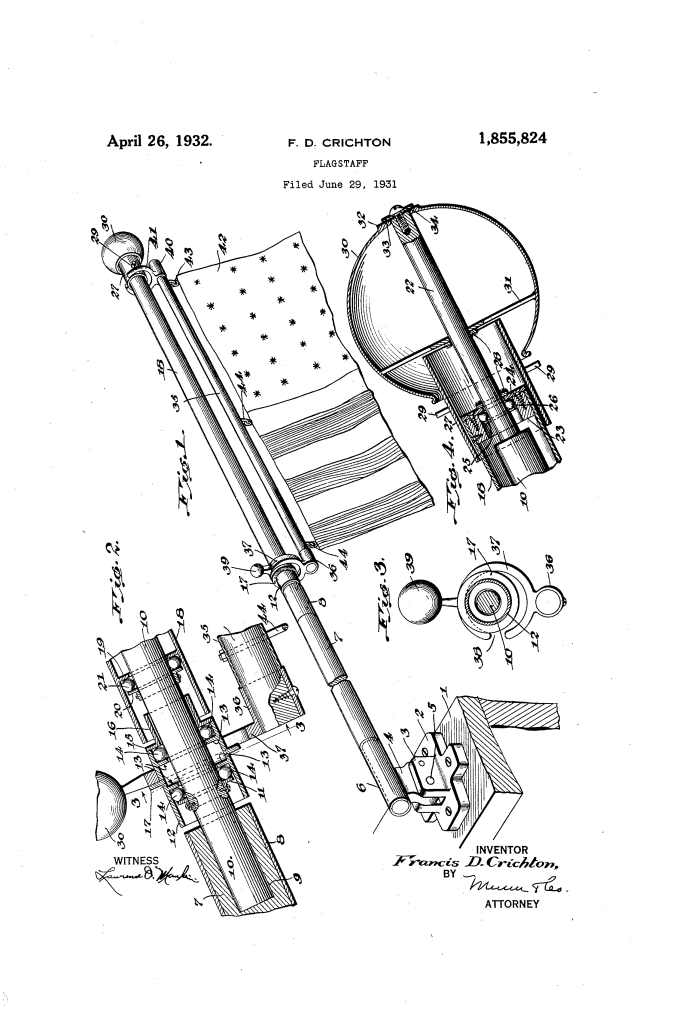
Anti-Tangle Flagstaff (Francis D. Crichton, No. 1,855,274)
Patented in 1932 by Francis D. Crichton, this flagstaff design solves a common annoyance: the flag wrapping around the pole during windy weather. While Crichton had patented an earlier version in 1919, this 1,855,274 improvement introduced a sophisticated system of counterweights and ball bearings to ensure the flag always returns to its natural, unfurled position.
1. The Counterweighted Flag-Holding Bar
The primary innovation is that the flag is not attached directly to the main staff. Instead, it is attached to a separate flag-holding bar (35).
- Parallel Rotation: The bar (35) sits parallel to the main staff and is connected by two split rings (37, 41). These rings allow the entire bar to rotate freely around the pole.
- The Counterweight (39): Attached to the inner ring (37) is a heavy weight positioned exactly opposite the flag bar.
- Momentum Action: When a gust of wind blows the flag upward, the momentum of the counterweight carries the flag bar past the vertical “tipping point.” Gravity then pulls the weight down, forcing the flag to swing back around and hang correctly.
2. The Low-Friction Rotating Sleeve
To prevent the flag from snagging on the wood or metal of the staff, Crichton added a secondary layer of movement.
- Rotating Tube (18): A hollow tube or sleeve surrounds the main staff rod (10).
- Ball Bearing Races (21, 26): This tube is mounted on anti-friction ball bearings. Even if the flag is blown onto the pole, the slightest weight or movement of the flag causes the tube (18) to spin.
- Slippery Surface: Because the tube rotates so easily, the flag cannot get “traction” to wind itself tight; it simply slides off the spinning sleeve and drops back down.
3. The Revoluble Finial Ball
Standard flagstaffs often have a fixed ball at the tip, which is a prime spot for the top corner of a flag to get stuck.
- Independent Movement: The ball-shaped end member (30) is mounted on its own bearing surface (32) and is completely independent of the rotating tube.
- Tangle Prevention: If the wind carries a portion of the flag over the very end of the staff, the ball spins freely, facilitating the “sliding off” of the fabric so it can rejoin the rest of the flag in the normal hanging position.
4. Technical Component Summary
| Component | Function |
| Flag-Holding Bar (35) | Holds the flag away from the pole and allows 360-degree rotation. |
| Counterweight (39) | Uses gravity and momentum to prevent the flag from resting on top of the staff. |
| Rotating Tube (18) | A ball-bearing mounted sleeve that prevents fabric snagging. |
| Split Rings (37, 41) | Allow the flag assembly to be easily removed for storage without taking down the pole. |
| Stop Member (17) | Keeps the flag assembly from sliding down toward the window bracket. |
Utility and Design Significance
Crichton’s design was particularly useful for “outrigger” style flags displayed from window sills or storefronts. By using mechanical momentum (the counterweight) alongside low-friction engineering (the ball bearings), he created a “self-healing” flagstaff that requires zero maintenance to keep the flag flying clearly, regardless of wind direction or intensity.
